SeeMeHired Insights
Your Practical Skills Gap Analysis Template
Putting off dealing with skill shortages is a costly mistake for UK businesses, hitting everything from day-to-day productivity to your recruitment budget. A skills gap analysis template is the tool that turns this fuzzy, nagging problem into a crystal-clear, actionable process. It gives you a solid framework to map out exactly what your team can do today against what they must be able to do tomorrow.
Listen to the podcast here:
Why Your UK Business Needs a Skills Gap Analysis Now

Let's be direct. A skills gap analysis isn't just another HR task to tick off a list; it's a strategic imperative. Ignoring the growing chasm between your team's current skills and your future business goals is a genuine threat to your company's growth and competitive edge.
The reality for many UK companies is a constant battle with lost productivity and difficult, drawn-out recruitment cycles. You feel this pain when projects grind to a halt because nobody has the right software skills, or when a critical role sits empty for months, draining money and morale. This isn't just a feeling; it's a massive economic problem.
The Soaring Cost of Inaction
The UK’s digital skills deficit is a stubborn and expensive issue. By 2025, it was projected that nearly 60% of the workforce—that's about 23.4 million people—would be missing the full suite of digital skills employers need. This gap is a big reason why IT and data roles are so notoriously hard to fill, costing the UK economy an estimated £63 billion per year in lost GDP potential. Experis offers even more insights into the UK's talent shortage.
This is precisely where a skills gap analysis becomes your strategic roadmap. It shifts you from being reactive—scrambling to hire when a crisis hits—to being proactive.
A well-run analysis does more than just flag weaknesses; it shines a light on opportunities. It shows you exactly where to invest in training for the biggest impact, who on your team has the potential to step into a new role, and which specific skills to target in your next hire.
From Problem to Actionable Plan
Using a structured template gives you the clarity you need to make smart, data-backed decisions. Instead of guesswork, you get a clear picture that helps you:
- Target Training Budgets: Invest in programmes that close your most critical gaps, making sure every pound spent on learning and development delivers real value.
- Improve Recruitment: Write sharper, more accurate job descriptions that attract candidates with the exact skills you need, which naturally speeds up the entire hiring process.
- Boost Internal Mobility: Spot current employees who can be upskilled for future roles. This is often more cost-effective and is one of the most proven ways to reduce employee turnover in the UK.
Ultimately, a skills gap analysis is about building a more resilient organisation. It ensures your business has the talent it needs not just to operate, but to adapt and thrive in a market that never stops changing.
Setting the Stage for an Effective Analysis
Jumping straight into a skills gap analysis template without laying the groundwork is a classic mistake. It's like starting a road trip without a map; you’ll certainly be moving, but probably not towards your destination. A little prep work transforms this exercise from a simple data-gathering task into a genuinely powerful strategic tool.
Before you even think about individual skills, the whole effort needs to be tethered to a core business objective. Why are you really doing this now? The answer to that question will anchor every single step you take. Having a clear goal stops the analysis from becoming a vague, purposeless audit of your workforce.
Maybe you're gearing up to launch a new service line that needs expertise in sustainable tech, or perhaps your five-year plan hinges on automating key operational processes. Whatever the reason, it has to be specific and, ideally, measurable.
Assemble Your Cross-Functional Team
A skills gap analysis can't be an HR-only project. To get it right, you need insights and buy-in from across the business. Putting together a small, dedicated team is the best way to get a holistic perspective and make the whole process run smoother.
Your ideal team should probably include:
- An HR Business Partner or Manager to lead the process, handle the data, and tie the findings back to your overall talent strategy.
- A Senior Leader or Department Head who can provide the big-picture strategic context and champion the initiative from the top down.
- An Operations or Team Manager — someone who understands the day-to-day realities and knows the practical skills their team actually needs on the ground.
This mix of viewpoints ensures your analysis is both strategically aligned and operationally relevant. It's a cornerstone of effective talent management, as it integrates workforce planning directly with business needs.
Define a Clear and Realistic Scope
Next up, you need to decide how wide you're going to cast your net. Trying to analyse the entire organisation in one go is a recipe for disaster. It’s often overwhelming and leads to shallow, unhelpful results. It’s far better to start with a focused, manageable scope.
Look back at your primary business driver. If your goal is to boost digital marketing ROI, you might limit your scope to just the marketing and sales departments. If you're rolling out a new company-wide CRM, your scope will be broader but still tightly focused on the roles directly affected by that new technology.
Don’t try to boil the ocean. A successful skills gap analysis often starts with one critical department or a single high-impact business unit. If you can prove its value on a smaller scale, you'll find it much easier to get support for a wider rollout later on.
To help you decide on the right scope for your goals, here’s a quick way to think about it.
Skills Gap Analysis Scope Definition
| Analysis Scope | Best For | Key Considerations | Example Objective |
|---|---|---|---|
| Individual Role | Piloting the process or tackling a critical, high-turnover position. | Quick to complete but offers limited organisational insight. | "Analyse the Senior Data Analyst role to reduce time-to-hire." |
| Single Department | Addressing a specific departmental challenge or transformation. | Balances depth and effort, making it ideal for most initial analyses. | "Assess the Engineering department's cloud computing skills for our upcoming migration." |
| Business Unit | Prepping an entire unit for a new market or product launch. | Needs more coordination but delivers comprehensive strategic insights. | "Evaluate the Product unit for AI implementation readiness." |
| Organisation-Wide | Responding to major market shifts or enterprise-wide digital transformation. | Highly complex and resource-heavy; best left for mature organisations. | "Identify digital literacy gaps across the entire company." |
Defining your scope early on keeps the project focused and prevents scope creep from derailing your efforts.
Communicate with Your Employees
Finally, and this is non-negotiable, you have to be transparent. The phrase "skills gap analysis" can make people feel anxious or scrutinised. You need to frame the initiative positively from the outset.
Explain that the goal isn't to find fault or point out weaknesses. It’s about identifying opportunities for growth, training, and professional development that will benefit everyone.
Reassure them that their honest input is what makes the whole thing work. When people understand the "why" and see it as an investment in their own careers, they’re far more likely to engage openly and give you an accurate picture of their abilities. That trust is the foundation you’ll build everything else on.
How to Use Your Skills Gap Analysis Template
Right, this is where the prep work pays off. You’ve got a clear business goal and you know exactly which roles or departments you’re focusing on. Now it’s time to turn that blank skills gap analysis template into a goldmine of strategic insights.
The whole idea is actually pretty straightforward. You're going to map out the skills a role needs, honestly assess where your team's skills are, and then pinpoint the difference. That gap isn't just a number—it's a bright, flashing sign telling you exactly where to direct your training budget, hiring efforts, and internal development plans.
We’ll walk through how to fill out the template, from identifying the must-have skills to measuring what you’ve already got in-house. I’ll even throw in a couple of real-world examples from two totally different UK sectors—digital marketing and construction—to show you how versatile this framework really is.
Before we jump in, it helps to remember the groundwork that got you here. It’s not just about downloading a spreadsheet; it's about the strategic thinking that comes first.
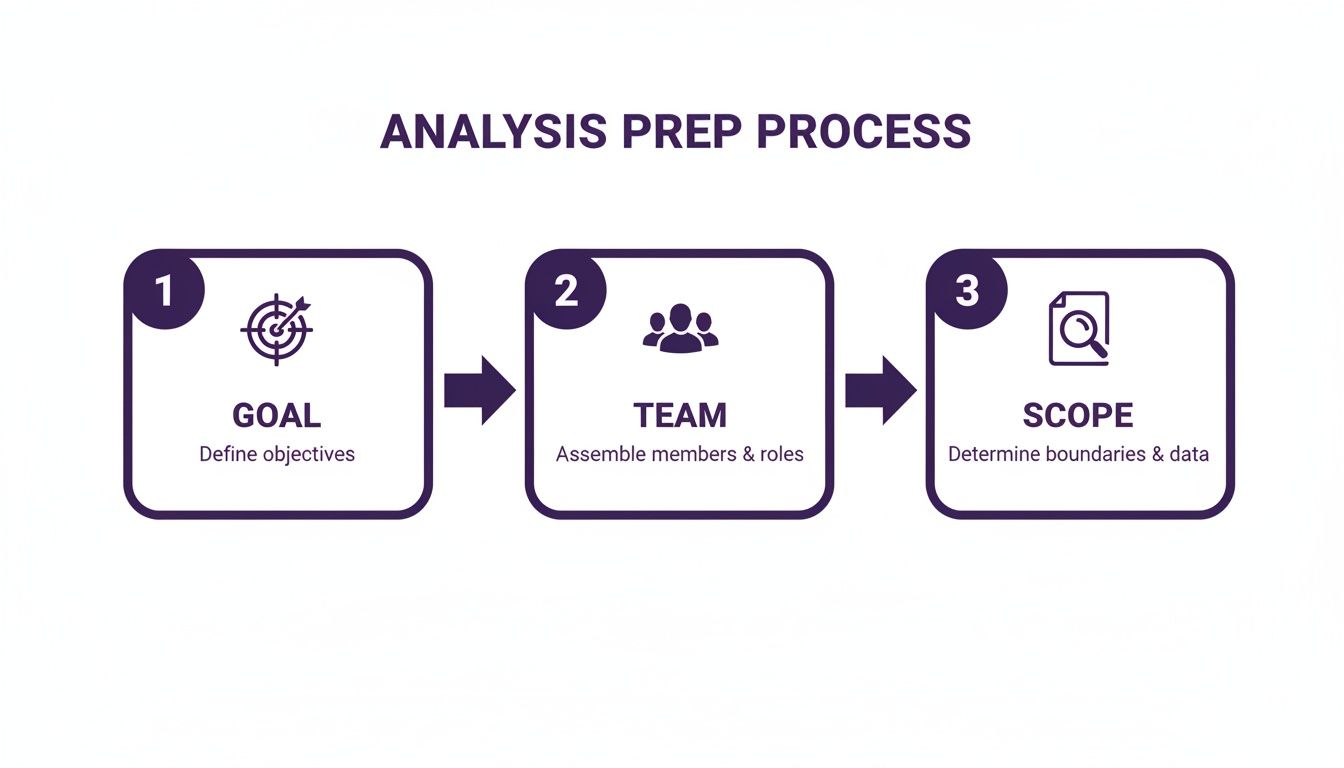
This just hammers home that a good analysis doesn’t begin with the template itself, but with the smart, strategic thinking you’ve already done.
Identifying the Skills Your Business Needs
The first column in your template, "Required Skills," is easily the most important. This isn't the time to just copy and paste a generic job description. You need to get specific about the real-world competencies needed to hit your business targets.
For every role you’re looking at, list out the skills that define success. I’ve found it’s much more effective to break them down into distinct categories.
Categorising Skills for Clarity
- Technical Skills: These are the hands-on, often tool-specific abilities. Think "SEO keyword research," "AutoCAD proficiency," or "CRM data entry."
- Soft Skills: These are the crucial interpersonal traits that dictate how someone works with others. Things like "client communication," "team collaboration," and "problem-solving."
- Leadership Skills: Absolutely vital for managers. This could be anything from "strategic planning" and "budget management" to "mentoring junior staff."
Breaking skills down this way gives you a much richer picture. You might discover a team is technically brilliant but lacks the collaborative skills to see complex projects through to completion.
Here's a key tip: don't just list skills you think you need. Tie every single one back to your main business objective. If the goal is to boost customer retention by 15%, then "Client Relationship Management" isn't a fluffy soft skill; it's a mission-critical competency.
Measuring Your Team's Current Capabilities
Once you’ve got your list of required skills, the next move is to figure out where your team stands right now. Honestly, this can be the trickiest part because it demands objective data. Just going on gut feeling is a recipe for biased, unreliable results.
There are a few solid methods for gathering this info, and the best approach is usually a mix of two or three.
- Manager Evaluations: Line managers are in the trenches. They see the day-to-day performance and can provide ratings based on project outcomes, direct observation, and one-on-ones.
- Self-Assessments: Asking employees to rate their own skills is incredibly powerful. It not only gives you data but also gets people thinking about their own development. Just make sure to sanity-check these against other data to balance out any natural over- or under-confidence.
- Performance Data and KPIs: Use hard numbers wherever you can. For a sales team, look at conversion rates. For a developer, it might be the number of bugs in their code. Tracking key HR metrics can provide a wealth of data to back up your assessments.
- Skills Testing: For some technical roles, a formal test or certification provides a clean, black-and-white measure of proficiency.
In the template, use a simple, consistent scoring system. A 1-5 scale usually works best, where 1 is a beginner and 5 is an expert. This numerical approach makes calculating the gaps a piece of cake.
Bringing It All Together in the Template
You've got your required skills listed and you've measured your current capabilities. The final step inside the template is the analysis itself. This is where it all clicks into place.
For each skill, you'll have two scores:
- Required Proficiency: The level needed for success (e.g., a "4" in SEO for a Digital Marketing Manager).
- Current Proficiency: The employee's actual skill level (e.g., they’re currently a "2" in SEO).
The gap is simply the difference: 4 - 2 = 2. A bigger number means a more urgent gap. The template will automatically flag your biggest priorities, showing you exactly where the most significant shortfalls are.
Completed Example: Digital Marketing Manager
Let's say a UK-based e-commerce firm has a big goal: increase organic search traffic by 50% in the next year. They run a skills gap analysis on their Digital Marketing Manager to see if they've got the talent to make it happen.
Here’s what a section of their filled-in template might look like:
| Skill | Category | Required Proficiency (1-5) | Current Proficiency (1-5) | Skill Gap |
|---|---|---|---|---|
| SEO Strategy | Technical | 5 | 3 | 2 |
| Content Marketing | Technical | 4 | 4 | 0 |
| PPC Campaign Mgt | Technical | 3 | 4 | -1 (Surplus) |
| Data Analysis (GA4) | Technical | 5 | 2 | 3 |
| Team Leadership | Leadership | 4 | 3 | 1 |
| Stakeholder Comms | Soft Skill | 4 | 4 | 0 |
The results are stark. The manager is solid on content and even has a surplus of skill in PPC. But their capabilities in SEO Strategy and, crucially, Data Analysis with Google Analytics 4 are way below what's needed to hit that aggressive traffic goal. That skill gap of "3" in data analysis is a massive red flag.
Completed Example: Construction Project Manager
Now, let's flip to a completely different industry. A mid-sized UK construction firm is getting hammered by project delays and budget overruns. Their goal is to improve project completion times by 20%. They decide to analyse their Project Managers.
This sector has its own unique pressures. As of late 2023, around 55% of construction firms struggled to find skilled tradespeople. A construction PM doesn't just need to manage a site; they need to be able to forecast labour needs in a tough market.
Here’s a snapshot of their analysis:
| Skill | Category | Required Proficiency (1-5) | Current Proficiency (1-5) | Skill Gap |
|---|---|---|---|---|
| Budget Management | Leadership | 5 | 3 | 2 |
| Risk Assessment | Technical | 5 | 5 | 0 |
| Subcontractor Negotiation | Soft Skill | 4 | 2 | 2 |
| Project Scheduling Software | Technical | 4 | 4 | 0 |
| Health & Safety Compliance | Technical | 5 | 5 | 0 |
| Labour Forecasting | Leadership | 4 | 1 | 3 |
This tells a very clear story. The PM is excellent at the technical and safety side of things. But their commercial acumen—Budget Management and Subcontractor Negotiation—is weak. The most glaring issue is the "3" gap in Labour Forecasting, which directly contributes to the skilled worker shortages and project delays the company is desperate to solve.
As you can see, it doesn't matter what industry you're in. A properly used skills gap analysis template cuts through the noise and gives you hard evidence of where your real problems are, letting you shift from vague frustrations to targeted, effective solutions.
Turning Your Analysis into an Action Plan

You’ve done the heavy lifting and completed the skills gap analysis. That’s a huge step, but the real work starts now. The data you've gathered is only as good as the action it inspires, so it's time to turn those numbers and scores into a practical plan that actually closes the gaps you’ve identified.
This is where many organisations stumble. They nail the analysis but then fail to build a concrete strategy for what comes next. A winning action plan isn't just a list of training courses; it’s a deliberate strategy that combines three powerful options: upskilling, strategic hiring, and internal mobility.
The secret is knowing which lever to pull for which gap, ensuring you get the fastest, most sustainable results for your business.
First Things First: Prioritise Your Skill Gaps
Before you can decide how to close a gap, you need to decide which gaps to tackle first. It’s tempting to try and fix everything at once, but that just spreads your resources too thin. A much smarter approach is to prioritise based on business urgency.
Ask yourself two simple questions for each skill gap:
- Business Impact: How badly is this gap affecting our ability to hit our core business goals right now?
- Future Relevance: How critical will this skill be for our strategic objectives in the next 12-24 months?
A gap that scores high on both is your top priority. For instance, a lack of data analysis skills that's directly hurting your marketing ROI is far more urgent than a minor gap in a legacy software system you plan to phase out next year.
The most effective action plans focus on the "critical few" gaps rather than the "trivial many." By zeroing in on the skills that have the biggest and most immediate impact, you build momentum and prove the value of the entire process to leadership.
The Three Levers for Closing Gaps
With your priorities locked in, you can now pick the right tool for the job. Each strategy has its own benefits, timelines, and costs, so it’s important to understand where each one fits best.
Here's a quick comparison of the three main strategies you'll be using to tackle those identified gaps.
Strategies for Closing Common Skill Gaps
| Strategy | Best For | Average Timeframe | Key Benefit |
|---|---|---|---|
| Upskilling & Reskilling | Closing moderate gaps in existing teams with strong foundational skills. | 3-6 Months | Boosts morale, cost-effective, and improves employee retention. |
| Strategic Hiring | Filling urgent, highly specialised, or senior-level roles quickly. | 2-4 Months | Immediately injects new, expert-level skills into the business. |
| Internal Mobility | Leveraging hidden talent and providing clear career paths for high-potential staff. | 1-3 Months | Fast to implement, highly motivating, and retains institutional knowledge. |
Let's dive a little deeper into how you can put these strategies into practice.
1. Upskilling and Reskilling Your Current Team
This should be your go-to for moderately sized gaps in your existing workforce. Upskilling enhances current skills (like teaching a marketer advanced SEO), while reskilling teaches new ones (like moving a customer service rep into a quality assurance role). It’s often the most cost-effective and morale-boosting option on the table.
- Best For: Closing gaps where employees already have strong foundational knowledge but need an update. Think training your sales team on a new CRM or getting your finance department up to speed with data visualisation tools.
- Methods: This can be anything from formal online courses and certifications to mentorship programmes, on-the-job coaching, or targeted workshops.
Investing in your current team sends a powerful message that you value their growth, which is a massive driver of employee retention. Plus, a strong training plan ensures new hires are entering a culture of continuous development—something you can proudly showcase when you create a standout onboarding process.
2. Strategic External Hiring
Sometimes, a gap is just too wide, too specialised, or too urgent to close through training alone. This is especially true in fast-moving fields like cyber security or AI development. When you need expert-level skills yesterday, strategic hiring is the only real answer.
This isn’t an uncommon problem. A recent report revealed that a staggering 76% of UK engineering employers are struggling to recruit for key roles, with cyber security being a top concern. Your skills gap analysis helps quantify this need, justifying the investment in a new hire by showing both the internal shortage and the external hiring difficulty.
- Best For: Filling highly specialised or senior-level roles, or bringing in skills that are completely missing from your organisation.
- Action: Use the data from your skills gap analysis template to write incredibly precise job descriptions that attract candidates with the exact competencies you’re missing.
3. Promoting Internal Mobility
Don't forget to look at the talent you already have in-house. Your analysis might uncover an employee in one department who has the skills—or the high potential to learn them—needed in another. Promoting from within is a fantastic way to fill gaps while providing clear, motivating career paths for your people.
- Best For: Capitalising on hidden strengths and giving high-potential employees a chance to grow into new roles.
- Example: You might discover a marketing coordinator with a surprising knack for data analysis who could be trained to fill a junior data analyst role, saving you a long and costly external search.
By combining these three strategies, you create a flexible and powerful action plan. Your completed skills gap analysis template becomes a living document that guides not just your training budget, but your entire talent acquisition and development strategy for the year ahead.
Making Your Skills Analysis a Living Process
A completed skills gap analysis template is a powerful snapshot in time, but its real value is unlocked when it becomes more than just another report filed away.
To keep your workforce sharp and agile, you have to transform your analysis from a one-off project into a continuous, living process. The goal is to create a constant feedback loop between identifying needs, developing your team, and hiring smarter. This is how you move from being reactive to proactive.
It all comes down to embedding your findings directly into the daily workflows of your HR and management teams. A static spreadsheet on a shared drive won't drive change. But when that data informs your job descriptions, training assignments, and performance conversations? It becomes a dynamic tool for growth.
Integrating Analysis with Your HR Technology
Your HR tech stack is the perfect place to bring your skills gap analysis to life. By connecting the dots between your analysis and your core systems, you create an engine for continuous improvement that practically runs itself. It’s about making data-driven talent management your default setting.
Think about the practical applications:
- Applicant Tracking System (ATS): Use the skills you've identified as gaps to sharpen your job descriptions in your ATS, like SeeMeHired. If your analysis flags a critical shortage in "data analysis," make sure that competency is explicitly listed and weighted in your next job posting for a marketing role. This immediately starts attracting candidates who already have the skills you need most.
- Learning Management System (LMS): Feed the results directly into your LMS. A manager who sees a "2-point gap" in a team member's "client negotiation" skills can immediately assign a relevant training module. This creates personalised development plans directly tied to documented business needs, not just guesswork.
When you integrate these systems, you start to automate the process of closing those gaps. You can find out more about how to automate your workflow using HR tech integrations in our detailed guide.
The ultimate aim is to create a seamless flow of information. The skills gap analysis identifies a need, the ATS helps you hire for it, the LMS helps you train for it, and your performance management system tracks the progress. This creates a powerful, self-reinforcing cycle.
Weaving Skills into Performance Reviews
The insights from your skills gap analysis shouldn't be a surprise sprung on an employee once a year. They should be a central part of your ongoing performance and development conversations.
This approach makes regular check-ins far more productive because they're grounded in clear, objective data.
Instead of a manager vaguely suggesting an employee needs to "work on their communication," they can now say, "Our analysis showed a gap in stakeholder reporting skills, which are crucial for your career progression. Let's create a goal to get you from a '2' to a '4' in that area over the next six months."
This makes feedback more specific, actionable, and a lot less personal. It transforms performance reviews from a backward-looking assessment into a forward-looking development tool, empowering employees to take ownership of their growth with a clear path forward in your organisation.
Got Questions? We've Got Answers
Diving into a skills gap analysis for the first time? It's natural to have a few questions. Getting the details right from the start makes the whole process smoother and more valuable for everyone involved. Let's tackle some of the most common queries we hear.
How Often Should We Run a Skills Gap Analysis?
For most UK businesses, a full, formal analysis once a year is a great starting point. This rhythm syncs up nicely with your annual business planning, giving you a structured moment to check if your team's skills still match your goals for the year ahead.
But a year is a long time, especially in some industries. You might want to pick up the pace and do a check-in every quarter or two if your company is:
- Going through a major digital shift, with new tech and software rolling out fast.
- In a rapidly changing sector like fintech or green energy, where the essential skills can become outdated in months, not years.
- Restructuring or expanding into new territories, which will naturally bring a whole new set of required skills.
Can We Just Use This Template for One Department?
Absolutely. In fact, starting small is often the smartest way to go.
Piloting your analysis with one key department—or even a single high-stakes role—is a brilliant way to test the waters. It keeps the project manageable and lets you iron out any wrinkles in your process on a smaller scale. You can figure out the best way to gather data and share the results without overwhelming everyone.
Once you’ve nailed it for one team and can show the value it brings, you'll have a solid case study to get buy-in for a company-wide rollout.
Don't feel pressured to analyse the entire company at once. A deep, insightful analysis of one team is infinitely more valuable than a shallow, rushed one of the whole organisation.
What Are the Biggest Mistakes to Avoid?
The number one mistake we see is doing an analysis without a clear business goal in mind. If you don't know why you're gathering the data, it’s just numbers on a spreadsheet. It needs purpose.
Another classic pitfall is poor communication. If your employees feel like they're being put under a microscope, they might give you inaccurate self-assessments out of anxiety. It's crucial to frame this as what it is: a positive investment in their growth and development.
Finally, the most wasteful error is to do all the work and then let the report gather dust. This template is a diagnostic tool. Its real value comes to life only when you build and follow through on an action plan to actually close the gaps you’ve found.
Ready to stop guessing and start building a data-driven talent strategy? The SeeMeHired applicant tracking system is designed to help you act on your skills gap insights. Attract, screen, and hire candidates who have the exact skills you need to move forward. Discover how SeeMeHired can sharpen your recruitment at seemehired.com.