SeeMeHired Insights
UK Criminal Background Checking Your Essential Guide

Running criminal background checks is a pretty standard part of recruitment in the UK. It’s all about verifying a candidate's criminal history to make sure they’re a suitable fit for the role. This process, mainly handled through the Disclosure and Barring Service (DBS), is an absolute must for safeguarding your business, especially if your team works with vulnerable people.
It’s one of those non-negotiable steps to ensure you’re building a safe, trustworthy environment for everyone.
Listen to the podcast here:
Understanding Your Role in Criminal Background Checking
Diving into criminal background checks can feel like wading through a lot of red tape, but it really boils down to one thing: making informed, responsible hiring decisions. It’s so much more than a box-ticking exercise; it's a fundamental part of your duty of care as an employer. Get it right, and you protect your organisation, your people, and your customers.
The goal here isn't to try and catch people out. Think of it as a structured way to assess potential risks tied to a specific job. A successful check gives everyone peace of mind and shows you’re committed to a secure workplace, which is vital in any sector where trust is key.
The Different Levels of DBS Checks
In the UK, the Disclosure and Barring Service (DBS) is the go-to for these checks. Getting your head around the different levels is the first real step to staying compliant and screening effectively. Not every role needs the same level of scrutiny, and you can land yourself in hot water by ordering a check that’s more intrusive than necessary.
Here’s a quick rundown of the three main levels of DBS checks, what they include, and when you’d typically use them.
A Quick Guide to UK DBS Checks
| DBS Check Level | What It Reveals | Typical Roles |
|---|---|---|
| Basic DBS Check | Reveals 'unspent' convictions and conditional cautions. | Can be requested for any role. Often used for positions involving trust, like handling cash or company data. |
| Standard DBS Check | Includes everything in a Basic check, plus 'spent' convictions, cautions, reprimands, and final warnings. | Reserved for specific roles, such as certain finance, security, or legal positions. |
| Enhanced DBS Check | The most detailed check. Contains all Standard check info, plus relevant information held by local police forces. | A legal requirement for roles involving regulated activities with children or vulnerable adults (e.g., teachers, carers, healthcare workers). Can include a check of the Barred Lists. |
Knowing which check to run is crucial. Each level is designed for different levels of responsibility and risk.
The key takeaway is that the level of check must be proportionate to the role's responsibilities. Applying for an Enhanced DBS check for an office administrator with no contact with vulnerable groups would be inappropriate and unlawful.
Why Context Is Everything
Let's put this into a real-world context. Imagine you're hiring for two different roles.
For a primary school teacher, you would be legally required to run an Enhanced DBS check, which includes a check of the Children's Barred List. No ifs, no buts. On the other hand, for a remote graphic designer at a marketing agency, a Basic DBS check would likely be sufficient, if you even need one at all.
The level of risk and responsibility completely dictates how deep you need to go. Making these distinctions correctly is central to fair and legal hiring.
This is especially important when you realise just how many people in the UK have a criminal record. According to Home Office data, over 12.5 million people have one. The Police National Computer holds records where around 74.6% are for convictions and 9.6% are for cautions. These numbers show that a lot of good candidates might have a record of some kind, which just reinforces the need for fair assessments that are relevant to the job.
Making sure your process is robust and compliant isn't just good practice; it's essential. For a deeper look into the legal frameworks that govern UK hiring, our guide on UK recruitment compliance offers an essential playbook for hiring teams. It’s all about building a process that is fair, consistent, and legally sound from day one.
Staying Compliant with UK Data and Privacy Laws
Handling the sensitive data that comes with criminal background checks puts you squarely on the front line of legal compliance. It’s not just about getting a result; it’s about how you collect, handle, and store that information. The two big legal frameworks you need to know inside-out are the Data Protection Act 2018 and the UK General Data Protection Regulation (GDPR).
These laws are all about protecting personal data, and a criminal record is what's known as 'special category data'. That's a formal way of saying it needs the highest level of protection. Get this wrong, and you're not just looking at a damaged reputation—you could face significant fines from the Information Commissioner's Office (ICO).
The Cornerstone of Compliance: Gaining Consent
Before you even think about running a check, you must get explicit, informed consent from the candidate. This is completely non-negotiable. And no, a simple tick-box buried in an application form isn't going to cut it.
So, what does 'informed consent' actually look like in the real world?
- Be transparent. You need to tell the candidate exactly what you’re checking and why it’s relevant for the role they’re applying for. Spell out whether it’s a Basic, Standard, or Enhanced DBS check.
- Explain the process. Let them know which third-party screening provider you're using and who within your organisation will see the results.
- Clarify their rights. Candidates must understand that giving consent is their choice and that they can pull it back at any time.
A classic mistake is burying the consent request deep inside a lengthy privacy policy. For consent to be valid, the request needs to be separate, clear, and unambiguous. The candidate must actively opt in, knowing exactly what they’re agreeing to.
For a deeper dive into these responsibilities, it's worth reading a guide on GDPR for UK recruitment teams. The principles apply right across the hiring journey.
Navigating Data Retention and Secure Disposal
Your duties don’t stop once you have the results of a check. A core principle of GDPR is data minimisation—only keeping data for as long as is strictly necessary. You absolutely cannot hold onto criminal record data indefinitely.
Your organisation needs a crystal-clear data retention policy that states how long you will store this information. For most roles, you’ll find it very difficult to justify keeping a DBS certificate for more than six months. You should really only hold it long enough to make a recruitment decision and handle any immediate disputes.
When that retention period is up, the data must be disposed of securely. And that means more than just dragging a digital file into the recycling bin.
- Physical copies must be cross-shredded, not just torn up.
- Digital copies must be permanently deleted from all your systems, including any backups.
Failing to have—and stick to—a strict retention and disposal schedule is one of the easiest ways to stumble into a data breach.
Responding to a Withdrawal of Consent
So, what happens if a candidate changes their mind halfway through the process? If a candidate withdraws their consent for a criminal background check, you have to stop everything immediately.
Let's say you've sent an application off to the DBS, but the candidate emails you to withdraw consent before the certificate comes back. You need to contact your screening provider right away to halt the check. If the check is already complete and you have the results, you must securely delete that data without using it to influence your hiring decision.
In this situation, you are legally able to withdraw a conditional job offer, as the candidate hasn't completed a mandatory step in your pre-employment screening. The key is to act fast and document every single step you take. This creates a clear audit trail that protects the candidate’s rights and shields your organisation from legal risk.
Choosing the Right Check for Your Industry
Applying a one-size-fits-all approach to criminal background checks isn't just lazy; it’s a fast track to serious compliance headaches. The level of check you run has to be directly proportional to the risks and responsibilities of the role. An overly intrusive check for a low-risk position could be unlawful, while a flimsy one in a high-risk sector could have devastating consequences.
The logic is simple: the check must match the job. This means you need to move past generic advice and tailor your screening process to the genuine demands of your industry.
Safeguarding Vulnerable Groups in Education and Healthcare
When it comes to roles involving regular contact with children or vulnerable adults, the rules are strict and completely non-negotiable. Sectors like education, social care, and healthcare are under this high-scrutiny umbrella, where the duty of care is everything.
In these fields, an Enhanced DBS check with a Barred Lists check isn't optional—it's a legal requirement.
- Enhanced Check: This brings up both spent and unspent convictions, cautions, reprimands, and final warnings. Critically, it also includes any extra information held by local police forces that they feel is relevant to the role in question.
- Barred Lists Check: This adds another vital layer of security. It cross-references the candidate against official lists of individuals who are legally barred from working with children and/or vulnerable adults.
Think of a primary school teacher, a carer in a children's home, or a nurse on a geriatric ward—they must all undergo this deep-dive check. It’s specifically designed to prevent unsuitable individuals from being placed in positions of immense trust. For a closer look at these stringent requirements, our guide on CQC recruitment provides essential insights for healthcare hiring.
Vetting for Trust in the Financial Sector
The entire finance industry is built on a foundation of trust and integrity. So, it's no surprise that criminal background checks are a massive part of upholding regulatory standards and protecting against financial crime. While not always as intensive as in healthcare, these checks are still a critical piece of the due diligence puzzle.
For many jobs in banking, insurance, and accountancy, a Standard DBS check is the appropriate level. This reveals all spent and unspent convictions and cautions, giving you a solid overview of their criminal history. It's often a must-have for positions approved by the Financial Conduct Authority (FCA).
It's common practice in finance to pair the Standard DBS check with other screenings, like credit history and adverse financial checks. A history of financial mismanagement or fraud-related convictions would obviously be a huge red flag for someone hired to handle client funds.
This combined approach ensures employees not only have a clean record when it comes to financial misconduct but also demonstrate the personal financial responsibility expected in the sector.
Proportionate Screening in Technology and Data Handling
But what about industries where the risk isn't physical, but digital? Take a tech company hiring a software developer who will handle sensitive user data. Their screening needs are different but just as important. In this scenario, running an Enhanced check would be completely over the top and unlawful.
This is where a Basic DBS check is often the most sensible and proportionate choice.
A Basic check only discloses unspent convictions and conditional cautions. This gives you a reasonable assurance of a candidate’s recent history without being overly intrusive. It helps you mitigate risks like data theft or misuse while respecting the candidate's privacy, striking the right balance for roles that don't involve regulated activities.
The sheer volume of checks processed annually shows just how embedded this process is across every UK sector. Leading providers like First Advantage EMEA handle over 797,000 applications each year, a figure that highlights the nationwide demand for diligent vetting. This scale reflects a collective effort to keep workplaces safe and maintain integrity, driven by both regulations and a simple commitment to public safety. You can discover more about UK crime outcome statistics to understand the bigger picture.
Ultimately, choosing the right check comes down to a thoughtful risk assessment, not just ticking a box. By aligning your screening with the specific legal requirements and genuine risks of your industry, you create a hiring framework that is both fair and secure.
Making Fair Decisions Based on Check Results
So, the results of a criminal background checking process have landed on your desk. What now? Especially if the certificate isn’t completely clear. The single most important thing to remember is not to panic or make a snap judgment. A record doesn’t automatically disqualify a candidate, and running a fair, structured assessment is your legal and ethical obligation.
An immediate rejection based purely on a conviction, without any further thought, could easily stray into discriminatory territory. Your task now is to objectively assess the information in front of you, focusing only on its relevance to the specific role you’re hiring for.
This whole process is guided by the principles of the Rehabilitation of Offenders Act 1974. The law is there to give people who have made mistakes a fair chance to move on, and your process needs to reflect that spirit.
A Framework for Fair Assessment
When you do discover a conviction, the first step is to pause and analyse. Don't jump to conclusions. Instead, you need to work through a consistent set of questions to figure out if the record genuinely poses a risk to your business, its people, or its customers. A structured approach is the only way to ensure every candidate is treated equitably.
Here’s a practical framework to guide you:
- Is it relevant? Does the nature of the offence have any real bearing on the duties the candidate would be doing? A conviction for a pub fight ten years ago has very little to do with an office-based data analyst role.
- How long ago did it happen? A minor offence from many years ago, especially when the person was young, carries far less weight than a recent, serious one. Consider the time that has passed and whether they’ve kept a clean record since.
- What was the context? Try to understand the circumstances. Was it a one-off mistake during a difficult period, or is there a pattern of behaviour that’s a genuine cause for concern?
The goal isn't to judge someone's past; it's to assess future risk. Your entire focus should be on whether the specific details of the record create a genuine, demonstrable risk in the context of the job's responsibilities.
Real-World Application and Communication
Let's walk through a common scenario. You’re hiring a delivery driver, a role that involves driving a company van and some customer interaction. A candidate’s Basic DBS check reveals a single conviction for speeding from three years ago.
An unfair reaction would be to bin the application immediately. A fair assessment, however, means looking at the specifics. Was it a minor speeding fine, or was it a dangerous driving conviction? A single incident of being slightly over the limit, with an otherwise clean driving history, is unlikely to suggest the candidate is a significant risk.
This infographic gives a great high-level view of how different check levels correspond to various industry risk profiles.
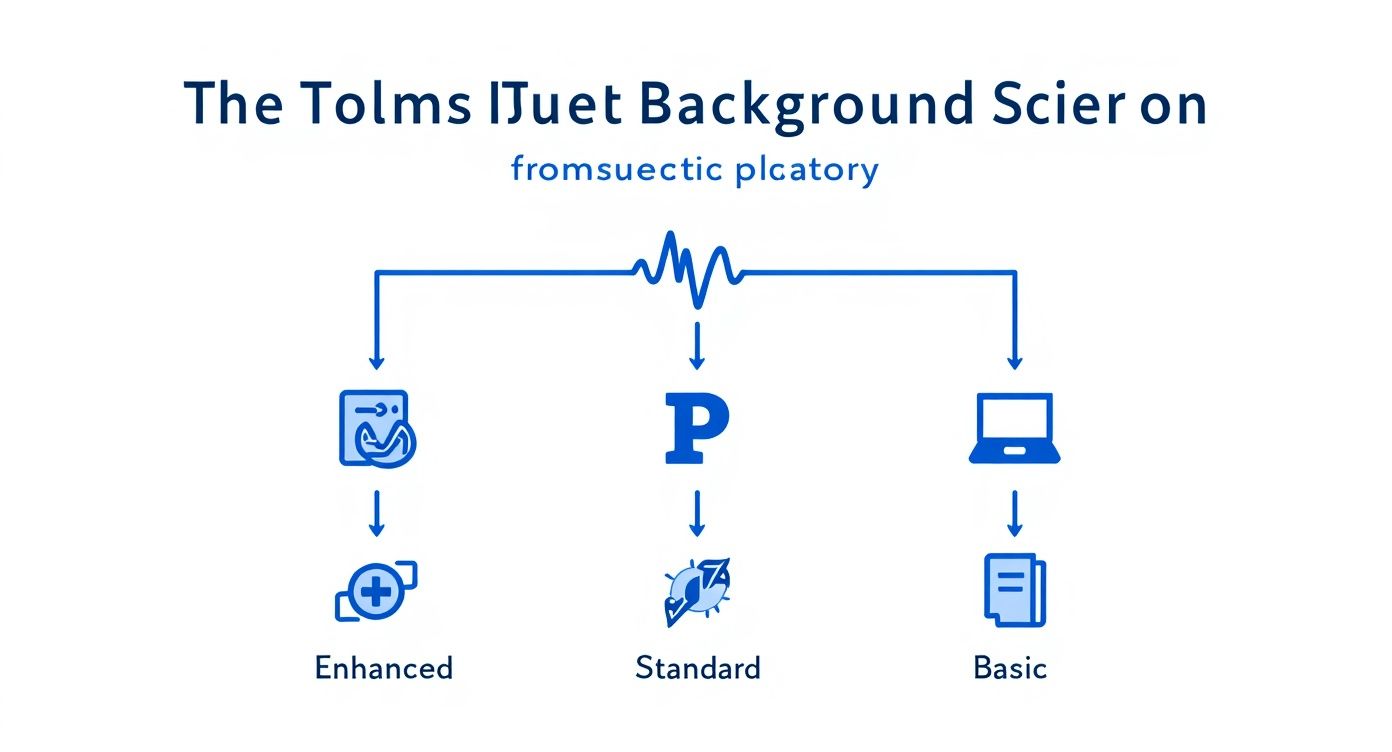
As you can see, the intensity of the check—from Basic to Enhanced—is directly tied to the level of trust and responsibility in sectors like Tech, Finance, and Healthcare.
After your assessment, you might decide the offence is minor and not relevant enough to stop the hiring process. Great, you can proceed with confidence. But what if you decide the risk is too great—for instance, if that driver had multiple recent dangerous driving convictions? Then you need to handle the communication carefully.
Handling Difficult Conversations and Avoiding Bias
If you decide not to proceed with an offer, it’s always best to let the candidate know. You aren't legally required to give a detailed breakdown, but a simple, professional message stating that they haven't met the pre-employment screening criteria is usually enough. This kind of clarity helps you maintain a positive employer brand, even with people who don't end up joining your team.
This entire process is about mitigating real risk while steering clear of prejudice. Every hiring decision we make has an element of unconscious bias, and that can be magnified when you’re looking at sensitive information like a criminal record. It's crucial to make sure your evaluation is based on facts and relevance, not assumptions. For more practical advice on this, you can explore these 10 examples of workplace bias and learn how to avoid them.
By adopting a fair, consistent, and legally-informed approach, you can navigate the complexities of adverse findings with confidence. You’ll not only stay compliant but also potentially find fantastic employees who just deserve a second chance.
How to Streamline Your Background Checking Process
Let's be honest, manual criminal background checking can quickly become an administrative nightmare. It’s a slow, paper-heavy process that’s riddled with the potential for human error, creating unnecessary delays and serious compliance risks.
Chasing candidates for consent forms, double-checking data entry, and trying to keep track of results in spreadsheets is no one’s idea of efficient recruitment. This old-school approach doesn’t just drag out your time-to-hire; it opens you up to data breaches and makes audit preparation a painful, last-minute scramble.
There is, however, a much smarter way to manage this critical hiring step.
Centralise and Automate with an ATS
The single most effective way to fix this broken process is by integrating your screening directly into an Applicant Tracking System (ATS). A platform like SeeMeHired acts as a central command centre for your entire recruitment workflow, transforming background checks from a manual burden into a seamless, automated part of your process.
Instead of juggling multiple systems and endless email chains, everything happens in one secure place. This centralisation is the key to reclaiming administrative hours and building a robust, defensible screening programme.
By bringing every step—from consent to result storage—into a single platform, you immediately reduce the risk of sensitive data being misplaced or mishandled. This creates a complete, time-stamped audit trail for every candidate, ensuring you are always ready for compliance checks.
Automating Key Steps for Speed and Accuracy
An integrated system allows you to automate the most time-consuming and error-prone parts of the background checking journey. This doesn't just make your team's life easier; it guarantees consistency and fairness for every single applicant.
Here’s where the automation really makes a difference:
- Automated Consent Management: Send digital consent forms to candidates directly through the ATS. They can review and sign electronically, and the system automatically logs their consent, removing any ambiguity.
- Triggering the Correct Check: You can set up rules to automatically initiate the right level of DBS check based on the job role. A care assistant role automatically triggers an Enhanced check, while a marketing role triggers a Basic one. No guesswork needed.
- Secure Result Handling: Results are delivered directly back into the candidate’s profile within the ATS. This prevents sensitive documents from sitting in unsecured email inboxes and ensures only authorised personnel can view them.
For example, our partnership with Certn, a leading global background screening provider, allows SeeMeHired users to manage this entire workflow without ever leaving the platform. To see how this integration works, you can learn more about the SeeMeHired and Certn partnership.
The Business Impact of an Integrated Process
Shifting to an automated, integrated system isn't just about saving time; it's a strategic move that delivers tangible business benefits. The efficiency gains are immediate and significant. You reduce the administrative workload on your HR team by slashing the time spent on manual data entry and chasing follow-ups.
This newfound efficiency allows your team to stop pushing paper and start focusing on what they do best: finding, engaging, and hiring great people.
A faster, more professional screening process also improves the candidate experience, helping you secure top talent before your competitors can. Ultimately, a streamlined process means you can onboard new hires quicker, filling critical roles faster and reducing the impact of vacancies on your organisation's productivity. It’s a clear win for your team, your candidates, and your bottom line.
Common Questions About Criminal Background Checking
Even with a solid process in place, navigating the world of criminal background checks can throw a few curveballs. Tricky situations pop up, and even the most seasoned HR pros can find themselves looking for answers.
To wrap things up, let's tackle some of the most common sticking points and questions we hear from hiring teams. Think of this as your go-to reference for those "what if" moments that are bound to happen.
How Long Does a Check Take in the UK?
This is probably the most practical question on everyone's mind. The short answer? It depends entirely on which check you’re running, as each one digs into different databases and has varying levels of police involvement.
- Basic DBS Check: These are the quickest. Since they're done online and only cover unspent convictions, you can often get the results back within 24 to 72 hours.
- Standard DBS Check: This takes a bit longer, usually around 14 days. It includes a search of the Police National Computer (PNC) for both spent and unspent convictions, cautions, and reprimands.
- Enhanced DBS Check: As the most thorough check, this one takes the longest. You should probably budget for 2 to 6 weeks, though sometimes they come through faster. The extra time comes from local police forces manually reviewing their records for any relevant non-conviction info they think should be disclosed.
It’s always a good idea to factor these timelines into your recruitment schedule to manage everyone’s expectations—both for your team and the candidate.
A classic mistake is promising a firm start date before an Enhanced DBS check is back. Always make job offers conditional upon a satisfactory check and be upfront with candidates about the potential wait. It avoids so many last-minute headaches.
Can a Candidate Refuse a Criminal Background Check?
Absolutely. A candidate has every right to refuse a check. How you handle it, though, comes down to the role itself.
If the check is a legal requirement for the job—like an Enhanced check for someone working with children—then you simply cannot employ them if they refuse. The conditional job offer has to be withdrawn.
If the check is just part of your company policy for a role where it isn't legally mandatory, you can still withdraw the offer. Your justification is that the candidate failed to complete a required step in your hiring process. This is exactly why it’s critical to mention that a background check is a condition of employment in the job description and offer letter.
What Is the Difference Between Spent and Unspent Convictions?
Getting your head around "spent" versus "unspent" convictions is key to making fair hiring decisions. The whole concept comes from the Rehabilitation of Offenders Act 1974, which is all about giving people a fair chance to move on from past mistakes.
An unspent conviction is one that hasn't yet passed its specified rehabilitation period. During this time, it has to be disclosed if asked.
A spent conviction is one where the rehabilitation period is over, and there have been no further offences. For most jobs, a person with a spent conviction doesn't have to disclose it and is legally considered rehabilitated.
But here’s the important part: many roles are exempt from this rule, especially those needing Standard or Enhanced DBS checks. For these jobs, you are legally allowed to ask about and receive information on both spent and unspent convictions. This gives employers in sensitive fields like healthcare, finance, and education the full picture they need to make an informed decision.
Ready to build a faster, fairer, and fully compliant hiring process? SeeMeHired integrates background checking directly into your workflow, eliminating administrative headaches and keeping you audit-ready. Discover how our all-in-one Applicant Tracking System can transform your recruitment at https://seemehired.com.