SeeMeHired Insights
Recruiting Social Media Your Guide to Attracting Top Talent

Social recruiting is all about using platforms like LinkedIn, Facebook, and even Instagram to find, attract, and ultimately hire new talent. But it's so much more than just firing off job ads into the void. A smart strategy is built around creating a genuine employer brand and nurturing a pipeline of both active and passive candidates.
Listen to the podcast here:
Building Your Foundation for Social Recruiting Success
Before you dive in and start posting, you need to lay some groundwork. Without a solid foundation, your efforts will likely feel scattered and, frankly, won't deliver the results you're after. The first move is to get more specific than just "we need more applicants." You have to define what success actually looks like for your business.
That means setting clear, measurable hiring goals.
Are you trying to hire 20 seasonal retail staff in Manchester, or are you on the hunt for one highly specialised cybersecurity expert in London? The goal shapes the entire game plan. One requires a broad, high-volume approach; the other needs a targeted, almost surgical precision.
First, Define Your Ideal Candidate Persona
Once you know what you're trying to achieve, you need to know exactly who you're talking to. This is where a candidate persona comes in. It’s a semi-fictional sketch of your perfect hire, but it goes way beyond a simple job description. It should dig into their skills, experience, career goals, and—most importantly for social recruiting—their online behaviour.
Start asking questions like:
- Which platforms do they use for professional networking versus scrolling in their downtime?
- What kind of content actually grabs their attention and makes them stop and read?
- Are they active in specific online communities or professional groups?
For example, a Graphic Designer persona is probably all over Instagram and Behance, drawn to highly visual content. A Financial Analyst? You're far more likely to find them in LinkedIn groups, deep in discussions about market trends. Knowing this stops you from wasting time and money shouting into the wrong rooms.
Find Your Voice and Align It with Your Employer Brand
Your voice on social media has to be a real extension of your company culture. If your office is collaborative and informal, a stuffy, corporate tone online will just feel jarring and inauthentic.
Consistency is everything. Every post, every comment, and every direct message should echo your employer brand. This gives candidates a genuine preview of what it's like to work with you. For a deeper dive on this, check out our guide on top recruitment marketing ideas to attract talent.
Choose the Right Playground: Picking Your Platforms
Not all social platforms are created equal, especially when it comes to recruiting in different sectors across the UK. A one-size-fits-all approach just doesn't work. You need to be where your ideal candidates are. A tech start-up in Bristol will find its talent in very different online spaces than a hospitality chain in Edinburgh.
To help you get started, here's a quick breakdown of where you might focus your efforts depending on your industry.
Platform Selection for Key UK Sectors
| Platform | Best For | Content Type | Audience Demographic |
|---|---|---|---|
| Professional roles, tech, finance, corporate, senior management. | Employer branding, industry insights, job ads, company news. | Professionals, graduates, experienced specialists. | |
| High-volume roles, hospitality, retail, local services, trades. | Behind-the-scenes, team culture, event promotion, targeted job ads. | Broad, diverse, strong for local community targeting. | |
| Creative industries, retail, hospitality, graduate roles. | Visuals: day-in-the-life stories, employee takeovers, office culture. | Primarily under 35s, visually-driven individuals. | |
| X (Twitter) | Tech, media, journalism, real-time engagement. | Quick updates, industry chats, linking to careers page, live Q&As. | Tech-savvy professionals, news followers. |
This table is just a starting point, of course. The key is to research where your specific candidate personas spend their time and meet them there with content that resonates.
Establish Your Key Performance Indicators
You can't improve what you don't measure. In the UK, a massive 91% of all employers are already using social media for hiring, so the competition is stiff. To make sure your budget is well-spent, you have to track the right metrics from the get-go.
Forget about vanity metrics like likes and followers for a moment. Instead, zero in on the KPIs that actually connect to hiring success. Think cost-per-application, the quality of hires from social channels, and the time-to-fill for roles you've sourced on these platforms.
These three pillars—clear goals, deep candidate knowledge, and sharp measurement—are the bedrock of any successful social recruiting strategy.
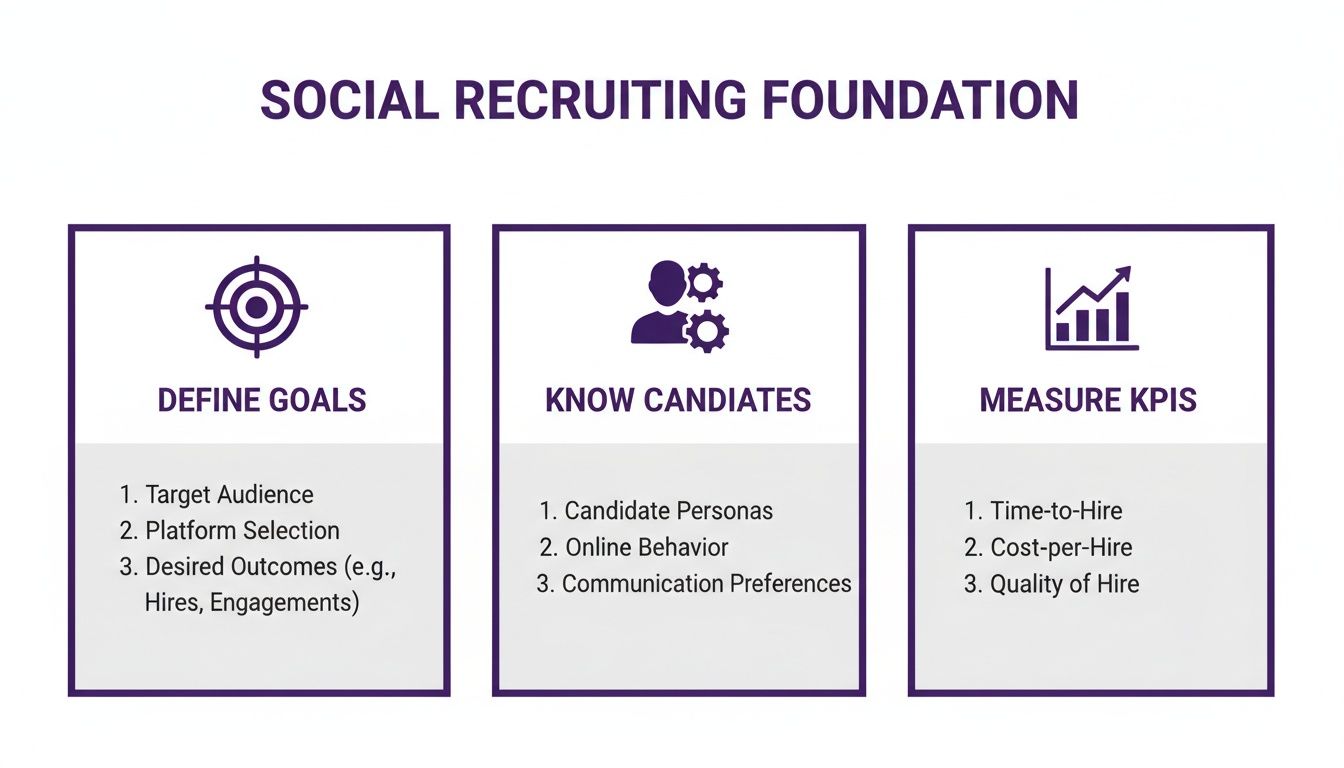
Get this foundation right, and you'll move from just posting jobs to strategically building a talent pipeline that works.
Crafting Content That Top Candidates Cannot Ignore
Let's be honest: generic job adverts are the digital equivalent of junk mail. They're easy to ignore and even quicker to forget. If you want to get anywhere with social media recruiting, your content needs to do more than just announce an opening. It has to tell a story, show off your culture, and give top talent a compelling reason to stop scrolling.
The real goal isn't just filling today's vacancy. It's about building a magnetic employer brand that pulls in passive candidates—those brilliant people who aren't actively job hunting but are always open to a fantastic opportunity if it lands on their feed.

Go Behind the Scenes with Authentic Stories
Candidates today want to see the real company, not just the polished corporate brochure. This is where authentic, employee-led content becomes your most powerful asset, offering a genuine peek into your world long before anyone steps into an interview.
Think about using formats that build a genuine connection:
- Day-in-the-Life Stories: Get a team member to take over Instagram Stories or TikTok to show their daily routine, projects, and chats with colleagues. It’s a relatable and unscripted look at what a role really involves.
- Employee Takeovers: Hand over the keys to one of your social accounts to a different employee for the day. They can share their perspective, answer questions from followers, and offer an unfiltered view of the company culture.
- Behind-the-Scenes Video Tours: A quick, informal video tour of the office, workshop, or even a remote employee's home setup makes your company feel much more accessible and human.
This kind of content builds trust and helps candidates figure out if they'd be a good fit. If they connect with the culture they see, they're far more likely to stick around for the long haul.
Optimise Job Posts for Social Feeds
Simply copying and pasting a job description from your website onto social media is a recipe for disaster. Social platforms are visual, fast-paced, and built for mobile. Your job posts have to play by their rules.
To make your adverts stand out, you need to:
- Use Compelling Visuals: Ditch the stock photos. Use a high-quality photo of the team they’d be joining, a short video from the hiring manager, or a branded graphic that highlights the top three perks of the role.
- Write a Strong Hook: Kick things off with a question or a bold statement that speaks directly to your ideal candidate’s ambitions. Instead of "We are hiring a Software Developer," try something like, "Ready to build software that impacts thousands of users every day?"
- Keep It Scannable: Use bullet points, emojis, and short sentences to break down key responsibilities and requirements. Remember, most users will be on their mobile phones, so big walls of text are an instant turn-off.
- Include a Clear Call-to-Action (CTA): Tell people exactly what to do next. "Apply via the link in our bio," "Send us a DM to learn more," or "Tag a friend who would be perfect for this!"
A well-crafted social job post isn't just an advert; it's a piece of marketing content. It needs to be engaging enough to stop someone mid-scroll and persuade them to take the next step.
Video, in particular, can make a huge impact here. For a deeper dive, check out our article on how to create an effective recruitment video that truly captures candidate attention.
Unleash the Power of Employee Advocacy
Your most credible and effective recruiters are already on your payroll: your employees. Getting them to share company news and job openings with their personal networks is an absolute game-changer. Their endorsement provides instant social proof and plugs you into a huge pool of passive talent.
The data backs this up. Content shared by staff receives 8 times more engagement and is 25 times more likely to be reshared. This drives leads that convert 7 times better than other methods, making it an ideal way to amplify your employer brand without any extra spend. It’s especially powerful when you consider that 79% of job seekers use social media in their search.
To get an employee advocacy programme off the ground, make it incredibly easy for your team to get involved. Provide them with pre-written (but customisable) posts, clear links, and eye-catching visuals. Most importantly, build a culture where people are genuinely proud to work and are happy to share their positive experiences. That kind of authenticity is something no marketing budget can ever buy.
Engaging Candidates and Building a Talent Pipeline

Putting out brilliant content is only half the story when it comes to social recruiting. The real magic happens when you stop broadcasting and start having genuine conversations. It’s this active engagement that turns passive scrollers into an active talent pipeline—a ready-made community of skilled people who already know and like your brand.
The idea is to build these relationships before you even have a role to fill. That way, when a vacancy does pop up, you’re not starting from a standstill. You’ll have a warm pool of candidates who already see you as a great place to work, putting you miles ahead of the competition.
Go Where the Talent Lives and Talks
Effective engagement means you have to join the conversations that are already happening. Simply posting on your own page and hoping for the best won't cut it. You need to get out there and participate in the digital spaces where your ideal candidates hang out.
This isn’t a one-size-fits-all approach. You need to adapt to the platform.
- LinkedIn Groups: Join groups relevant to your industry, like "UK Marketing Professionals" or "Software Development UK". But don’t just drop job links. Share valuable insights, answer questions, and contribute to discussions. This is how you establish your company as a knowledgeable voice in the sector.
- X (formerly Twitter) Threads and Chats: Follow industry hashtags (#FinTech, #DigitalHealth) and jump into relevant conversations. If a thought leader in your field posts something interesting, add your perspective. It’s all about visibility with the right crowd.
- Niche Communities: Don't forget to look beyond the big names. Are your ideal candidates sysadmins on Reddit in r/sysadmin? Are they designers sharing work on Behance? Finding these communities and engaging authentically can deliver incredible results.
Mastering Personalised Outreach That Works
When you do spot a promising candidate, that first message is everything. A generic, copy-and-pasted template is the quickest way to be ignored. If you want a response, personalisation isn't just a nice-to-have; it's essential.
A strong outreach message should always:
- Reference Something Specific: Mention a project they shared, an article they wrote, or a comment they made. It proves you’ve actually looked at their profile.
- Explain "Why Them": Clearly link their skills or experience to your company or a potential opportunity. What was it about them that caught your eye?
- Keep It Short and Conversational: This isn’t a formal email. Keep your message brief, friendly, and straight to the point.
- End with a Low-Pressure Question: Instead of "Are you interested in a job?" try something like, "Would you be open to a brief chat about your career goals sometime next week?"
Here’s an example that gets replies:
"Hi Sarah, I saw your recent post in the 'UX Designers UK' group about accessibility in app design—great points on WCAG compliance. We're building a team focused on inclusive design, and your expertise really stood out. Would you be open to a quick, informal chat about what we're working on?"
This feels like a genuine professional connection, not a sales pitch. For a deeper dive into these techniques, you can learn how to source more and better candidates with LinkedIn by following a structured sourcing process.
The Art of Community Management
Building a talent pipeline is a long-term game. It's all about relationships, and that's where community management becomes a crucial part of your social recruiting strategy. It’s the consistent, day-to-day work of nurturing the audience you've worked so hard to attract.
Good community management is more than just scheduling posts. It means:
- Responding Promptly: Acknowledge every comment and question on your posts. Even a simple "Thanks for sharing your thoughts!" shows you're listening.
- Answering Questions Transparently: If someone asks about your remote work policy or benefits, give them a straight, honest answer. This builds a huge amount of trust.
- Fostering Dialogue: Ask your audience questions. Run polls about the kind of content they'd like to see. Spark discussions that aren't just about your job openings.
By consistently showing up and adding value, you create a vibrant community around your employer brand. Your social media pages will transform from static job boards into dynamic talent hubs, giving you a steady stream of engaged, high-quality candidates ready for your next big hire.
Measuring Your ROI and Optimising Performance
So, you're posting great content and chatting with potential candidates. That’s a fantastic start, but how do you actually prove your social recruiting strategy is paying off? Without clear data, you’re just guessing. To show a real return on investment (ROI), you need to look past the vanity metrics like likes and followers and get down to the numbers that actually move the needle on your hiring goals.
Measuring what matters is how you show leadership the tangible value of your work. It also gives you the critical insights needed to fine-tune your approach, ditch what isn’t working, and double down on the platforms and tactics that are bringing in quality hires. The aim is to create a feedback loop where data drives your strategy, leading to constant improvement.
Key Metrics That Go Beyond the Surface
To get a true picture of your performance, you have to connect your social media activity directly to your hiring outcomes. This means blending the analytics from your social platforms with the hard data from your Applicant Tracking System (ATS).
Here are the essential metrics you should be tracking:
- Source of Hire: This is the big one. It tells you exactly which social media platform—be it LinkedIn, Facebook, or another—delivered the candidates you ultimately hired. Knowing that 70% of your new marketing hires came from a specific LinkedIn campaign is powerful information.
- Applicant Quality Score: Not all applications are created equal. You need to track the quality of candidates coming from each channel. Your ATS can help you score applicants against key criteria, revealing if Instagram brings in a high volume of candidates but LinkedIn delivers those with the essential skills.
- Cost per Hire: Tally up the total cost of your social recruiting efforts (including ad spend, tools, and your team's time) and divide it by the number of hires from those channels. This lets you compare the financial efficiency of social media against other sources, like job boards.
- Engagement on Job Posts: Don't just look at overall page engagement; zoom in on your job announcements. Clicks, shares, and comments on these specific posts indicate that your messaging and visuals are hitting the mark with the right audience.
The Importance of a Data-Driven Approach
To really understand what’s working, you need solid data. This means setting up a system to track key performance indicators (KPIs) that connect your social media efforts directly to your hiring pipeline.
Below is a table outlining the most important metrics to keep an eye on.
Key Social Recruiting Metrics to Track
A breakdown of essential KPIs for measuring the effectiveness of your social recruiting campaigns and their impact on hiring goals.
| Metric | What It Measures | Why It's Important | Tool for Tracking |
|---|---|---|---|
| Source of Hire | Which social platform the hired candidate originated from. | Identifies the most valuable channels for investment. | Applicant Tracking System (ATS) |
| Time to Hire | The number of days from job posting to offer acceptance. | Shows the efficiency of your social recruiting funnel. | ATS Analytics |
| Cost per Hire | Total social recruiting spend divided by total hires from social. | Measures the financial ROI of your social channels. | ATS & Finance Reports |
| Application Rate | The percentage of people who apply after seeing a job post. | Indicates the effectiveness of your job ad copy and visuals. | Social Media Analytics & ATS |
| Candidate Quality | The percentage of applicants who meet minimum qualifications. | Shows if you're attracting the right talent pool. | ATS Screening & Scoring Tools |
| Offer Acceptance Rate | Percentage of candidates who accept a job offer. | Reflects the strength of your employer brand and candidate experience. | ATS Analytics |
Tracking these metrics gives you a 360-degree view, allowing you to stop guessing and start making strategic, data-backed decisions that improve your hiring outcomes.
Creating a Holistic View with Your ATS
Relying only on the built-in analytics from social media platforms gives you an incomplete story. The real power comes from integrating these platforms with your ATS. This connection lets you follow a candidate’s journey from their first click on a Facebook ad all the way to a signed offer letter.
An integrated system is the only way to accurately track your source of hire. It closes the loop, showing you that the candidate who saw your "day-in-the-life" Instagram Story is the same person your hiring manager just onboarded. Without this link, you're flying blind.
This unified view helps you make much smarter decisions. If your data shows that X (formerly Twitter) drives a lot of clicks but very few qualified applicants, you can confidently reallocate that budget to a LinkedIn campaign that has a proven track record of delivering candidates who pass the initial screening.
To build a robust measurement framework, it helps to understand the full scope of what you can track. For a deeper dive, you can master recruitment metrics for hiring success with our in-depth guide.
Building Performance Reports for Leadership
The final piece of the puzzle is translating your data into a clear, compelling story for stakeholders. A good performance report doesn’t just throw numbers on a page; it explains what they mean for the business and outlines a clear plan for the future.
Your report should be simple, visual, and focused on the key takeaways.
Example Monthly Report Snippet
| Channel | Applications Received | Qualified Candidates | Hires | Cost per Hire |
|---|---|---|---|---|
| 120 | 45 | 4 | £450 | |
| 250 | 30 | 1 | £600 | |
| 85 | 15 | 0 | N/A |
A table like this makes the story instantly clear. While Facebook generated more applications, LinkedIn delivered four times the hires at a lower cost. Use this kind of data to justify your strategy, ask for budget adjustments, and confidently steer your social recruiting efforts toward measurable success.
How to Integrate Social Recruiting with Your ATS
Great content and a buzzing social media presence are brilliant for grabbing candidates' attention. But without the right systems backing you up, that success can quickly turn into chaos.
Manually tracking applications from LinkedIn, Facebook, and everywhere else is a recipe for missed opportunities and a huge administrative headache. To really make your recruiting social media efforts count, you need to connect them seamlessly with your Applicant Tracking System (ATS).
This integration is what turns your hiring from a scattered, manual slog into a streamlined, unified workflow. It’s the engine that powers a modern recruitment strategy, making sure no candidate slips through the cracks and freeing up your team to do what they do best: building relationships with top talent.
From Multiple Channels to a Single Dashboard
The most immediate win from an integrated system is centralising every single application. No more logging into five different platforms to download CVs or sift through DMs. Instead, every candidate who applies is automatically funnelled into one organised dashboard inside your ATS.
This creates a single source of truth for your entire hiring pipeline. With a platform like SeeMeHired, you can post a job once and watch it go live across all your social channels and job boards. Every application, no matter where it came from, lands in the same place, ready for your team to review.
This isn't just about convenience; it’s about control. A centralised dashboard gives you a complete, real-time overview of your talent pipeline. You can track candidates, schedule interviews, and manage all your communications without ever having to leave the system.
Automating the Initial Screening Process
One of the biggest time-sinks in recruitment is manually sifting through hundreds of applications just to find the few that meet your basic requirements. An integrated ATS with smart matching capabilities can automate this critical first step, saving your recruiters hours of painstaking work.
When an application flies in from a social media post, the system can instantly screen it against your job criteria. It can automatically shortlist candidates whose skills and experience are a strong match, letting your team skip the noise and focus their attention on the most promising talent.
This kind of automation is a lifesaver when you're dealing with the high volume of applications that a successful social campaign can bring in. To get a better idea of how this works, you can explore the benefits of automating your workflow using HR tech integrations in our detailed guide.
Elevating the Candidate Experience
A disjointed process doesn’t just frustrate your team; it creates a terrible experience for candidates. When applicants are left in the dark without timely acknowledgements or clear updates, they lose interest fast.
An integrated system makes sure every candidate receives prompt, professional communication. From automated "we've got your application" emails to easy interview scheduling right from the platform, a unified system keeps top talent engaged from their very first click. This is crucial in a competitive market where a positive candidate experience can be a key differentiator for your employer brand.
Think about the power of this unified approach. An impressive 90% of UK companies have successfully hired through LinkedIn. That success rate gets a massive boost when you pair it with an all-in-one ATS like SeeMeHired, which handles everything from multi-channel posting to integrated video interviews.
With 64% of employer branding goals focused on increasing applications, a smooth, integrated process is no longer a nice-to-have—it's essential for turning interest into actual hires. You can discover more insights about recruitment market trends on signaturerecruitment.co.uk.
By connecting your social recruiting directly to your ATS, you're building a powerful, efficient, and scalable hiring machine. You’ll eliminate admin bottlenecks, improve data accuracy, and provide an experience that keeps the best candidates engaged, ensuring your hard work on social media translates into high-quality hires.
Got Questions About Social Recruiting? We’ve Got Answers.
Diving into social media recruiting can feel a bit like learning a new language. You've got the basics down, but as you start putting your strategy into practice, real-world questions are bound to pop up.
Let's walk through some of the most common hurdles recruiters face. From setting a realistic budget to handling that inevitable negative comment, think of this as your go-to guide for navigating the day-to-day of hiring on social media.
How Much Should We Actually Budget for Social Recruiting?
This is the million-dollar question, isn't it? The honest answer is: it depends entirely on your goals and the roles you're trying to fill. Don't just pull a number out of thin air. A solid starting point is to carve out a specific portion of your overall cost-per-hire budget just for your social channels.
For high-volume roles, like in retail or hospitality, you'll want a bigger budget for targeted Facebook and Instagram ads to reach a broad local audience. But if you're hunting for a single, highly specialised senior developer, your budget might be smaller but laser-focused on premium tools like LinkedIn Recruiter to pinpoint very specific skills.
When you're crunching the numbers, think about these key areas:
- Ad Spend: The direct cost of promoting your job posts and employer brand campaigns.
- Content Creation: The time and resources needed for videos, graphics, and employee stories.
- Tools and Technology: Subscriptions for scheduling software, analytics platforms, or design tools.
My advice? Start small. Pick one or two key roles, set a modest, experimental budget, and track your ROI obsessively. Once you see what’s working, you can confidently scale up.
How Do We Handle Negative Comments or Reviews?
Look, it’s not a matter of if you’ll get a negative comment, but when. The absolute worst thing you can do is ignore it. Silence looks like guilt, and it tells every other potential candidate that you don't care about their experience. Having a plan is crucial.
A prompt, professional response shows you're listening. Your strategy should have two simple parts:
- Acknowledge and Move Offline: Post a brief, empathetic public reply. Something like, "We're sorry to hear you had this experience. We take feedback very seriously and would like to learn more. Please send us a direct message so we can look into this for you."
- Take Action Internally: This is the most important step. Use the feedback as a genuine chance to get better. Was there a communication breakdown? A glitch on your careers page? Find the root of the problem and fix it.
Never, ever get dragged into a public argument. Your goal is to show other candidates that you’re responsive and professional, not to win a debate. A calm, constructive public response builds far more trust than hitting the delete button.
Which Platforms Work Best for Niche or Hard-to-Fill Roles?
When you’re searching for that unicorn candidate with a rare skill set, casting a wide net on mainstream platforms is usually a waste of time. You need to go where these professionals actually hang out online, and that often means looking beyond the usual suspects.
Think smaller, more focused communities. For example:
- Developers: Forget generic job ads. You’ll find your next software engineer by engaging on GitHub, Stack Overflow, or in specific subreddits like r/programming.
- Designers: Creative professionals are showcasing their work and talking shop on Behance, Dribbble, or in dedicated Slack communities for UX/UI designers.
- Scientists or Academics: ResearchGate or niche academic forums can be goldmines for connecting with people in highly specialised fields.
The play here isn't to blast out job ads. It’s about authentic engagement. Join discussions, share valuable insights, and build relationships. You want to be seen as a knowledgeable peer, not just another recruiter with a job to fill.
Should We Post Salaries in Our Social Media Job Adverts?
Yes. If you can, you absolutely should.
Transparency is king in today's job market. Including a salary range is one of the single most effective things you can do to boost the quality and quantity of your applicants. It shows you respect a candidate's time and gives your role immediate credibility.
Of course, sometimes company policy or competitive concerns get in the way. If you absolutely can't post an exact range, at least try to give some indication of the compensation level.
Let’s break down the two approaches:
| Approach | Pros | Cons |
|---|---|---|
| Include Salary Range | Attracts more relevant applicants, builds trust, saves time for everyone involved. | Competitors can see your pay scales; may create internal equity issues if not managed well. |
| Exclude Salary Range | Keeps compensation details private, allows more flexibility in negotiations. | Fewer applications, attracts candidates with unrealistic expectations, can come across as untrustworthy. |
In a competitive market, being upfront about salary is a powerful differentiator. It helps you stand out and attract serious candidates who know their worth and are ready to apply.
Ready to turn social media interest into your next great hire? SeeMeHired provides an all-in-one Applicant Tracking System that centralises applications from every channel, automates screening, and helps you build a seamless candidate experience. Learn how you can hire smarter, not harder, with SeeMeHired.