What Is Applicant Tracking for Businesses
What is applicant tracking? This guide explains how ATS software streamlines hiring, its benefits for UK businesses, and how to choose the right system.
Applicant tracking software is pretty much what it sounds like: a digital command centre for your entire hiring process. It's the tech that takes the mountain of job applications you receive and turns a chaotic, overwhelming workflow into an organised, efficient system.
Listen to the podcast here:
Your Digital Recruitment Command Centre
Picture this: you're trying to manage dozens, maybe even hundreds, of applications using nothing but a clunky spreadsheet and an inbox that’s bursting at the seams. It’s a recipe for disaster. Great candidates get lost in the shuffle, and your team spends more time on admin than actually talking to people. This is the exact headache that applicant tracking was built to cure.
At its core, an Applicant Tracking System (ATS) is your smart assistant for hiring. It does all the heavy lifting, acting like a super-organised librarian for your talent pool. Instead of manually sifting through every single CV, the system collects, sorts, and files each application into one central, searchable database. It’s a foundational piece of modern hiring.
The growth of this technology really tells the story. The UK applicant tracking system market was valued at around USD 73.4 million in 2024 and is expected to hit USD 106 million by 2032. This surge shows just how essential digital recruitment has become for businesses across the UK. You can find out more about the UK's growing ATS market on Pitchnhire.
To help you get a quick handle on what an ATS really is, here's a simple breakdown.
Applicant Tracking at a Glance
| Aspect | Explanation |
|---|---|
| What it is | A software platform that centralises and automates the entire recruitment process, from job posting to hiring. |
| Primary Goal | To manage the flow of job applications and candidate data in one organised, accessible system. |
| Who uses it | HR departments, recruiters, and hiring managers in businesses of all sizes, from small start-ups to large corporations. |
| Key Function | Automating repetitive tasks like application collection, CV screening, candidate communication, and tracking progress. |
In short, an ATS brings much-needed structure and efficiency to the hiring game.
From Chaos to Clarity
Think of applicant tracking as the bridge connecting the moment you post a job to the day you make a hire. The system handles all those repetitive, mind-numbing tasks so your team can focus on what really matters—connecting with the best people. It automates key steps along the recruitment journey, a topic we dive into deeper in our guide to recruitment automation.
This technology brings structure and clarity to what can otherwise be a messy process. Here’s a quick look at what it does:
- Centralises Applications: It pulls in all applications from various job boards and your careers page, putting them into one single, unified dashboard. No more hopping between different websites.
- Filters and Sorts Candidates: The system can automatically scan CVs for specific keywords, skills, and qualifications, serving up a ready-made shortlist of the most relevant people.
- Tracks Candidate Progress: It gives your team a bird's-eye view of where every single candidate is in the hiring pipeline, from the initial application right through to the final offer.
- Improves Communication: Many systems come with tools to send automated updates to candidates, making sure nobody is left in the dark wondering about their status.
An ATS doesn't replace the human element of recruitment; it enhances it. By handling the administrative burden, it frees up recruiters to engage more meaningfully with top candidates and make better-informed hiring decisions.
Ultimately, understanding what applicant tracking is all about means recognising its power to build a more strategic, organised, and effective hiring function for any business.
How an Applicant Tracking System Actually Works
To really get what applicant tracking is, you need to look past the textbook definition and see how the tech works day in, day out. Don't think of an Applicant Tracking System (ATS) as some robotic gatekeeper. Instead, picture it as a super-efficient co-pilot for your recruitment team. Its core job is to manage the entire candidate journey, from the moment someone hits ‘apply’ right through to the final offer. It automates the repetitive stuff so you can focus on the human side of hiring.
The process kicks off the second a candidate submits their application, whether that’s on your careers page or through a job board. Instead of their details ending up in a chaotic inbox, they're funnelled straight into the ATS. This is where the first bit of magic happens: resume parsing. The software intelligently scans the CV, pulling out key information like contact details, work history, skills, and qualifications, and organises it all into a neat, standardised candidate profile. That means no more manual data entry and a consistent, easy-to-review format for every applicant.
This organised data is the bedrock for everything that follows. An ATS builds a comprehensive candidate database, storing details from both current and past applicants. This allows recruiters to create powerful talent pools they can dip into for future roles. By using keyword filtering and resume parsing, the system can compare candidates on a like-for-like basis, making the initial screening much more straightforward.
This diagram breaks down the core workflow of an applicant tracking system into three simple stages.
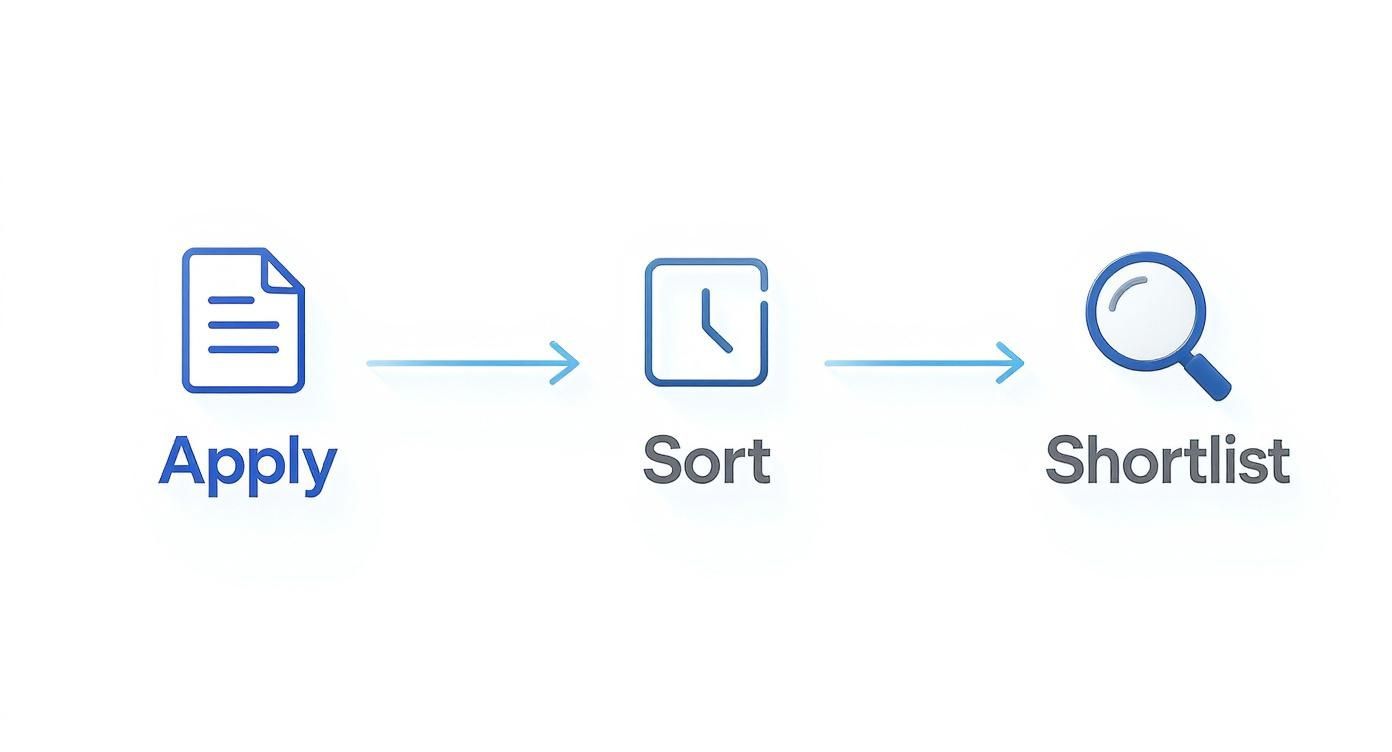
As you can see, the system helps turn a high volume of applications into a manageable, qualified shortlist for your team to get stuck into.
From Application to Shortlist
Once candidate data is parsed and organised, the ATS helps you intelligently sift through the applicant pool. You can set specific criteria based on your job requirements—things like years of experience, essential skills, or necessary certifications. The system then automatically screens the profiles, flagging the candidates who are the best match.
This doesn't mean the system is just rejecting people. It’s a common myth that an ATS automatically bins perfectly good candidates. In reality, modern systems rank and categorise applicants, presenting you with a prioritised list. This lets your hiring team focus on the most promising individuals first, without having to trawl through hundreds of unsuitable CVs. It’s all about efficiency, not exclusion.
This process is a key part of what makes recruitment automation software so powerful. It handles the initial, time-sapping screening stages, freeing up your team for more strategic, high-value work.
Managing the Entire Hiring Pipeline
Beyond just screening, an ATS acts as the central command centre for your entire hiring pipeline. It gives you a clear, visual overview of where every single candidate is in the process, from application to offer.
Here’s how it keeps everything moving smoothly:
- Centralised Communication: Send automated emails for application confirmations, interview invites, and rejection notices directly from the platform. This ensures a consistent and professional experience for every candidate.
- Interview Scheduling: Many systems integrate with calendars to take the headache out of scheduling interviews. No more endless back-and-forth emails between recruiters, candidates, and hiring managers.
- Team Collaboration: Hiring is a team sport. An ATS allows recruiters and hiring managers to leave notes, ratings, and feedback on candidate profiles, keeping everyone on the same page.
The real power of an ATS lies in its ability to bring structure and visibility to a complex process. It transforms recruitment from a series of disjointed tasks into a single, cohesive workflow where no candidate gets left behind.
Ultimately, the system works by taking the administrative burden out of hiring. It sorts, filters, and organises candidate information so your team can make smarter, faster, and more informed decisions—all without losing that essential human touch.
The Core Benefits of Using an ATS
Knowing how an applicant tracking system works is one thing, but the real value is in what it actually does for your business. An ATS isn't just about clever features; it's about fundamentally changing recruitment from a reactive, admin-heavy chore into a proactive, strategic part of your company. It gives your team the right tools to stop just managing applications and start building a powerful, efficient hiring machine.
One of the first things you'll notice is the creation of a centralised talent pool. Think about it: right now, CVs are probably scattered across inboxes, buried in spreadsheets, or lost in forgotten folders. With an ATS, every single application is stored in one organised, searchable database. A brilliant candidate who wasn't quite right for one role can be instantly found for another opening months down the line, saving you a huge amount of time and money on future sourcing.
This efficiency boost directly impacts your team's day-to-day work. Those repetitive but necessary tasks—sending "we've received your application" emails, scheduling interviews, and letting unsuccessful candidates know—can all be automated. This frees up countless hours, allowing your recruiters to focus on what really matters: talking to top prospects and working closely with hiring managers.
Driving Smarter Hiring Decisions with Data
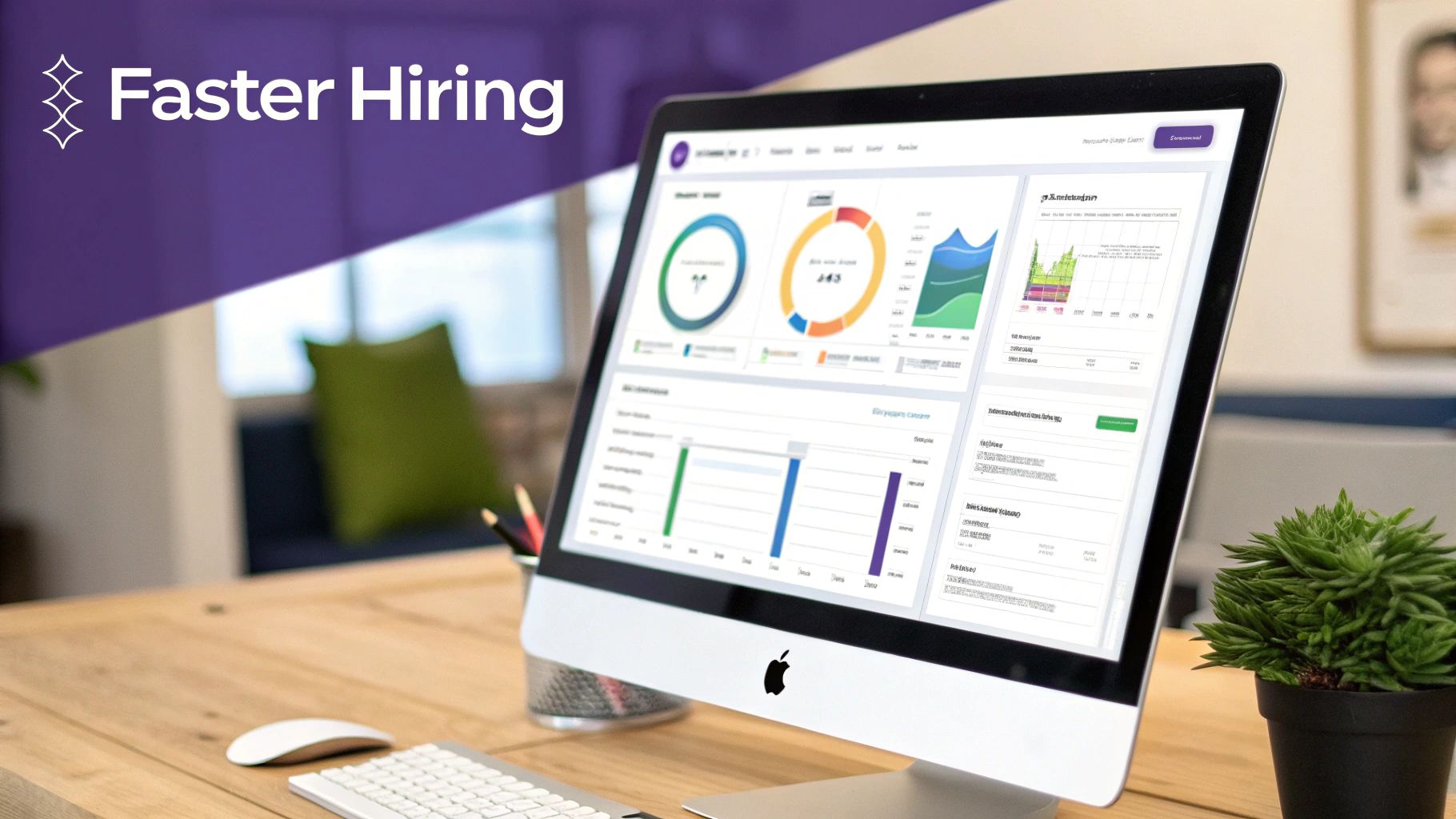
Maybe the biggest win with a modern ATS is the move away from guesswork and towards a data-driven strategy. The system becomes your single source of truth for all hiring metrics, giving you clear, easy-to-understand insights on analytics dashboards.
With this data, you can finally get real answers to critical questions about your recruitment process:
- Which job boards actually deliver the best candidates? Stop throwing money at channels that don't perform.
- How long is it really taking to fill roles? Pinpoint the bottlenecks in your hiring pipeline and fix them.
- What's our interview-to-hire ratio? Figure out how effective your interview process actually is.
This kind of analytical power is a game-changer. A typical online job post can pull in over 250 applicants, but only a handful will ever get an interview. An ATS doesn't just help you sort through that volume; it gives you the data to make your entire strategy better. It's no wonder 99% of Fortune 500 companies use one—studies show a good system can shorten the hiring cycle by over 60%.
By providing clear, actionable data, an ATS empowers you to continuously improve your hiring process. It turns recruitment into a measurable business function where you can track progress, demonstrate ROI, and make smarter investments.
Enhancing the Candidate Experience
In a competitive market, the experience you give applicants says everything about your employer brand. A clunky, slow, or silent hiring process will put off top candidates and can even damage your company's reputation. An ATS helps you create a professional and engaging journey for every single person who applies.
Automated communications mean candidates are never left wondering what's happening. From instant application confirmations to timely status updates, the system keeps everyone in the loop. This simple act of consistent communication makes applicants feel valued and respected, even if they don't get the job.
Plus, integrated scheduling tools get rid of the frustrating email tennis of trying to find a good interview time. This smooth experience shows candidates that your organisation is efficient and modern, setting a positive tone from the very first interaction. You can explore a deeper dive into these advantages by reading our guide on the key benefits of an ATS for smarter hiring.
The difference between a manual hiring process and one powered by an ATS is night and day. Let's break down just how stark that contrast is.
Manual Hiring vs ATS-Powered Recruitment
The table below paints a clear picture of how an ATS transforms tedious manual tasks into efficient, automated workflows, freeing up your team to focus on strategic goals.
| Hiring Task | Manual Process (Without ATS) | Automated Process (With an ATS) |
|---|---|---|
| Application Management | Scattered across multiple inboxes and spreadsheets, leading to lost candidates. | All applications are centralised in one dashboard for easy tracking and review. |
| Candidate Screening | Hours spent manually reading every CV, often leading to inconsistent evaluation. | Automated filtering based on keywords and skills provides a qualified shortlist in minutes. |
| Communication | Inconsistent or non-existent updates, leading to a poor candidate experience. | Automated email templates ensure every applicant receives timely and professional updates. |
| Reporting and Analytics | Relies on manual tracking, making it nearly impossible to get accurate hiring data. | Real-time dashboards provide deep insights into time-to-hire, source effectiveness, and more. |
Ultimately, adopting an ATS is about more than just managing applications; it’s about gaining a strategic advantage in the war for talent.
Applicant Tracking in the Real World

The theory behind applicant tracking is all well and good, but the technology truly comes alive when you see it tackling real, industry-specific challenges. An Applicant Tracking System (ATS) is no one-size-fits-all gadget; its real value lies in how it adapts to the unique pressures of different sectors.
Whether it’s managing mission-critical compliance in healthcare or handling the whirlwind of seasonal hiring in hospitality, a good ATS is a versatile tool for real-world problems. Let’s look at how different UK industries put applicant tracking into practice, turning abstract features into powerful, problem-solving solutions.
Solving High-Stakes Recruitment in Healthcare
In the UK healthcare sector, hiring is about much more than just finding skilled professionals. It’s about safeguarding patients and navigating a maze of strict regulatory standards. Recruiters are under immense pressure to verify credentials, sift through high volumes of applications for roles like nursing staff, and keep a constant pipeline of qualified talent on standby.
In this environment, an ATS becomes an essential partner in compliance. It brings much-needed structure to a notoriously complex process:
- Certification Management: Recruiters can set up custom fields to track vital certifications, like an NMC registration for nurses. The system can automatically flag any candidate missing the required credentials, ensuring only compliant people move forward.
- Audit-Ready Records: From DBS checks to professional qualifications, all candidate documents are stored securely in one central location. This creates an organised, easily accessible record ready for internal audits or CQC inspections at a moment's notice.
- High-Volume Screening: When a single nursing vacancy pulls in hundreds of applicants, an ATS automates the initial screening. It filters for essential skills and experience, letting recruiters focus their limited time on the most promising candidates.
For healthcare providers, an ATS is more than just an efficiency tool—it’s a cornerstone of risk management. It adds a layer of automated checks and balances that reinforces compliance and helps maintain a higher standard of care.
Streamlining Seasonal Hiring in Hospitality
The hospitality industry runs on a rhythm of peaks and troughs. This demands a flexible workforce that can swell to meet seasonal demand. Hotels, restaurants, and event venues often need to hire a lot of people quickly, manage high turnover, and maintain a pool of reliable temporary staff.
Applicant tracking software is perfectly built for this kind of dynamic hiring. It helps managers get ahead by building and nurturing talent pools of previous seasonal workers who can be re-engaged with minimal fuss. This slashes the time and money spent finding new staff from scratch every single season.
On top of that, communication automation is a complete game-changer. An ATS can fire off bulk messages to applicants about interview days or shift availability, coordinating large-scale hiring drives that would be a logistical nightmare to manage manually over email.
Empowering Small Business HR Teams
For many small and medium-sized businesses (SMBs), the "HR department" is often just one person juggling a dozen different roles. These small teams have to compete for talent against larger corporations with bigger budgets and more resources. An ATS is the great equaliser, giving them the tools to punch well above their weight.
By automating routine communication, an SMB can deliver a candidate experience that rivals a much larger organisation, building a professional employer brand from the very first interaction. Crucially, it organises the entire hiring process, ensuring compliance with UK employment law and GDPR without needing a dedicated legal team.
For a closer look at how these benefits deliver measurable results, you can learn more by quantifying the value of an Applicant Tracking System (ATS)/) in our detailed guide. It’s a strategic investment that frees up small teams to focus on growth, confident that their hiring is both efficient and compliant.
How to Choose the Right ATS for Your Business
Picking an applicant tracking system is a big deal. It’s not just another piece of software; it’s an investment in the very engine of your company's growth. The right ATS can completely reshape your hiring for the better, but the wrong one will just add a new layer of frustration. This guide will walk you through a practical framework for making the best choice for your business.
The first step, before you even look at a single demo, is to look inward. You need to get crystal clear on exactly what problems you're trying to solve. Are you drowning in applications? Is patchy communication with candidates hurting your employer brand? Maybe your biggest headache is staying on top of UK GDPR compliance. Don't even think about shopping for features until you have a solid list of your own recruitment pain points.
This self-assessment is everything. It shifts your search from a vague "we need an ATS" to a focused mission to find a solution that tackles your specific challenges head-on.
Define Your Must-Have Features
Once you know your problems, you can start translating them into a list of essential features. This isn't about finding the system with the longest, most impressive feature list. It’s about finding the one with the right features for your team. A great way to start is by splitting your needs into two camps: "must-haves" and "nice-to-haves."
Your list of absolute deal-breakers might look something like this:
- UK GDPR Compliance Tools: For any UK business, this is non-negotiable. You need features that can automate consent management and data retention policies without you having to think about it.
- Integration Capabilities: Does the ATS need to talk to your existing HR software, payroll system, or company calendars? Make a list of every system it has to connect with.
- A User-Friendly Interface: The system has to be intuitive for everyone, from your seasoned recruiters to your hiring managers who only dip in occasionally. If it’s clunky, your team just won't use it.
- Scalability: Think about your growth plans. Will the system you choose today still be fit for purpose in three to five years?
A common mistake is getting wowed by flashy features that you’ll never actually use. By nailing down your core requirements first, you can stay focused on what will genuinely improve your hiring process and give you a clear return on your investment.
Key Questions to Ask Every Vendor
With your requirements list in hand, you're ready to start talking to vendors. Going into these conversations with a prepared set of questions is your secret weapon. It ensures you get the specific information you need to compare apples with apples, stops you from getting lost in a sales pitch, and keeps the focus on your needs.
Make sure you ask direct questions covering these critical areas:
- Data Security and Compliance: "How exactly does your platform help us stay compliant with UK GDPR? Where will our candidate data be stored, and what security measures do you have in place to protect it?"
- Implementation and Support: "What does the onboarding process actually look like, and how long does it usually take? What level of training and ongoing customer support is included in our plan?"
- User Experience: "Can you give us a live demo that walks through the daily tasks of a recruiter and a hiring manager? How do you make sure the experience for candidates is positive and straightforward?"
- Pricing Structure: "What’s your pricing model? Are there any hidden costs for implementation, support, or adding more users that we should know about?"
For businesses in the UK, it pays to partner with someone who understands the local landscape. SeeMeHired, for instance, is a UK-based platform designed from the ground up with the specific compliance and operational needs of UK businesses in mind. Its entire focus is on simplifying complex tasks for in-house HR teams—from automated compliance checks to seamless job board integrations—making it a very strong contender for companies wanting a practical, all-in-one solution.
Common Questions About Applicant Tracking
When you first start looking into applicant tracking, it's natural to have questions. A bit of healthy scepticism is normal, too. Most of the common worries come from old ideas about how these systems used to work, but the reality is that modern Applicant Tracking Systems (ATS) are smart, user-friendly tools designed to help, not replace, human decisions.
Let's tackle some of the most frequent questions UK businesses ask. We'll give you clear, straightforward answers to help separate fact from fiction.
Will an ATS Automatically Reject Good Candidates?
This is probably the biggest and most stubborn myth about applicant tracking, and it’s a hangover from older, clunkier technology. Modern platforms don't just scan for keywords and toss out anyone who doesn't fit a rigid template. They use sophisticated parsing technology to actually understand the context of a CV.
Think of an ATS as a shortlisting assistant. It intelligently highlights the most relevant profiles based on the criteria you set—like skills, experience, and qualifications—allowing your team to focus their attention on the most promising people first.
A well-configured ATS surfaces top talent for human review; it never makes the final hiring decision. The ultimate choice always rests with the recruiter, ensuring that unique or exceptionally talented candidates are not overlooked.
Is an Applicant Tracking System Only for Large Companies?
Not at all. It's true that 98.4% of Fortune 500 companies use an ATS to manage massive hiring volumes, but the technology offers just as much value to small and medium-sized businesses (SMBs). Today’s cloud-based solutions are affordable and scalable, with pricing plans designed specifically for smaller teams.
For an SMB, an ATS is a powerful force multiplier. It helps to:
- Level the playing field by creating a professional, slick candidate experience that rivals larger competitors.
- Automate tedious admin, freeing up small teams where every single minute counts.
- Ensure compliance with UK employment law and data protection regulations.
- Build a talent pool for future growth without needing a dedicated sourcing team.
Put simply, an ATS gives smaller businesses the structure and efficiency they need to compete for top talent.
How Difficult Is It to Implement a New ATS?
The days of long, painful software rollouts are pretty much over. Modern, cloud-based systems have made the setup process far simpler and more accessible for businesses of all sizes. Any reputable provider will walk you through a structured onboarding process to get you up and running quickly.
Typically, this involves:
- Configuration: Customising the system to mirror your specific hiring workflows.
- Data Migration: Getting support to securely transfer your existing candidate data into the new platform.
- Team Training: Making sure your recruiters and hiring managers are comfortable and confident with the new tools.
For most businesses, a standard setup can be wrapped up in a matter of days or weeks, not months. The best platforms are built around user-friendly interfaces, meaning your team can start seeing the benefits almost immediately with minimal disruption.
How Does an ATS Help with UK GDPR Compliance?
For any UK business, GDPR compliance isn't just a good idea—it's the law. An ATS is an essential tool in your compliance kit, turning a complex legal headache into a manageable, systematic process. It gives you the framework to handle personal data responsibly and transparently.
An ATS strengthens your GDPR position by systematically managing candidate consent, creating a clear audit trail of when and how people agreed to have their data processed.
It also automates data retention policies. You can set the system to automatically delete candidate information after a certain period, helping you comply with the "right to be forgotten" and data minimisation principles. This automated approach reduces the risk of human error. For a deeper dive, our essential guide to GDPR for UK hiring teams has everything you need to know.
Finally, an ATS provides a secure, central hub for all sensitive candidate data. Instead of information being scattered across insecure spreadsheets and email inboxes, it's protected in a single system with controlled access. This massively reduces the risk of a data breach and makes responding to subject access requests a simple, a "few-clicks" task.
Ready to transform your hiring process from a chaotic administrative burden into a streamlined, strategic advantage? SeeMeHired provides an all-in-one applicant tracking system designed specifically for the needs of UK businesses. From effortless job posting and smart candidate matching to integrated video interviews and robust compliance tools, our platform empowers you to hire better talent, faster.
Discover how SeeMeHired can work for you
