HR Processes
The True Definition of Workforce Planning A Practical Guide
Ask someone for the definition of workforce planning and you might get a dry, textbook answer. The simplest way to think about it is this: it's the process of getting the right people with the right skills into the right roles at the right time. It’s a forward-thinking game plan that stops your business from being blindsided by surprise talent shortages or critical skills gaps.
Listen to the podcast here:
What Does Workforce Planning Actually Mean?

Let's cut through the jargon. At its heart, workforce planning is your company's people strategy. Think of it like a chess grandmaster who’s always thinking several moves ahead, not just reacting to what their opponent did last. It’s the crucial bridge connecting your overall business strategy to your HR and people strategy.
Too many organisations confuse workforce planning with simple headcount forecasting—basically, just guessing how many bodies they might need next quarter. That's a common mistake. Real workforce planning goes much deeper by asking the critical questions that will shape the future of your entire business.
From Reactive Hiring to Proactive Strategy
Without a plan, HR often gets trapped in a reactive loop. A key employee resigns, a project suddenly needs new expertise, or a new site opens up, and it triggers a frantic scramble to hire someone. This 'firefighting' approach is costly, inefficient, and rarely lands you the best person for the job.
Workforce planning flips that script entirely. It’s a proactive strategy that helps you see your needs coming long before they become urgent problems. Think about how a championship sports team is built. The manager doesn't just sign star players at random. They analyse the current roster, scout for specific positions needed for the next season, develop promising young talent in their academy, and plan for veteran retirements.
That’s exactly what strategic workforce planning does for a business. It involves:
- Analysing your current team's skills, strengths, and any weak spots.
- Forecasting the future skills your business will need to compete and grow.
- Identifying the gaps between where you are today and where you need to be tomorrow.
- Building a concrete plan to close those gaps through hiring, training, or internal moves.
By linking your people directly to your bottom line, effective workforce planning transforms HR from a support function into a strategic business driver. It ensures every hiring decision, training programme, and promotion aligns with the company's long-term vision.
Ultimately, this methodical approach is a cornerstone of any robust talent management system. To see how it fits into the bigger picture of developing your people, check out our guide on what is talent management. It's the difference between hoping you'll have the right team and ensuring you do.
Why Planning Your Workforce Is No Longer Optional
In today’s market, simply reacting to staffing needs as they pop up is a recipe for disaster. While knowing the definition of workforce planning is a start, it's understanding its crucial importance that separates thriving businesses from those just about getting by. Without a forward-thinking plan, you're just constantly fighting fires.
This reactive cycle leads to expensive hiring mistakes, projects getting delayed, and that nagging feeling of always being one step behind. Proactive planning is what helps you navigate economic shifts, bridge critical skills gaps, and adapt to big changes like artificial intelligence and automation.
Navigating Market Shifts and Skills Gaps
Picture a UK hospital facing a shortage of specialist nurses. The reactive approach? Paying exorbitant agency fees and burning out their existing staff. Strategic workforce planning, on the other hand, allows them to forecast retirement rates and changing patient needs, so they can kick off a targeted training programme or recruitment drive years in advance.
It's the same for a growing tech startup. They can't afford to wait until a new product is about to launch to start looking for the right software engineers. By planning their workforce, they can map out the exact coding skills they’ll need for their future roadmap and start building a talent pipeline today. That way, they have the right people ready to hit the ground running.
Workforce planning transforms HR from a reactive cost centre into a proactive, strategic partner. It’s the difference between being a victim of market changes and being the architect of your company's future resilience.
This forward-looking stance has never been more vital. Labour market analyses show that UK organisations are increasingly using data to get a handle on skills gaps. For instance, in the period from March to May 2025, there were an estimated 736,000 UK vacancies. At the same time, experts warn that automation could displace up to 3 million low-skilled UK jobs by 2035, which really drives home the urgent need for reskilling. If you want to dig deeper into these trends, you can explore detailed labour market statistics for June 2025.
Protecting Your Competitive Edge
At the end of the day, a lack of planning hits your bottom line and your competitive position—hard. When critical roles sit empty, productivity grinds to a halt and innovation stalls. The constant churn of reactive hiring also hammers morale, which inevitably leads to higher employee turnover.
By anticipating your talent needs, you can make smarter, more deliberate decisions that actually support long-term growth. This includes:
- Reducing Costs: You'll minimise your reliance on expensive last-minute recruitment agencies and sidestep the eye-watering cost of a bad hire.
- Improving Retention: You can create clear career paths and invest in upskilling, which shows employees they have a real future with your company.
- Boosting Agility: You'll be able to pivot quickly to new market opportunities simply because you have the right talent already in place.
As the old saying goes, failing to plan is planning to fail. When you invest in your people strategy, you don't just avoid common pitfalls—you build a more engaged, resilient, and effective team. For more on this, you might be interested in our guide on 7 proven ways to reduce employee turnover in the UK.
The Four Pillars of an Effective Workforce Plan
A solid workforce plan isn't a one-off task; it’s a structured process built on four essential pillars. Think of them as the foundation, framework, and finishing touches of a well-built house. Each pillar answers a crucial question, guiding you from understanding the team you have today to strategically building the one you'll need tomorrow.
Let's walk through this with a practical example: a growing UK e-commerce company planning its next big expansion.
Pillar 1: Supply Analysis
The first pillar, Supply Analysis, kicks things off by asking: "Who do we have right now?" This is your starting point—a detailed inventory of your current workforce. It goes way beyond a simple headcount to map out the skills, experience, tenure, and hidden potential of your existing employees.
For our e-commerce company, this means taking a hard look at their logistics team. They’d identify that they have 15 warehouse operatives, three junior supervisors, and one seasoned warehouse manager who is nearing retirement. They also note that only two supervisors have completed advanced inventory management training, a critical skill for their future plans.
Pillar 2: Demand Forecasting
Next up is Demand Forecasting, which asks the forward-looking question: "Who will we need in the future?" This is where your people strategy connects directly to your business goals. You look at where the company is heading—like launching in a new region or introducing a new product line—and predict the talent required to make it happen.
Our e-commerce business plans to double its order volume over the next 18 months. Their forecast shows they won't just need more hands on deck; they'll need two new data analysts to optimise delivery routes and an additional senior warehouse manager to oversee a second distribution centre. It's about predicting needs, not just reacting to them.
Pillar 3: Gap Analysis
With a clear picture of your supply (what you have) and your demand (what you need), the third pillar is Gap Analysis. This step is straightforward, asking: "Where are the differences?" You simply compare the two, identifying the specific shortfalls in numbers, skills, or leadership.
The e-commerce company’s analysis reveals some obvious gaps. They need one more senior manager, two data analysts they don't currently employ, and warehouse operatives with more advanced tech skills. On top of that, there's a looming leadership succession gap, with their most experienced manager set to retire.
A gap analysis is the moment of truth in workforce planning. It translates your strategic goals into a tangible shopping list of talent requirements, highlighting exactly where you need to focus your efforts.
Pillar 4: Solution Implementation
Finally, Solution Implementation answers the most important question of all: "How will we close these gaps?" This is your action plan. Based on your gap analysis, you decide on the best strategies, which is often a mix of recruiting externally, reskilling your current team, or even redesigning roles.
The e-commerce company develops a multi-pronged plan. They will:
- Recruit externally for the two specialist data analyst roles.
- Promote one of their trained junior supervisors to fill the upcoming warehouse manager vacancy, tapping into internal talent.
- Invest in a training programme to upskill their existing warehouse operatives on the new inventory software.
This four-pillar approach provides a clear, repeatable framework for any organisation. It ensures the very definition of workforce planning translates into a practical strategy that truly aligns your people with your purpose.
Your Step-By-Step Workforce Planning Roadmap
Knowing the core pillars of workforce planning is one thing, but actually putting them into practice is another game entirely. To bridge that gap between theory and action, here’s a practical, five-step roadmap that cuts through the complexity. Think of this as your clear path from high-level strategy to on-the-ground execution.
Step 1: Align with Strategic Business Goals
First things first: your workforce plan should never exist in a vacuum. The most critical step is to tie it directly to your organisation's biggest goals. Are you planning to break into new markets, launch a game-changing product, or boost operational efficiency by 20%?
Each of these goals demands a specific talent strategy. By starting here, you make sure your people plan isn't just an HR exercise—it's a core driver of the company's future success. This simple shift transforms HR from a support function into a true strategic partner.
Step 2: Analyse Your Current and Future Workforce Needs
With your business goals as your North Star, it’s time to get into the detail of supply and demand. Start by taking a proper inventory of your current workforce. Go beyond a simple headcount; you need to catalogue skills, competencies, performance levels, and even potential succession risks, like key team members nearing retirement.
Next, you need to forecast the talent you’ll need to hit those future goals. This means predicting the roles, skills, and number of people you'll require in one, three, or even five years. This step gives you a crystal-clear picture of what you have versus what you'll need.
This visual shows the fundamental flow of any good workforce plan—moving from analysing your current supply and future demand to identifying the gaps and finding the right solutions.
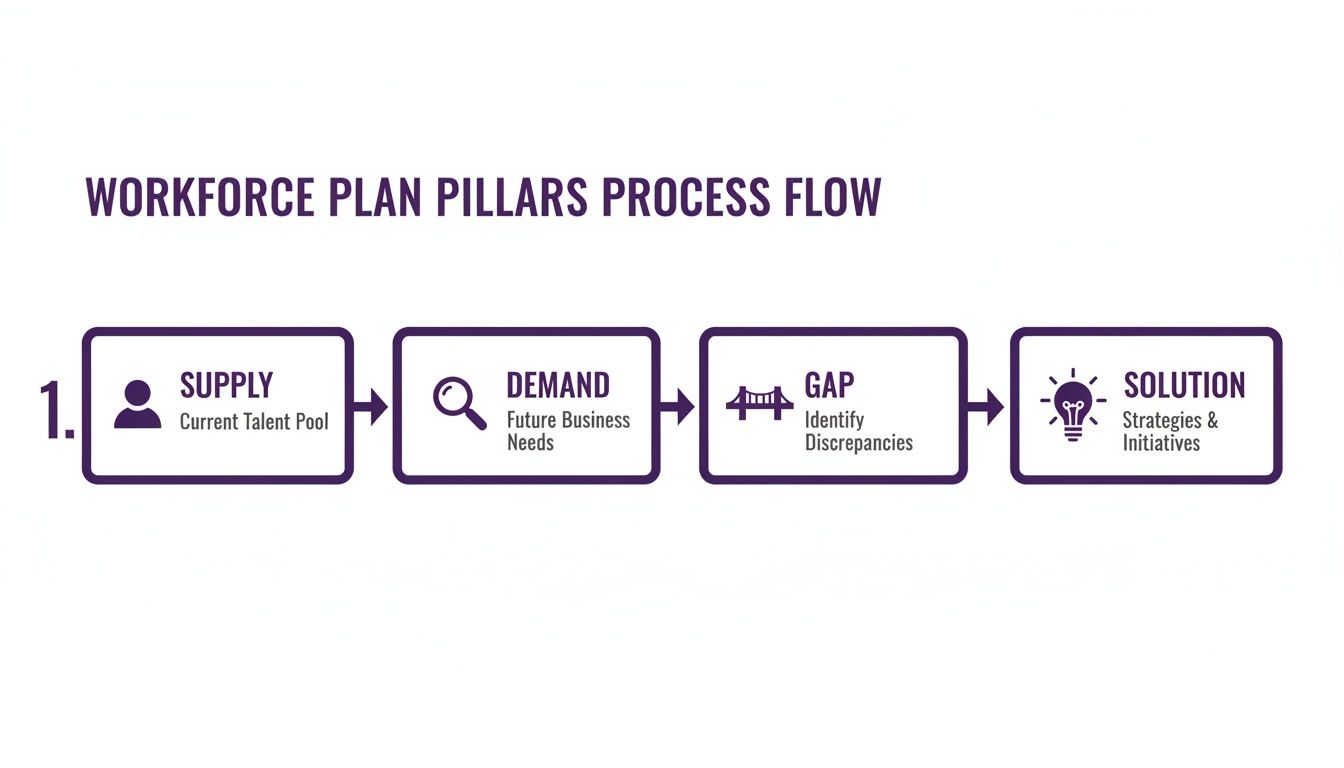
This process ensures every action you take is a logical step towards building the exact team your future business strategy requires.
Step 3: Identify and Prioritise Your Talent Gaps
Now for the moment of truth. By comparing your current supply with your future demand, you can perform a gap analysis. This is where you uncover the specific shortfalls between the workforce you have today and the one you'll need tomorrow.
You might discover a shortage of data scientists, a lack of leadership skills in your middle management, or realise you don't have enough customer service agents to handle projected growth. The trick isn't just to identify these gaps but to prioritise them based on how much they could impact your business goals.
A prioritised gap analysis is your moment of clarity. It transforms vague concerns into a concrete, actionable list of talent priorities, telling you exactly where to focus your resources for the biggest impact.
Step 4: Develop and Implement Your Action Plan
This is where you decide how you’re going to close those priority gaps. Your action plan will likely be a mix of strategies, often summed up by the classic "build, buy, or borrow" model.
- Build: Develop talent from within through targeted training, upskilling programmes, and professional development.
- Buy: Bring in new talent from the external market through strategic recruitment and hiring.
- Borrow: Use contractors, freelancers, or temporary staff to fill specific project-based needs.
For example, you might decide to "build" future leaders with a new management training programme while you "buy" specialist technical skills through a focused hiring push. A solid recruitment process is essential for any 'buy' strategy, and you can learn more about crafting one in our guide on the 8 stages of a solid recruitment process.
Step 5: Monitor, Review, and Adjust Continuously
Finally, remember that workforce planning isn't a "set it and forget it" task. It’s a continuous cycle. The business landscape changes, markets shift, and new challenges always pop up.
You need to regularly monitor your progress, keep an eye on your key metrics, and be ready to adjust your strategy on the fly. A successful plan is agile and responsive, evolving right alongside your organisation. This ongoing review ensures your workforce stays perfectly aligned with business needs, no matter what comes next.
How to Measure What Matters in Workforce Planning
A strategic workforce plan is only as good as the results it delivers. To prove its value, you need to move beyond simple headcount figures and focus on concrete Key Performance Indicators (KPIs) that business leaders truly care about. Measuring what matters allows you to connect HR initiatives directly to tangible business outcomes.
Think of it this way: you wouldn't launch a major marketing campaign without tracking leads or sales. In the same vein, you shouldn’t implement a workforce plan without measuring its impact on your talent pipeline and organisational health. This data-driven approach turns your strategy from a theoretical exercise into a compelling business case backed by hard numbers.
Key Metrics for Proving ROI
To demonstrate the real return on investment (ROI) of your planning, focus on metrics that tell a clear story about efficiency, quality, and retention. These KPIs show exactly how well your plan is addressing critical business needs and strengthening your team for whatever comes next.
Some of the most impactful metrics include:
- Quality of Hire: This measures the value a new employee brings to the table. You can track this through their performance review scores or their contribution to team goals within their first year.
- Time to Fill Critical Roles: How long does it take to fill your most important positions? A shorter time-to-fill for these roles shows your succession planning and talent pipelines are working effectively.
- Internal Promotion Rate: What percentage of your open roles are filled by current employees? A high rate is a brilliant sign that you’re developing talent well and providing clear career paths.
- Employee Turnover Rate in Key Positions: A lower turnover rate in a mission-critical department directly proves the success of your retention strategies and succession planning.
Tracking these specific KPIs is crucial. They provide the evidence you need to show that your workforce plan isn't just an HR activity—it’s a powerful driver of organisational stability and growth.
This approach is becoming standard practice in the UK. According to the Office for National Statistics, key figures like the UK employment rate, estimated at 75.0% in July–September 2025, and the vacancy count, around 723,000 in August–October 2025, are used as baseline inputs for forecasting. You can discover more about these labour market statistics from the ONS.
Ultimately, tracking the right data allows you to refine your strategy continuously. For a deeper dive into which numbers to watch, check out our guide on 15 key HR metrics you should track in 2024.
Using Technology to Power Your People Strategy
Trying to do strategic workforce planning with a bunch of spreadsheets is like navigating a motorway with a paper map from the 1990s. It’s slow, clunky, and you’re almost guaranteed to get lost. Modern HR tech isn’t a luxury anymore; it's the engine that actually drives a forward-thinking people strategy.
Tools like a Human Resource Information System (HRIS) or, more specifically, an Applicant Tracking System (ATS) handle all the heavy lifting. They shift workforce planning from a dusty, once-a-year report into a living, breathing part of your HR function. Instead of guessing, you can pull real-time data on your team's skills for your supply analysis or dig into recruitment pipelines to get a much clearer picture of what you'll need tomorrow.
Making Data-Driven Decisions Effortless
A good ATS like SeeMeHired is built to make this whole process feel seamless. It becomes the central hub for all your talent data, helping you turn those big-picture goals into concrete, actionable steps. A few features directly support your planning:
- Talent Pool Management: This lets you build a bench of pre-vetted, interested candidates for roles you know you'll need to fill. When a gap suddenly appears, you've already got a head start, dramatically cutting down your time-to-fill.
- Analytics Dashboards: Forget manually wrestling with spreadsheets to track KPIs. You can instantly see crucial metrics like where your best hires are coming from and how long it takes to hire them, helping you monitor and tweak your plan on the fly.
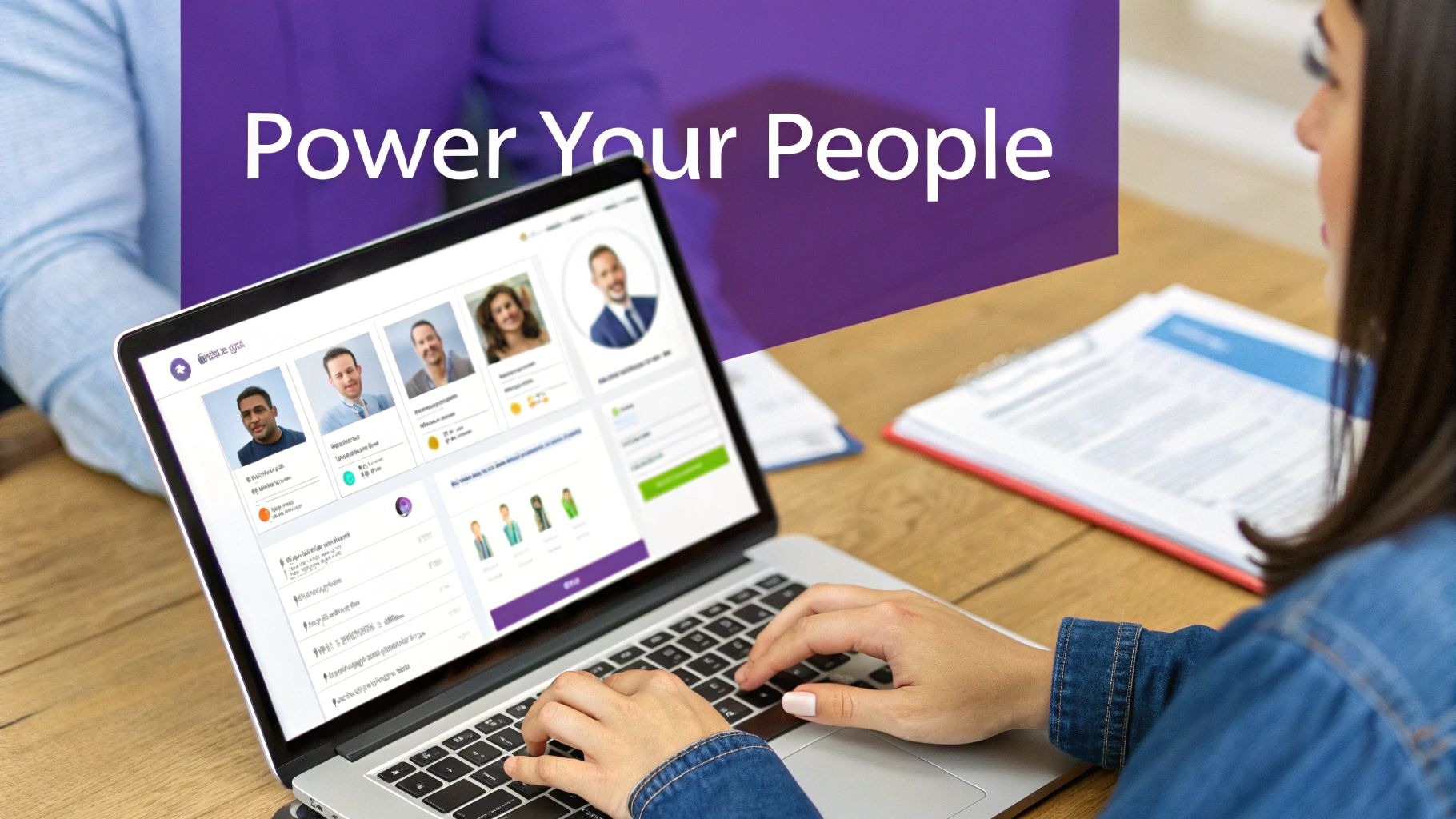
This kind of centralised view gives HR teams an immediate pulse on their recruitment pipeline—vital for both today's hiring needs and forecasting what's coming down the track.
This data-led approach is exactly how large-scale organisations operate. UK public-sector planning, for instance, relies on precise data to turn policy into headcount. A 2025 snapshot showed the Civil Service grew by 6,655 employees in a single year, with targeted increases in departments like the Ministry of Justice and HMRC. It's a perfect example of how data-driven plans become reality.
Technology makes strategic workforce planning agile, accurate, and truly impactful. It gives you the visibility needed to anticipate change and build a resilient team.
When you connect different systems, you create a powerful, unified view of your entire talent ecosystem. If you want to dive deeper into this, you might find our guide on how to automate your workflow using HR tech integrations really helpful.
Your Workforce Planning Questions, Answered
Even with the best strategy laid out, you’re bound to have questions when you start putting it into practice. Let's tackle some of the most common queries that pop up.
How Often Should We Review Our Plan?
Think of workforce planning as a living strategy, not a document you create once and file away. For most businesses, a deep-dive review should happen annually, perfectly timed with your yearly strategic planning and budgeting.
But don't just leave it at that. It's smart to schedule quarterly check-ins. These are your moments to see how you’re tracking against your goals and quickly pivot if the market throws you a curveball or your internal priorities shift.
Is Workforce Planning Only for Large Companies?
Not at all. This is a common misconception. While massive corporations might have whole departments dedicated to it, the core idea is just as vital for small and medium-sized enterprises (SMEs).
For an SME, losing just one key person unexpectedly can cause major disruption. A simple, practical workforce plan helps you see these risks coming and ensures you’ve got the talent lined up to grow without hitting roadblocks.
The essence of workforce planning—having the right people with the right skills at the right time—doesn’t change with company size. The scale is different, but its strategic importance is universal.
What Is the Difference Between Workforce Planning and Recruitment?
It's helpful to think of it like this: recruitment is a tactic, but workforce planning is the grand strategy.
Recruitment is the reactive process of filling an empty seat you have right now. Workforce planning is the proactive, bigger-picture work. It's about looking ahead to forecast the skills you'll need next year, identifying where your current team has gaps, and deciding the best way to fill them—whether that’s by hiring externally, training your existing staff, or even reorganising teams.
Simply put, recruitment is just one of many possible actions that stem from a solid workforce plan.
Ready to move your workforce planning from a manual headache to a data-backed strategy? SeeMeHired gives you the tools to analyse your talent pipeline, manage every candidate, and make smarter hiring decisions. Discover how our all-in-one ATS can power your people strategy today.