Industry Trends
Top Recruitment Marketing Ideas to Attract Talent

Ready to Revamp Your Recruitment?
Facing challenges in attracting top talent? This article offers ten effective recruitment marketing strategies to help UK businesses enhance their hiring approach. Discover how to boost your employer brand, refine your recruitment process, and secure the best candidates. These practical strategies, from employee advocacy programs and recruitment marketing automation to targeted social media campaigns and recruitment SEO, can improve your talent acquisition efforts in 2025 and beyond.
Listen to the podcast here:
1. Employee Advocacy Programs
Employee advocacy programs turn your current workforce into effective recruiters and brand ambassadors. This recruitment marketing tactic utilises the networks and trust your employees have already established, offering a more genuine and extensive alternative to traditional advertising. These programs motivate employees to share job openings, engaging company content, and their own positive work experiences across their social media channels, greatly widening your potential candidate pool, especially among passive candidates who aren't actively job hunting. This organic reach provides valuable social proof and resonates more with potential candidates than corporate messaging.

Employee advocacy programs often include social media sharing tools designed for ease of use by employees, content libraries filled with pre-approved company messages, and gamification elements like rewards and leaderboards to boost participation. Robust analytics dashboards track referral sources and engagement metrics, allowing you to assess the program's effectiveness. For organisations in sectors such as healthcare, hospitality, retail, and SMEs with in-house HR teams (up to ~1500 employees), this approach can be particularly effective.
For example, Cisco's #WeAreCisco campaign encouraged employees to share their workplace experiences, resulting in a surge of positive brand awareness. Similarly, T-Mobile launched an internal advocacy platform that generated over 1,300 social shares and 400+ job applications within the first month. Dell also empowers its workforce through their Social Media and Communities University, training employees to be effective brand ambassadors. These successes highlight the potential of employee advocacy across various sectors.
Why This Approach Deserves Its Place on the List:
For UK businesses, especially in competitive sectors like healthcare and hospitality, attracting and retaining top talent is crucial. Employee advocacy tackles this challenge by providing a cost-effective and genuine recruitment marketing strategy. Candidates referred by employees often show higher retention rates and are a better cultural fit, reducing recruitment costs and improving long-term stability. Learn more about Employee Advocacy Programs to understand how to maximise their impact.
Pros:
Higher Retention Rates: Candidates referred by employees tend to stay longer.
Extended Reach: Reaches passive candidates through trusted connections.
Cost-Effective: More economical than traditional advertising methods.
Authenticity: Provides genuine insights into company culture.
Cons:
Requires Engagement: Needs consistent employee participation to maintain momentum.
Incentive Needs: May require incentives to encourage consistent sharing.
Content Demands: Requires regular content updates to keep shared material fresh.
Culture Dependent: Can be difficult to implement in organisations with low employee satisfaction.
Actionable Tips for Success:
Simplify Sharing: Provide user-friendly social media sharing tools.
Authentic Content: Create a mix of ready-to-share content that feels personal and avoids a corporate tone.
Social Media Training: Offer training to employees who need guidance on effective social media practices.
Recognition: Publicly acknowledge and reward top advocates to encourage participation.
Fresh Content: Regularly update content and align it with current recruitment needs.
This focused approach can significantly improve your recruitment marketing strategy, helping you attract high-quality candidates in a cost-effective and genuine way.
2. Recruitment Marketing Automation
Recruitment marketing automation is reshaping modern recruitment, particularly for busy HR teams in sectors like Healthcare, Hospitality, and SMEs. It involves using technology to personalise candidate communications across multiple touchpoints, from the initial application to onboarding. This approach uses AI, machine learning, and dedicated automation tools to nurture talent pools, schedule communications, and track candidate engagement throughout the recruitment funnel, significantly boosting efficiency and improving the candidate experience.

This deserves a place on any list of top recruitment marketing ideas because it addresses key challenges faced by many organisations, including high volumes of applications, the need for consistent communication, and the demand for a positive candidate experience. Features like automated email nurture campaigns keep candidates engaged throughout the process, while chatbots provide immediate answers to common queries, freeing up your team's time. Personalised content delivery based on candidate behaviour ensures relevant information reaches the right people at the right time, fostering a stronger connection with your brand. Analytics dashboards provide invaluable data-driven insights to measure engagement metrics and optimise your strategy. Furthermore, the ability to schedule multi-channel communications (email, SMS, social) ensures maximum reach and engagement.
For example, L'Oréal’s AI-powered recruitment assistant ‘Mya’ screens candidates and answers questions 24/7, showcasing the power of automation to handle high-volume tasks. Unilever's digital recruitment process reportedly saved 50,000 hours of interviewer time, demonstrating the efficiency gains possible with this approach. Similarly, Johnson & Johnson's candidate relationship management system shows how automation can nurture talent over time, building strong pipelines for future roles. Learn more about Recruitment Marketing Automation to delve deeper into the future impact of this technology.
Pros:
Significantly reduces manual workload for recruiters, allowing them to focus on strategic activities.
Ensures consistent and timely communication with candidates, improving the overall candidate experience.
Creates personalised candidate experiences at scale, fostering stronger connections with your brand.
Improves conversion rates through the recruitment funnel, leading to more successful hires.
Provides data-driven insights for recruitment strategy optimisation.
Cons:
Requires significant initial setup and integration with existing systems.
Can feel impersonal if not properly implemented, so careful planning and personalisation are crucial.
May involve substantial technology investment, although the long-term ROI can be significant.
Needs regular content updates and maintenance to ensure relevance and accuracy.
Tips for Implementation:
Map your entire candidate journey: Before implementing automation, understand every touchpoint a candidate experiences.
Start small: Automate repetitive tasks like initial screening, follow-ups, and application acknowledgements first.
Personalise: Use dynamic content based on candidate data to tailor messages and create a more engaging experience.
Maintain the human touch: Balance automation with human touchpoints for critical interactions like interviews and offer discussions.
Test and optimise: Regularly analyse conversion data and adjust automated workflows to improve performance.
Recruitment marketing automation is particularly beneficial for UK organisations in Healthcare, Hospitality, and SMEs who often struggle with high staff turnover and competitive talent markets. By automating time-consuming tasks, these organisations can free up HR teams to focus on building relationships and finding the best talent. While there are initial setup and investment considerations, the long-term benefits in terms of efficiency, candidate experience, and data-driven decision-making make recruitment marketing automation a worthwhile investment for organisations looking to optimise their hiring processes.
3. Employer Branding Content Strategy
A robust employer branding content strategy is a valuable recruitment marketing idea, especially for UK organisations in competitive sectors like healthcare, hospitality, retail, and SMEs. It involves creating and distributing engaging multimedia content that showcases your company culture, values, and employee experience. This approach helps position your organisation as an employer of choice by telling authentic stories across multiple channels, ultimately attracting top talent and boosting your recruitment efforts. This strategy goes beyond simply advertising open roles; it's about building a desirable narrative around what it's like to work for your company.

Specifically, an employer branding content strategy might include features like a dedicated careers blog featuring employee stories, "day-in-the-life" video content showcasing real employees, a podcast series discussing company culture and industry trends, behind-the-scenes social media content revealing the workplace environment, and employee testimonials and case studies highlighting career growth opportunities within your business. For example, a restaurant could showcase its chefs discussing their favourite dishes or a care home could feature a heartwarming story about a carer's bond with a resident. These authentic glimpses into your workplace can be far more persuasive than traditional job adverts.
This approach deserves a place on this list because it addresses a crucial aspect of modern recruitment: appealing to candidates' values and desires for a positive work experience. For businesses in the UK, where competition for talent is fierce, a strong employer brand can be the differentiating factor. Learn more about Employer Branding Content Strategy to understand its full potential.
Pros:
Attracts Aligned Talent: Builds an authentic employer brand that attracts candidates whose values align with your company culture, leading to better long-term fit.
Content Repurposing: Creates a library of content that can be repurposed across various channels, maximizing your investment.
Self-Selection: Helps candidates self-select based on cultural fit, reducing time spent on unsuitable applicants.
Competitive Edge: Differentiates your organisation from competitors in the crowded talent marketplace.
Retention Benefits: Serves both recruitment and retention purposes, contributing to a positive employee experience.
Cons:
Resource Intensive: Requires consistent content creation resources (time, budget, personnel).
Delayed Results: Results may take time to manifest in recruitment metrics. This is a long-term strategy.
Coordination Efforts: Needs strategic coordination across HR, marketing, and communications teams.
Authenticity is Key: Must be authentic or risks creating expectation gaps for new hires, leading to disappointment and turnover.
Examples of Successful Implementation:
Spotify's 'Life at Spotify' blog and social media channels: Offers an authentic glimpse into their workplace culture.
Airbnb's employer brand content: Features employee stories and company values in action, resonating with potential candidates.
HubSpot's Culture Code slide deck: Publicly available, this deck has been viewed millions of times, showcasing their transparent and values-driven culture.
Actionable Tips for UK Businesses:
Content Calendar: Develop a content calendar aligned with your specific recruitment priorities and target audience. For instance, if you’re recruiting nurses in the UK, focus on content that highlights professional development opportunities and the supportive work environment.
Employee Involvement: Involve employees from various departments and levels in content creation for diverse perspectives and authentic storytelling.
Data-Driven Approach: Use data analytics to identify which content formats and topics resonate with your target candidates.
Authenticity Above All: Ensure content authentically reflects your actual workplace experience to avoid misleading potential hires.
Scalable Production: Create content templates and guidelines to maintain consistency and efficiency while scaling content production.
By implementing a thoughtful employer branding content strategy, your UK business can stand out in the competitive talent market, attract the right candidates, and build a strong employer brand that fosters both recruitment and retention.
4. Candidate Experience Optimisation
Candidate experience optimisation is a vital recruitment marketing idea, especially for UK businesses in competitive sectors like healthcare, hospitality, retail, and for SMEs managing recruitment in-house. It involves strategically enhancing every touchpoint a potential employee interacts with during the hiring process, from the initial job posting to the final decision (and even beyond). This approach treats candidates like valued customers, focusing on clear communication, streamlined applications, and personalised interactions. The ultimate goal? To create a positive and engaging experience that strengthens your employer brand and significantly boosts your conversion rates – turning applicants into hires.
For HR managers in fast-paced sectors like hospitality and retail, where high staff turnover is common, optimising the candidate experience is crucial. A smooth, quick process, like Hilton's mobile-friendly application that takes just 5 minutes to complete, can significantly reduce drop-off rates and attract talent in a competitive market. Similarly, for healthcare and care organisations, where attracting qualified and compassionate individuals is essential, a positive candidate experience can differentiate your brand and build a strong reputation.
Learn more about Candidate Experience Optimisation
This approach boasts features such as mobile-optimised application processes, clear communication regarding timelines and expectations, personalised feedback mechanisms, self-scheduling interview tools, candidate journey mapping, and regular communication touchpoints. These elements work together to create a seamless and respectful journey for each applicant.
Why is Candidate Experience Optimisation so important for recruitment marketing?
In today’s digitally connected world, candidates readily share their experiences online. A negative encounter can damage your employer brand and deter future applicants, impacting your ability to attract top talent. Conversely, a positive candidate experience creates brand advocates, even among those who aren't ultimately hired. They're more likely to recommend your company to others and even become customers, especially pertinent for B2C businesses.
Pros:
Creates positive brand advocates even among rejected candidates
Reduces candidate drop-off rates during the application process
Improves quality of hire through better candidate self-selection
Enhances employer brand reputation on review platforms (like Glassdoor)
Can convert candidates into customers (particularly relevant for B2C businesses)
Cons:
Requires coordination across multiple departments and systems
May necessitate significant changes to existing recruitment processes
Demands consistent execution from all team members involved in recruiting
Needs regular investment in technology and process improvements
Examples of Successful Implementation:
Virgin Media recognised that a poor candidate experience was costing them £5 million annually in lost customers and consequently overhauled their approach.
Hilton’s simplified application process can be completed on a mobile device in just 5 minutes.
Microsoft utilises a candidate experience platform that provides real-time updates and personalised content.
Actionable Tips for UK Businesses:
Conduct regular candidate experience surveys: Identify pain points and areas for improvement directly from applicants.
Test your application process yourself: Experience the process firsthand to uncover any friction points or confusing steps.
Create candidate personas: Design targeted experiences that resonate with your ideal candidates.
Implement automated but personalised status updates: Keep candidates informed throughout the process without adding to your workload.
Train all interviewers on consistent messaging and candidate treatment: Ensure everyone involved in the hiring process delivers a cohesive and positive experience.
By embracing candidate experience optimisation as a core recruitment marketing strategy, your UK business can attract, engage, and convert top talent, ultimately contributing to a stronger, more successful organisation.
5. Recruitment SEO and Content Marketing
Recruitment SEO and content marketing is a powerful yet often overlooked strategy for attracting top talent in today's competitive job market. It involves optimising your online presence – specifically your careers site, job descriptions, and related content – to rank higher in search engine results pages (SERPs) like Google when potential candidates in the UK are actively searching for job opportunities. This approach employs the principles of search engine optimisation (SEO) and content marketing to create a sustainable pipeline of qualified applicants.
Instead of relying solely on costly paid advertising or job boards, recruitment SEO and content marketing focuses on attracting candidates who are already interested in positions like yours. They're actively searching for keywords related to your industry, role, or location, making them highly qualified leads. This proactive approach draws in individuals who are genuinely interested in your company and its offerings, resulting in higher quality applicants through self-selection.
How it Works:
This strategy hinges on understanding what your ideal candidates are searching for online. Through keyword research, you can identify the terms and phrases they use when looking for jobs. This information is then used to optimise your careers site and create targeted content that resonates with their search intent. Technical aspects of SEO, such as site structure and page load speed, are also addressed to ensure your content is easily discoverable by both search engines and potential candidates.
Features and Benefits:
Keyword-optimised job descriptions and career pages: Improves visibility in search results for specific job titles and locations.
Long-form content addressing industry and career questions: Positions your company as a thought leader and attracts candidates interested in your expertise. This might include blog posts about career paths in your industry, advice on specific skills, or interviews with current employees.
Technical SEO improvements to careers site structure: Ensures a positive user experience and makes it easier for search engines to crawl and index your content.
Location-based landing pages for regional recruitment: Targets candidates searching for jobs in specific UK locations like London, Manchester, or Birmingham. For example, a hotel chain could create dedicated pages for "hotel jobs in London" or "restaurant jobs in Edinburgh".
Structured data markup for job postings: Allows search engines to understand the context of your job postings, leading to richer search results with key details like salary and location displayed directly in SERPs.
Backlink building strategy for careers content: Increases the authority and visibility of your careers site.
Pros:
Attracts candidates already interested in positions like yours: Improves the quality and relevance of applications.
Creates sustainable, long-term candidate pipelines: Reduces reliance on reactive recruitment methods.
Reduces dependency on paid recruitment channels: Lowers recruitment costs over time.
Provides valuable analytics on candidate search behaviour: Offers insights into what candidates are looking for, enabling you to refine your recruitment strategy.
Often results in higher quality applicants through self-selection: Candidates are more likely to be a good fit for your company culture.
Cons:
Takes time to see significant results (typically 3-6 months): SEO is a long-term strategy.
Requires specialised SEO knowledge or resources: You may need to invest in training or hire an SEO consultant.
Needs ongoing content creation and optimisation: Maintaining visibility requires consistent effort.
Competitive keywords may be difficult to rank for initially: Patience and a strategic approach are essential.
Examples of Success:
- Major companies like Home Depot have leveraged location-specific landing pages to dominate local job searches. IBM's developer-focused content attracts technical talent while simultaneously serving as recruitment material. Deloitte's career advice content ranks for industry-specific search terms, showcasing their expertise and attracting potential hires.
Actionable Tips for UK Businesses:
Research keywords: Use tools like Google Keyword Planner to identify the terms your target candidates are using. Focus on location-based keywords relevant to the UK, such as "nursing jobs in Bristol" or "chef jobs in Glasgow".
Create dedicated landing pages: Develop specific pages for different roles and locations within the UK.
Implement schema markup: Use structured data to enhance your job postings in search results.
Optimise page load speed and mobile experience: Ensure your careers site is accessible and user-friendly on all devices.
Focus on creating genuinely helpful content: Answer candidate questions and provide valuable insights into your industry and company culture.
Track organic traffic and application conversions: Measure the ROI of your SEO efforts.
Learn more about Recruitment SEO and Content Marketing
Recruitment SEO and content marketing deserve a place on this list because they offer a sustainable, cost-effective way to attract high-quality candidates who are actively searching for opportunities like yours. For UK businesses in competitive sectors like healthcare, hospitality, and retail, this approach can be particularly valuable for building robust talent pipelines and reducing recruitment costs in the long run. Especially for smaller to mid-sized enterprises with in-house HR teams, mastering these techniques can level the playing field against larger competitors and attract the best talent in their respective regions.
6. Programmatic Recruitment Advertising: Boost Your Hiring with AI
Programmatic recruitment advertising is revolutionising how organisations find and attract top talent. This data-driven approach uses AI and machine learning to automate and optimise job ad placements across a wide network of online platforms. In essence, it's like having a highly efficient, always-on recruitment marketing assistant working tirelessly to connect your open roles with the right candidates. This makes it a powerful recruitment marketing idea, particularly for UK businesses facing competitive hiring landscapes.
For healthcare organisations struggling to fill critical roles, hospitality businesses seeking seasonal staff, retail stores expanding their teams, and SMEs with limited HR resources, programmatic advertising offers a scalable and efficient solution. Instead of manually posting jobs across multiple sites and managing bids, the system handles it all automatically, allowing you to focus on other crucial aspects of HR.
How it Works:
Programmatic recruitment advertising uses real-time bidding (RTB) to secure ad placements on job boards, social media platforms, and other websites. Think of it as an auction where your job ad competes with others for visibility. However, instead of you manually placing bids, the AI-powered system does it for you, based on factors like candidate demographics, browsing behaviour, and the performance of previous ads. This ensures your budget is spent effectively, targeting the most relevant audiences and maximising your return on investment (ROI).
Features and Benefits:
Real-time bidding and budget allocation: The system continuously analyses performance metrics and adjusts bids in real-time, ensuring your budget is used most effectively.
Sophisticated targeting: Target specific candidate profiles based on demographics, skills, interests, and even online behaviour. This precision targeting is crucial for reaching niche talent pools.
A/B testing: Experiment with different ad creatives and job description formats to see what resonates best with potential candidates.
Cross-device tracking and attribution: Track candidates across multiple devices, from initial impression to application, providing valuable insights into campaign effectiveness.
Predictive analytics: The system uses historical data to predict future campaign performance, enabling you to make proactive adjustments and optimise your strategy.
Examples of Success:
FedEx: By implementing programmatic advertising with Appcast, FedEx reduced its cost-per-hire by 30%, demonstrating the significant cost savings potential.
Uber: Their global programmatic recruitment strategy effectively reaches drivers across diverse markets, highlighting the scalability of this approach.
PepsiCo: A targeted campaign reduced PepsiCo's cost-per-application by 50% while increasing the quality of applicants, proving the power of programmatic for achieving both efficiency and effectiveness.
Pros:
Maximises ROI: Data-driven optimisation ensures your budget is spent effectively.
Broad reach with unified management: Manage campaigns across multiple platforms from a single dashboard.
Reduced cost-per-application: Continuous optimisation lowers your recruitment costs.
Precise targeting: Reach even the most niche candidate segments.
Comprehensive analytics: Gain valuable insights into your recruitment marketing performance.
Cons:
Technical expertise: Requires specialised knowledge or partnership with a vendor.
Setup costs: Initial setup and platform fees can be substantial.
Potential impersonality: Requires careful balancing with human-centred approaches to avoid feeling impersonal.
Data privacy: Strict adherence to data privacy regulations is essential.
Actionable Tips for UK Businesses:
Define clear goals: Determine whether you're prioritising volume or quality of applicants for each role.
Accurate tracking: Ensure your Applicant Tracking System (ATS) can accurately track source attribution.
Test ad creatives: Experiment with different ad formats and job descriptions.
Conversion tracking: Set up proper conversion tracking from initial impression to hire.
Regular evaluation: Re-evaluate performance benchmarks as market conditions change.
Targeted audience: Look beyond keywords to target candidates based on behaviour and interests.
When and Why to Use Programmatic Recruitment Advertising:
Programmatic recruitment advertising is particularly beneficial when:
You’re hiring for high-volume roles.
You need to reach niche or hard-to-find candidates.
You want to improve your recruitment marketing ROI.
You need to streamline your recruitment process and free up HR resources.
By embracing this technology, UK businesses can gain a significant advantage in the talent acquisition landscape. While it requires careful planning and execution, the potential benefits of programmatic recruitment advertising make it a valuable addition to any recruitment marketing strategy.
7. Recruitment Marketing Analytics Framework
In today's competitive hiring landscape, simply posting job ads isn't enough. A Recruitment Marketing Analytics Framework is a crucial recruitment marketing idea, especially for UK Healthcare organisations, Hospitality businesses, and SMEs, where attracting and retaining talent is paramount. This data-driven approach provides the insights needed to optimise your recruitment process, improve your return on investment, and ultimately hire the best candidates. It deserves its place on this list because it transforms recruitment from a reactive process to a proactive, strategic function.
Essentially, a Recruitment Marketing Analytics Framework involves systematically collecting, analysing, and acting upon data throughout the entire recruitment funnel – from initial awareness to application to hire. Think of it as applying the principles of a marketing sales funnel to your recruitment efforts. By tracking key metrics at each stage, you can pinpoint bottlenecks, identify the most effective channels, and improve conversion rates, leading to better hires and a more efficient process.
How it Works:
This framework treats your recruitment process as a measurable journey. Imagine a candidate first learning about your company through a social media post, then visiting your careers page, and finally submitting an application. A robust analytics framework tracks each of these touchpoints, providing valuable data on candidate behaviour.
Features of a Comprehensive Framework:
Comprehensive recruitment funnel tracking and visualisation: See exactly where candidates are dropping off in the process.
Multi-touch attribution modelling for source effectiveness: Understand which channels are driving the most qualified applicants, whether it's LinkedIn, Indeed, or a specific recruitment agency.
Conversion rate analysis for each stage of the application process: Identify friction points in your application form or interview process.
Channel performance comparisons with ROI calculations: Determine which recruitment channels offer the best return on your investment.
Predictive analytics for forecasting hiring needs and outcomes: Anticipate future staffing needs and proactively adjust your recruitment strategies, especially crucial for seasonal hiring in retail and hospitality.
A/B testing framework for recruitment marketing elements: Experiment with different job ad copy, visuals, or application processes to optimise conversion rates.
Pros:
Data-driven decision making: Base your recruitment marketing investments on concrete data, not guesswork.
Bottleneck identification: Pinpoint specific areas for improvement within the recruitment process.
Accurate metric calculation: Accurately calculate vital metrics like cost-per-hire and time-to-fill.
Budget justification: Provide concrete evidence to justify your recruitment marketing budget allocation.
Continuous improvement: Enable ongoing optimisation through systematic testing.
Cons:
Integration challenges: Requires integrating data from multiple sources and systems.
Analytical expertise: Needs skilled analysts to interpret the data correctly.
Technology investment: May require investment in analytics platforms and tools.
Over-optimisation risk: Focusing solely on data can sometimes negatively impact the candidate experience.
Examples of Successful Implementation:
IBM reduced cost-per-hire by 25% through channel optimisation driven by data analysis.
Microsoft identified specific drop-off points in their application process using an analytics framework.
Walmart utilises predictive analytics for more efficient seasonal hiring.
Actionable Tips for UK Businesses:
Identify Key Performance Indicators (KPIs): Start by defining what success looks like at each stage of the funnel (e.g., application completion rate, interview-to-offer ratio).
Implement UTM Tracking: Use UTM parameters on all your recruitment marketing links to accurately track source effectiveness.
Regular Reporting: Set up a regular reporting cadence with actionable insights, not just raw data.
Benchmarking: Compare your performance against industry standards to identify areas for improvement.
Accessible Dashboards: Create dashboards that are easy to understand and accessible to stakeholders across recruitment and marketing teams.
A/B Test Strategically: Test one variable at a time for clear, actionable results.
When and Why to Use This Approach:
A Recruitment Marketing Analytics Framework is particularly valuable when:
You're struggling to attract qualified candidates.
Your cost-per-hire is too high.
Your time-to-fill is too long.
You want to optimise your recruitment marketing budget.
You're looking to make data-driven decisions about your recruitment strategy.
While setting up a comprehensive framework may require an initial investment of time and resources, the long-term benefits for UK businesses, especially in competitive sectors like healthcare and hospitality, are significant. By leveraging data, you can build a more efficient, effective, and ultimately successful recruitment process. Popularised by research from Lighthouse Research & Advisory, Bersin by Deloitte, and adapted from tools like Google Analytics, this framework is becoming the industry standard for modern recruitment.
8. Recruitment Event Marketing & Virtual Experiences
Recruitment event marketing offers a way to engage potential candidates in interactive experiences, going beyond traditional job postings. This approach involves strategically planning, promoting, and executing both in-person and virtual events, creating memorable touchpoints in the candidate journey. This method deserves a place on this list because it provides a dynamic way to build relationships with prospective hires, showcase company culture, and access a broader talent pool. It's particularly valuable as a recruitment marketing idea because it creates two-way communication and fosters a sense of community around your employer brand.
How it Works:
Recruitment event marketing has evolved to include sophisticated virtual and hybrid events. These combine the reach of digital platforms with the engagement of personal interaction. Virtual career fairs, webinars, online Q&A sessions, and even virtual office tours allow potential candidates to experience your organisation firsthand. Hybrid events offer a blend of in-person and virtual elements, catering to a wider audience and offering flexibility. For UK businesses, this offers an attractive solution to connect with talent across the country, regardless of location.
Features and Benefits:
Virtual Career Fairs: Interactive booths and video chats allow candidates to "meet" recruiters and hiring managers in a digital space.
Webinar Series: Showcase company culture, career paths, and employee testimonials, providing valuable insights into your organisation.
Hybrid Recruiting Events: Combine the best of both worlds, offering in-person networking opportunities alongside virtual access for a broader audience.
Interactive Q&A Sessions: Enable candidates to directly interact with current employees, gaining authentic perspectives on the work environment.
Virtual Office Tours & Day-in-the-Life Experiences: Offer immersive glimpses into the workplace, fostering a sense of connection and transparency.
Gamified Assessment Challenges: Engage candidates through interactive challenges during events, adding an element of fun and identifying potential skills.
Pros:
Direct Engagement with Passive Candidates: Events, especially virtual ones, can attract individuals who aren't actively job searching but are open to exploring new opportunities.
Authentic Showcase of Company Culture: Events provide a platform to showcase your company's values and personality in a more engaging way than traditional job descriptions.
Increased Reach: Virtual components eliminate geographical limitations, expanding your talent pool significantly.
Team Interaction: Candidates can connect with potential teammates, not just recruiters, providing a more holistic view of the company.
Repurposable Content: Recordings and materials from events can be repurposed for other marketing channels, maximising your investment.
Cons:
Resource Intensive: Planning and promoting events require significant resources, including time, budget, and personnel.
Technology Dependence: Technical glitches can negatively impact the candidate experience, so thorough testing is essential.
Potential for Reduced Personal Connection (Virtual Events): While virtual events offer many advantages, they may lack the face-to-face connection of in-person interactions.
Promotion is Key: Success depends on effective promotion to ensure adequate attendance.
Examples of Successful Implementation:
Amazon's virtual career day attracted over 300,000 attendees globally, demonstrating the vast reach of these events.
Deloitte's virtual reality office tours provide an innovative way for candidates to experience their workplace remotely.
General Mills' webinar series featuring employees from diverse backgrounds discussing their career journeys provides valuable insights into the company culture.
Actionable Tips for UK Businesses:
Multi-Channel Promotion: Leverage social media, email marketing, industry-specific job boards, and partnerships with universities or professional organisations to promote your events. Consider targeted advertising campaigns on platforms like LinkedIn to reach specific candidate profiles within the UK.
Value-Added Content: Offer educational content, networking opportunities, or CV workshops alongside recruitment information to enhance the attendee experience.
Thorough Technology Testing: Test all platforms and equipment well in advance to avoid technical issues during live events.
Data Capture & Nurturing: Capture attendee data for follow-up communication and nurture leads through targeted email campaigns.
On-Demand Content: Record sessions and make them available on-demand to extend the event's reach and lifespan.
Employee Training: Prepare participating employees with key messaging and engagement techniques to ensure a consistent and positive candidate experience.
When and Why to Use This Approach:
Recruitment event marketing is particularly beneficial when:
Targeting passive candidates: Reaching individuals not actively seeking new roles.
Building employer brand: Strengthening your reputation and attracting top talent.
Filling niche or hard-to-fill roles: Accessing a wider pool of specialised candidates.
Showcasing company culture: Providing a tangible experience of your work environment.
By strategically planning and executing recruitment event marketing, UK businesses, from healthcare organisations to hospitality and retail, can engage potential candidates in a meaningful way, building a strong talent pipeline and fostering a positive employer brand.
9. Targeted Social Media Recruitment Campaigns
In today's competitive recruitment landscape, simply posting job ads on traditional job boards is no longer enough. Targeted social media recruitment campaigns offer a way to reach the right candidates where they already spend their time – online. This recruitment marketing idea uses the advanced audience segmentation and targeting capabilities of social platforms like LinkedIn, Instagram, TikTok, and Facebook to connect with specific candidate profiles using tailored messaging. This approach goes beyond basic job postings and focuses on creating engaging, multi-format content campaigns that resonate with potential hires based on their interests, behaviours, qualifications, and career aspirations.
This method deserves a place on this list of recruitment marketing ideas because it offers access to both active and passive job seekers. For UK businesses, particularly in sectors like healthcare, hospitality, and SMEs with in-house HR teams, it’s a cost-effective and efficient way to expand reach and attract top talent.
How it Works:
Targeted social media recruitment campaigns involve identifying your ideal candidate persona and then using social platform advertising tools to define your target audience. You can specify parameters like skills, education, location (crucial for UK-based recruitment), interests, job titles, and even company affiliations. Once your audience is defined, you can create compelling content specifically designed to resonate with them. This could include video testimonials from current employees, behind-the-scenes glimpses into company culture, interactive polls, and of course, targeted job ads.
Features and Benefits:
Platform-Specific Content Strategies: Tailoring content to each platform (LinkedIn for professionals, Instagram for visual storytelling, TikTok for engaging Gen Z) ensures maximum impact.
Hyper-Targeting: Define your audience with laser precision based on a wide range of criteria, something traditional job boards often lack.
Dynamic Ad Formats: Utilise videos, carousel ads, and interactive content to capture attention and encourage engagement.
Retargeting: Re-engage individuals who have previously interacted with your career site or social media content.
Employee Advocacy: Leverage employee takeovers and behind-the-scenes content to showcase your company culture authentically.
Social Listening: Monitor conversations and hashtags relevant to your industry and target audience to identify potential candidates and understand their needs.
Examples of Successful Implementation:
Goldman Sachs: Successfully targeted Gen Z financial talent on TikTok using creative video content showcasing their company culture and career opportunities.
Shopify: Attracted distributed talent by showcasing their remote work culture through engaging Instagram Stories.
Microsoft: Ran LinkedIn campaigns targeting women in tech, featuring inspiring stories of current female engineers.
Pros:
Reach Passive Candidates: Connect with individuals who aren't actively searching job boards but might be open to new opportunities.
Highly Specific Targeting: Reach precisely the candidates you're looking for, increasing the quality of applications.
Multiple Touchpoints: Create a consistent presence in a candidate's social experience, building familiarity and trust.
Rich Analytics: Gain valuable insights into audience demographics and campaign performance for continuous optimisation.
Adaptability: Quickly adjust campaigns to respond to changing recruitment needs and market conditions.
Cons:
Platform Expertise: Requires platform-specific content creation and understanding of each platform’s advertising tools.
Algorithm Changes: Social media algorithms can impact organic reach and campaign performance.
Privacy Concerns: Be mindful of data privacy regulations and targeting limitations, particularly within the UK and GDPR.
Ongoing Management: Campaigns require consistent monitoring, analysis, and optimisation for best results.
Actionable Tips for UK Businesses:
Create Platform-Native Content: Avoid cross-posting the same content everywhere. Tailor your messaging and format for each platform.
Custom and Lookalike Audiences: Leverage data to build custom audiences based on your current top performers and use lookalike audiences to expand your reach.
A/B Testing: Experiment with different ad creatives and messaging to identify what resonates best with each target segment.
Pixel Tracking: Implement pixel tracking to measure full-funnel conversion metrics, from initial click to application submission.
Employee-Generated Content: Encourage employees to share their experiences and create authentic content that showcases your company culture.
Balance Branding and Promotion: Balance employer branding content with direct job promotions to build long-term relationships with potential candidates.
When and Why to Use This Approach:
Targeted social media recruitment campaigns are particularly effective when:
Targeting niche skills or specific demographics: Ideal for roles requiring specialised expertise or when focusing on diversity and inclusion initiatives.
Building employer brand awareness: Establish your company as a desirable place to work and attract passive candidates.
Reaching a younger demographic: Essential for connecting with Gen Z and Millennials who are highly active on social media.
Promoting remote or flexible work opportunities: Showcase your company's work-life balance and attract talent across the UK.
By implementing a well-planned and targeted social media recruitment strategy, UK businesses in healthcare, hospitality, retail, and other sectors can effectively connect with top talent, build a strong employer brand, and improve their overall recruitment outcomes.
10. Recruitment Tech Stack Integration: Streamline Your Talent Acquisition
Recruitment marketing ideas are constantly evolving, and one that's gaining significant traction, particularly for growing businesses in the UK, is Recruitment Tech Stack Integration. This involves strategically selecting, implementing, and connecting various recruitment technologies to create a seamless, data-driven talent acquisition ecosystem. It’s about building an integrated technology infrastructure that supports your entire recruitment marketing and hiring process, from initial candidate attraction to onboarding. This approach is crucial for organisations looking to enhance their recruitment marketing efforts and gain a competitive edge, especially in competitive sectors like healthcare, hospitality, and for SMEs with in-house HR teams.
How it Works:
Imagine your Applicant Tracking System (ATS), Customer Relationship Management (CRM) system, and marketing platforms (like social media scheduling tools and job boards) all talking to each other seamlessly. That’s the essence of recruitment tech stack integration. It eliminates data silos, enabling advanced analytics, automation, and a significantly improved candidate experience.
Features of a Well-Integrated Tech Stack:
API-based integration: Connects different systems, allowing them to share data automatically.
Centralised candidate data repository: Creates unified candidate profiles, eliminating duplicate entries and providing a holistic view of each applicant.
Automated workflow triggers: Automates tasks like sending interview invitations or rejection emails based on pre-defined criteria.
Cross-platform analytics and reporting dashboards: Provides a comprehensive overview of recruitment performance metrics across all platforms.
Single sign-on capabilities: Simplifies access for both recruiters and candidates.
Custom integration development: Allows for tailored solutions for proprietary systems.
Why This Approach Deserves a Place in the List:
In today’s competitive talent market, attracting and retaining top talent is crucial. A disjointed recruitment process filled with manual tasks and fragmented data is a recipe for inefficiency and a poor candidate experience. Tech stack integration solves these challenges by streamlining workflows, automating repetitive tasks, and providing valuable insights into the effectiveness of your recruitment marketing strategies. This is particularly beneficial for UK businesses in sectors like healthcare and hospitality, which often face high staff turnover and require efficient recruitment processes.
Pros:
Unified candidate journey: Creates a seamless and positive experience for candidates across all touchpoints.
Comprehensive analytics: Enables data-driven decision-making through detailed insights into the entire recruitment funnel.
Reduced manual data entry: Minimises errors and frees up recruiter time for more strategic activities.
Advanced automation and personalisation: Allows for targeted messaging and automated workflows.
Improved recruiter efficiency and candidate experience: Streamlines processes and enhances communication.
Cons:
Technical resources and expertise: Requires skilled professionals to manage the integration process.
Initial investment and ongoing maintenance: Can be costly to implement and maintain.
Internal IT roadblocks: Integration projects may face resistance from internal IT departments.
Periodic re-integration efforts: Technology changes may require adjustments to the integrated system.
Examples of Successful Implementation:
Johnson & Johnson's integrated talent acquisition ecosystem connects multiple vendors through a unified data model.
Siemens' global tech stack transformation consolidated 14 different ATS systems.
Salesforce utilises its own CRM technology for recruitment marketing.
Actionable Tips for UK Businesses:
Map your candidate journey: Start by understanding your current process and identify areas for improvement.
Prioritise integration points: Focus on integrations that offer the highest ROI and impact on candidate experience.
Consider middleware: If direct integrations aren't available, explore middleware solutions to bridge the gap between systems.
Data governance and security: Implement robust practices to protect sensitive candidate data.
Plan for scalability: Ensure your integrated stack can accommodate future growth and technology additions.
Involve recruiters: Include your recruitment team in the planning process to ensure user adoption and gather valuable feedback.
Popularised By:
Talent Tech Labs' ecosystem mapping and integration frameworks
iCIMS' talent cloud integration approach
Workday's unified HCM and recruitment platform
By embracing recruitment tech stack integration, your organisation can optimise its talent acquisition strategy, improve the candidate experience, and gain a competitive advantage in the UK market. This is especially relevant for time-strapped HR teams in SMEs and fast-paced industries like healthcare and hospitality, where efficient recruitment is crucial.
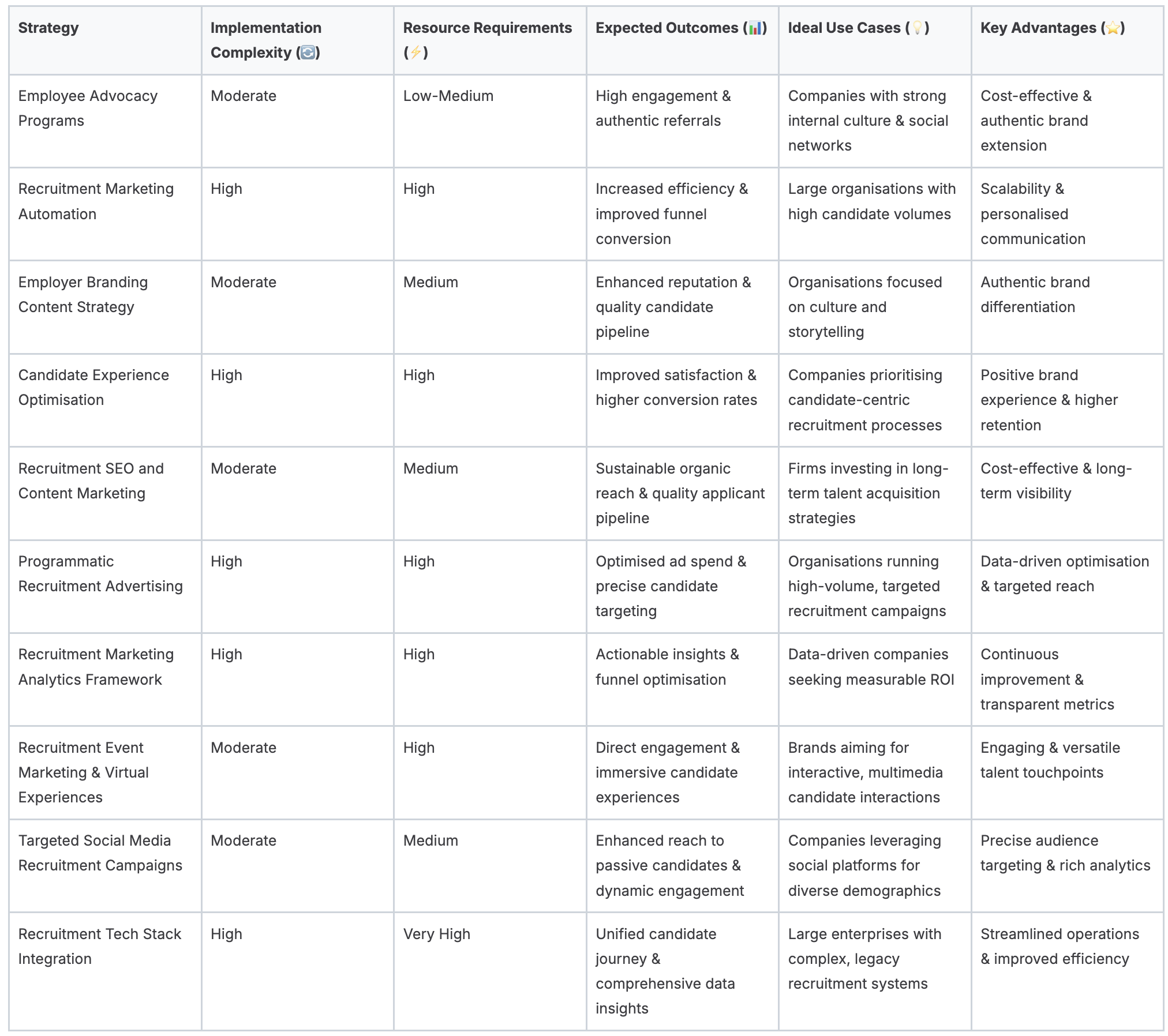
Top 10 Recruitment Marketing Strategies Comparison
Elevate Your Recruitment Marketing with SeeMeHired
This article has explored ten powerful recruitment marketing ideas, from leveraging employee advocacy and automating processes to optimising your candidate experience and using targeted social media campaigns. Mastering these strategies is crucial in today's competitive hiring landscape, particularly for UK healthcare organisations, hospitality businesses, and SMEs. By implementing these recruitment marketing ideas, you can not only attract top talent but also build a strong employer brand, reduce time-to-hire, and improve your overall return on investment. These improvements ultimately contribute to a more efficient, effective, and successful recruitment process, leading to a stronger, more dynamic team and a thriving business.
From creating engaging employer branding content to implementing a robust recruitment marketing analytics framework, each element plays a vital role in attracting, engaging, and converting potential candidates. Remember, the key takeaway here is integration. A disjointed approach can lead to wasted resources and missed opportunities. By embracing a comprehensive recruitment marketing strategy, you can ensure all your efforts work together seamlessly to achieve your hiring goals.
Ready to simplify your recruitment marketing and transform your hiring process? SeeMeHired's comprehensive applicant tracking system (ATS) integrates the recruitment marketing tools and strategies discussed above into one platform, perfect for streamlining your workflow and enhancing your candidate experience. Visit SeeMeHired today and discover how we can help you hire smarter, not harder.