Hiring Statistics
How an Applicant Tracking System Works for Smarter Hiring

Ever tried managing a flood of job applications using nothing but your email inbox and a trusty spreadsheet? It’s a recipe for chaos. An applicant tracking system (ATS) steps in to act as your central command centre for absolutely everything hiring-related. It's less of a simple database and more like a smart assistant, automating the entire recruitment journey from the moment you post a job to the day you welcome your new hire.
Listen to the podcast here:
What Exactly Is an Applicant Tracking System?
At its heart, an applicant tracking system is a piece of software built to take the headache out of hiring. It gathers every application in one place, organises candidate details into neat, standardised profiles, and helps you pinpoint the best talent without getting buried in admin.
Essentially, an ATS transforms hiring from a manual, often messy, chore into a structured, strategic process. It gives recruiters and hiring managers a single, organised platform to manage every stage of the pipeline, preventing great candidates from getting lost in overflowing inboxes and ensuring everyone gets a consistent, professional experience. By taking care of the repetitive tasks, it frees up your HR team to focus on what really matters: talking to top candidates and making brilliant hiring decisions.
From Filing Cabinets to Cloud Software
The idea of tracking applicants isn't new, but the technology has come a very long way. Here in the UK, what started as simple CV databases in the early 2000s has blossomed into sophisticated recruitment platforms that are finely tuned to our local labour laws and data protection rules.
The UK ATS software market was valued at around USD 71.17 million in 2023 and is projected to grow at a 5.19% CAGR through to 2033. This growth is largely pushed by heavily regulated sectors like healthcare and finance, which need rock-solid audit trails for compliance. This isn't just a niche trend; it's a fundamental shift. An ATS is no longer a luxury for giant corporations but an essential tool for any company wanting to hire smarter.
If you're keen to dig deeper, our detailed guide explains more about what an applicant tracking system is and how it can help your business.
The Real-World Impact on Hiring
To really get your head around how an ATS works, it helps to see the stark contrast between the old way of hiring and the new. A modern system brings efficiency to every single step, creating a far smoother ride for both your hiring team and your applicants.
An ATS serves as the backbone of modern recruitment, automating the administrative burdens so that human connection—the very heart of hiring—can take centre stage. It’s about working smarter, not harder.
The table below really brings this to life, showing just how an ATS solves the most common headaches in the recruitment journey.
The Recruitment Journey Before and After an ATS
Take a look at how daily recruitment tasks change with the right system in place. The difference is night and day, moving from slow, error-prone manual work to fast, automated efficiency.
| Hiring Stage | Manual Process (Without an ATS) | Automated Process (With an ATS) |
|---|---|---|
| Job Posting | Manually posting on each job board one by one—a time-consuming and error-prone task. | Distributing the job advert to multiple job boards and social media channels with a single click. |
| Application Capture | Sifting through countless emails, downloading attachments, and manually entering data into spreadsheets. | Automatically collecting and parsing all applications into consistent, searchable candidate profiles. |
| Screening | Reading every single CV to find candidates who meet the basic qualifications, which often takes hours. | Using keyword filters and screening questions to instantly shortlist the most relevant applicants. |
| Communication | Juggling email threads to schedule interviews and provide updates, leading to delays and inconsistency. | Sending automated, templated emails for acknowledgements, updates, and interview scheduling. |
As you can see, the benefits go far beyond just saving time. An ATS introduces a level of organisation and consistency that’s nearly impossible to achieve manually, improving the experience for everyone involved.
The ATS Workflow From Job Post to Job Offer
To really get your head around how an applicant tracking system works, let's walk through the entire journey, from the moment you post a job to the day you make an offer. Think of the ATS as a digital production line for your recruitment. Each stage is designed to take a raw application and methodically turn it into a successful hire, cutting out the usual chaos and admin headaches along the way.
This structured process means no candidate ever falls through the cracks and every step is handled with the same level of care. It’s the engine of the system, transforming a messy, complicated process into a series of simple, manageable stages.
This flow chart gives you a bird's-eye view of the core ATS process, showing how it captures, screens, and moves candidates through a clear pipeline.
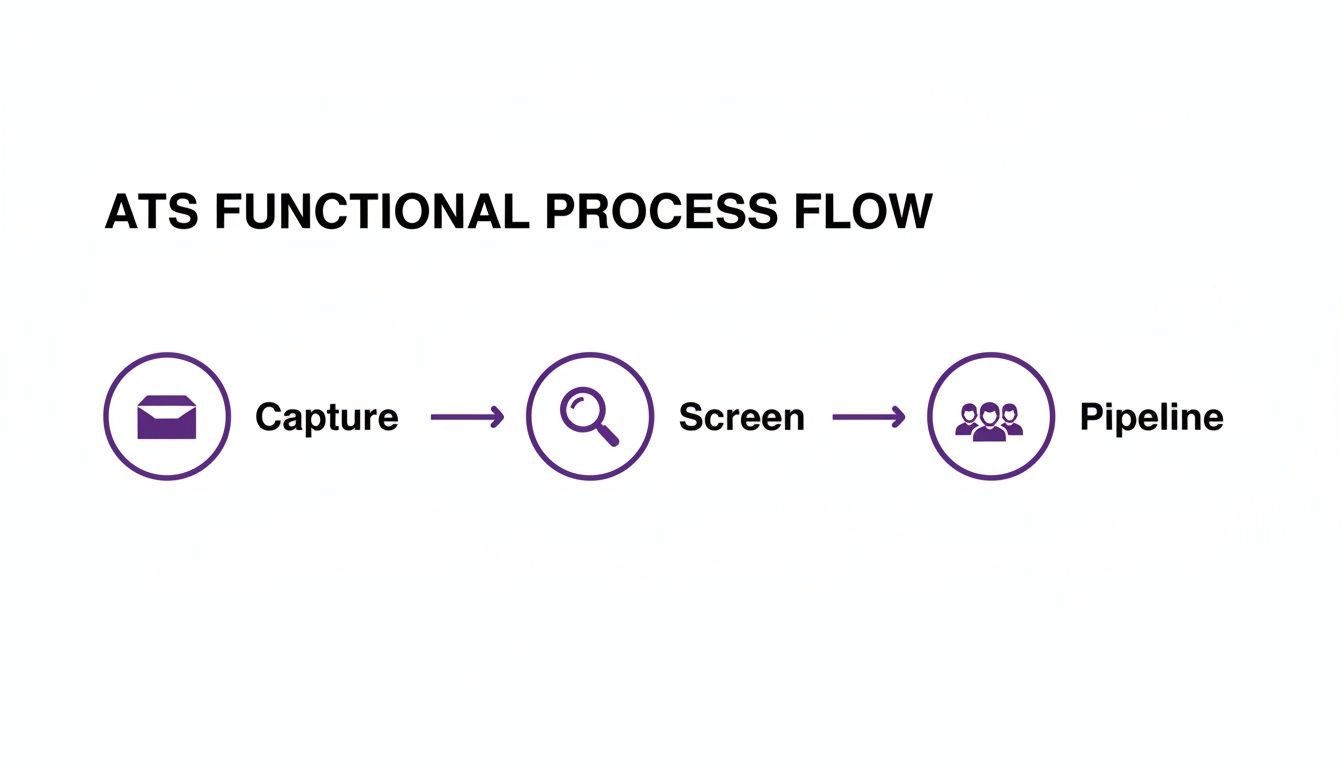
As you can see, the whole point is to funnel a large volume of applicants into a smaller, highly qualified group through a series of smart, automated steps.
Stage 1: Job Posting and Distribution
It all kicks off the second you have a role to fill. Without an ATS, this is where the grind begins. You’d have to manually log into LinkedIn, Indeed, Reed, and a dozen other niche sites, copying and pasting your job advert onto each one. It's repetitive, slow, and easy to make mistakes.
An ATS completely changes this first step. With a feature like SeeMeHired’s Multi-Channel Job Posting, you just write the job description once, right inside the platform. Then, with a single click, the system fires it out to all your connected job boards and social media channels.
Not only does this save you hours of mind-numbing admin, but it also keeps your branding and messaging perfectly consistent everywhere. Your job advert gets in front of a much wider, more relevant audience almost instantly, giving you the best possible shot at attracting top talent from the get-go.
Stage 2: Application Capture and Parsing
Once the job is live, the applications start flooding in. In a manual world, your inbox would quickly become a jumble of CVs in different formats, cover letters, and random direct messages. You’d then have to download every attachment and painstakingly type the candidate’s details into a spreadsheet—a true data-entry nightmare.
An ATS handles all of this automatically. As applications arrive from all the different job boards, they’re funnelled straight into your SeeMeHired dashboard. The system then uses a clever bit of tech called CV parsing to read and pull out all the key information from each CV.
CV parsing is like having a digital assistant who reads every CV for you. It automatically spots and categorises crucial data like contact details, work history, skills, and education, creating a standardised, searchable profile for every single applicant.
This means you get a clean, organised database of candidates without lifting a finger. Every profile looks the same, making it a breeze to compare applicants fairly. It completely gets rid of manual data entry, cuts down on errors, and keeps all candidate information stored securely in one central place.
Stage 3: Automated Screening and Shortlisting
This is where an ATS really flexes its muscles. Manually sifting through hundreds of CVs is one of the biggest bottlenecks in recruitment. It's said that recruiters spend, on average, just seven seconds glancing at a CV. It's so easy for a great candidate to get missed in the rush.
An ATS automates this initial screening using rules you set yourself. You can create "knockout questions"—deal-breakers like having the right to work in the UK or holding a specific qualification. The system will automatically filter out anyone who doesn't meet these basic requirements.
On top of that, you can filter candidates using keywords for specific skills, experience, or qualifications. For example, a care home manager looking for a nurse could instantly filter for anyone with "NMC registration" and "palliative care" on their CV. The system immediately brings the most relevant people to the top.
- Keyword Matching: Finds candidates whose CVs contain specific skills you’ve flagged as essential for the role.
- Smart Scoring: Advanced systems like SeeMeHired use algorithms to score and rank candidates based on how well they match the job description, pushing the best fits right to the top of your list.
- Filtering by Location: Quickly narrows the field to candidates living within a reasonable commuting distance.
This intelligent screening means your hiring team can spend their time reviewing a pre-vetted shortlist of top contenders, instead of drowning in a sea of irrelevant applications.
Stage 4: Candidate Communication and Engagement
Keeping candidates in the loop is vital for a positive experience, but doing it manually is a real challenge. Trying to manage endless email threads for interview invites, updates, and rejections is disorganised and often leads to people being left in the dark—a huge reason why good applicants drop out.
An ATS like SeeMeHired centralises all your communications. You can send bulk emails to applicants at different stages using pre-written templates, ensuring everyone gets a timely and professional update.
For instance, you can set up an automatic acknowledgement email that goes out the second someone applies. Later, you can send one message to all shortlisted candidates to invite them for an interview, or politely inform all unsuccessful applicants with a personalised rejection letter. Every single interaction is logged in the candidate's profile, giving your team a complete communication history at a glance.
Stage 5: Interview Scheduling and Collaboration
Trying to coordinate interviews between a candidate and several team members can turn into a logistical nightmare of back-and-forth emails. An ATS smooths this out completely.
Many systems integrate with calendars like Google Calendar or Outlook. You can share your team's availability directly with candidates, letting them book an interview slot that works for everyone. It puts the candidate in control and takes the admin burden off your team.
Better yet, SeeMeHired’s integrated video interviewing feature lets you conduct interviews right inside the platform, so you don't have to mess about with third-party tools like Zoom or Teams. It keeps the whole process tidy and seamless. Your team can also share notes and feedback on candidates directly within the ATS, making it much easier to make collaborative hiring decisions.
If you’re keen to connect your ATS with other tools, you can learn more about how to automate your workflow using HR tech integrations in our detailed guide.
Stage 6: Offer Management and Onboarding
The final steps are just as critical. Once you've picked your star candidate, the ATS helps manage the offer process. You can create and send a formal offer letter straight from the system. The candidate can then digitally review and accept it, making the final step secure and efficient.
But the journey doesn't stop there. An all-in-one platform like SeeMeHired carries on into onboarding. As soon as an offer is accepted, the system can automatically kick off your onboarding checklist.
This could include:
- Sending out new hire paperwork for them to complete digitally.
- Collecting essential compliance documents, like right-to-work checks.
- Assigning introductory tasks or training modules.
By managing these final stages in the same system, you create a seamless transition from candidate to employee, setting your new hire up for success from day one. This end-to-end control is what makes an ATS an essential tool for any modern HR team.
Why an ATS Is a Game Changer for HR Teams
Knowing the mechanics of an applicant tracking system is one thing, but truly understanding its impact on a business is something else entirely. An ATS does more than just organise applications; it completely reshapes how HR teams function. Think of it less as a tool and more as a strategic partner, shifting your focus from tedious admin to valuable human connection.
By automating the most repetitive parts of the hiring workflow, an ATS delivers huge advantages that directly affect your bottom line, brand reputation, and your ability to build a winning team. Let's dig into why this system is such a game changer.
Massive Time and Cost Savings
The most immediate benefit of an ATS is the sheer amount of time it gives back to your team. Just think about the hours spent manually posting jobs, sifting through hundreds of CVs, and coordinating interview schedules over email. An ATS automates these gruelling tasks, turning hours of work into mere minutes.
This efficiency translates directly into cost savings. A quicker hiring process means less money spent on advertising open roles and less productivity lost from vacant positions. For UK businesses, an applicant tracking system transforms hiring into a measurable funnel, turning each stage—from application to offer—into trackable data.
Globally, a good ATS can reduce the average hiring cycle by up to 60%. It’s no surprise that more than 86% of recruiters say their system has slashed their time-to-hire.
A Superior Candidate Experience
In today’s competitive job market, the candidate experience is everything. A clunky, slow, or confusing application process will put off top talent before they even finish applying. An ATS like SeeMeHired ensures a smooth, professional journey for every single applicant.
A positive candidate experience is your best recruitment tool. Even unsuccessful applicants who are treated with respect are more likely to reapply in the future or speak highly of your company, strengthening your employer brand.
From instant application acknowledgements to timely updates and simple interview scheduling, the system keeps candidates engaged and in the loop. This level of professionalism shows applicants you value their time, helping you win over the best people before your competitors even have a chance.
Enhanced Compliance and Data Security
Navigating complex employment laws and data protection regulations like GDPR is a major headache for UK businesses. Trying to manage candidate data across spreadsheets and overflowing email inboxes isn't just inefficient—it’s a huge compliance risk waiting to happen.
An ATS provides a secure, centralised database for all candidate information. It helps you manage data retention policies automatically, making sure old applicant data is deleted in line with legal requirements. It also tracks consent, creating a clear audit trail that proves your commitment to data privacy. For regulated sectors like healthcare, this isn't just a nice-to-have; it's essential for avoiding hefty fines.
Our guide explores more of the 8 key benefits of an ATS for smarter hiring.
Data-Driven Hiring Decisions
Finally, an ATS turns recruitment from guesswork into a predictable, data-backed strategy. Instead of relying on gut feelings, you can use real data to understand what’s working and what isn’t.
An effective system provides analytics on crucial metrics, including:
- Source of Hire: Which job boards are actually delivering your best candidates?
- Time-to-Fill: How long does it take to fill roles in different departments?
- Candidate Pipeline Health: Where are the bottlenecks in your hiring process?
This information empowers you to make smarter decisions, optimise your spending, and continuously improve your hiring strategy. It's telling that around 62% of teams using an ATS report finding more high-quality candidates, while 79% say new-hire quality improved after they made the switch. This is exactly how an applicant tracking system works to build a stronger, more effective team.
To properly measure the impact of an ATS, it helps to track a few key performance indicators. The table below outlines some of the most important metrics that demonstrate the real-world return on your investment.
Return on Investment Metrics for an ATS
| Metric | Description | Average Improvement with an ATS |
|---|---|---|
| Time-to-Hire | The number of days between a job being posted and an offer being accepted. | Up to 60% reduction |
| Cost-per-Hire | Total recruitment costs (advertising, agency fees, staff time) divided by the number of hires. | 20-40% reduction |
| Quality of Hire | Performance metrics of new hires (e.g., performance reviews, retention rate) in their first year. | Up to 79% of teams report improvement |
| Candidate Drop-off Rate | The percentage of candidates who start but do not complete an application. | 30-50% reduction |
| Recruiter Productivity | The number of roles managed or filled per recruiter over a specific period. | Increases by 25% or more |
Tracking these figures before and after implementation will give you a clear, quantifiable picture of how an ATS is boosting your bottom line and making your entire recruitment function more strategic.
How to Choose the Right ATS for Your Business
Picking an applicant tracking system is a big deal. It’s not just another piece of software; it’s the new central hub for your entire hiring strategy. With so many options out there, it’s easy to feel a bit lost. A system that works wonders for a massive corporation might be total overkill for a growing care home group or a local hotel chain.
The trick is to look past the flashy features and get real about what your business actually needs. To figure out how an ATS will work for you, you need to define your priorities first. That means sitting down and making a clear checklist of what really matters to your team, your candidates, and your future.
Ensure the System Can Grow with You
The very first question you should ask is about scalability. The ATS you pick today needs to be able to keep up with you tomorrow. If you're a small business planning to double in size over the next two years, you need a system that can handle a flood of new applicants and more complex hiring workflows without breaking a sweat.
Think about these key scalability factors:
- User Licences: How easy is it to add more recruiters or hiring managers as your team gets bigger?
- Applicant Volume: Will the system grind to a halt if you suddenly get hundreds of applications for a popular role?
- Feature Tiers: Does the provider offer more advanced features you can upgrade to later on, like detailed analytics or full onboarding tools?
A scalable system saves you from the massive headache and cost of switching platforms right when your business is hitting its stride. For a deeper dive into this, check out our guide to small business applicant tracking systems.
Prioritise a User-Friendly Interface
Honestly, the most powerful ATS in the world is useless if your team finds it a nightmare to use. Ease of use is absolutely non-negotiable. A clunky, confusing interface leads to your team avoiding it, getting frustrated, and ultimately, a poor return on your investment. Your hiring managers are busy people; they won’t touch a tool that just adds more work to their plate.
An intuitive ATS should feel like a helpful assistant, not another complex piece of software to learn. If your team can’t get the hang of it quickly, it will become a roadblock instead of a solution.
Look for a clean dashboard, logical navigation, and clear instructions. The goal is to get your team managing their hiring tasks efficiently from day one, with as little training as possible.
Match Key Features to Your Industry Needs
Not all features are created equal, and what’s crucial for one industry might be irrelevant for another. A tech start-up might be obsessed with integrations for coding tests, while a healthcare provider’s top priority is rock-solid compliance management. This is where key feature alignment comes in.
Before you even book a demo, map out your current hiring process and pinpoint the biggest headaches.
- High-Volume Hiring: If you run a retail store or a hotel, you’ll need brilliant screening and filtering tools to sift through hundreds of applicants without losing your mind.
- Regulated Industries: For care homes, features like automated compliance checks and secure document storage are an absolute must.
- Remote Teams: If you hire people from all over the country, a system with built-in video interviewing, like SeeMeHired, can be a complete game-changer.
By matching features to your specific challenges, you make sure the ATS will solve real, everyday problems for your business.
Check Integration Capabilities and Support
Finally, your ATS won’t be working in isolation. It needs to play nicely with the other tools your business depends on every day. Check its integration capabilities with your existing HR software, payroll systems, and calendar apps to create a joined-up, efficient tech setup.
Just as important is the level of support and training you’ll get. Look for a provider that offers solid onboarding help, responsive customer support, and genuinely useful training resources. Knowing you have a reliable partner to call on when you’re stuck makes all the difference. This support, along with a clear picture of the costs, is vital. In the UK, ATS subscriptions often start around £5,000 per year, with many businesses spending £10,000–£40,000 annually. Knowing this helps you budget properly for a system that will deliver real value in the long run.
Putting Theory Into Practice with SeeMeHired
It’s one thing to understand the theory of how an applicant tracking system works, but seeing it in action is where you really grasp its value. A platform like SeeMeHired takes all these concepts and makes them real, offering practical answers to the daily headaches that bog down busy in-house HR teams. Think of it as an end-to-end partner for your entire recruitment journey.
Let’s connect the dots and see exactly how SeeMeHired’s features solve the workflow challenges we’ve discussed, turning abstract ideas into tangible results.
From Sourcing to Screening in Seconds
Getting your job advert in front of enough of the right people is the first major hurdle. Manually posting to a dozen different job boards is a slow, painful grind. SeeMeHired tackles this head-on with its Multi-Channel Job Posting feature, letting you push your vacancy out to all the major job boards with a single click.
Once the applications flood in, you hit the next bottleneck: screening. Sifting through hundreds of CVs manually is a massive time-sink. This is where Smart Candidate Matching becomes your secret weapon. The system’s intelligent algorithms automatically score and shortlist the most suitable candidates for each role, allowing your team to focus on a pre-vetted pool of top talent from the get-go.
Creating an Exceptional Candidate Journey
A positive candidate experience isn't just a nice-to-have; it's essential for attracting the best people. Clunky interview scheduling and disjointed communication can make top talent drop out of your process entirely. SeeMeHired keeps everything in one place to solve this.
- Centralised Communication: Every message, from interview invitations to feedback, is handled within the platform. This guarantees every applicant gets a timely, professional update.
- Integrated Video Interviews: You can schedule and conduct video interviews directly inside SeeMeHired, so there’s no need to juggle third-party tools. It creates a smooth, professional experience for everyone.
This unified approach shows candidates that you value their time and have an organised process, which does wonders for your employer brand.
By bringing every step of the hiring journey into one platform, you transform a series of separate, often chaotic, tasks into a single, cohesive workflow. This not only saves time but also drastically improves the experience for both recruiters and candidates.
Delivering a Complete End-to-End Solution
The hiring process doesn’t stop once an offer is accepted. For many businesses, especially those in regulated industries like healthcare or finance, the onboarding and compliance stage is just as critical. SeeMeHired is one of the few platforms that truly delivers a complete solution.
Its unique Onboarding & Compliance Tools let you manage new-hire checklists, securely collect essential documents, and make sure all regulatory requirements are met. For a care home, this means having a clear, audit-ready trail for every new employee, from their initial application to their first day on the job.
This all-in-one capability is what truly shows how an applicant tracking system works to simplify hiring. You can learn more about how SeeMeHired stacks up as the best applicant tracking system for 2024.
Got Questions About Applicant Tracking Systems? Let's Clear a Few Things Up
Even after seeing how an ATS works, it’s natural to have a few questions. Some persistent myths still float around, and it's worth tackling them head-on to separate the facts from the fiction.
Getting these details right is important. The last thing you want is for a simple misunderstanding to stop your team from adopting a tool that could genuinely transform your hiring process for the better.
Will an ATS Automatically Reject Good Candidates?
This is probably the biggest fear we hear about, feeding the whole "CV black hole" anxiety. But let's be clear: a modern ATS doesn't just reject good people out of hand. That’s not what it’s for. Think of it more like a powerful search engine for your talent pool.
When an application comes in, the ATS stores it and lets the recruiter search their database using specific keywords and criteria. If a fantastic candidate's CV is missing a key term, they might not show up at the very top of the results, but they aren't automatically binned. A human always, always makes the final call.
An ATS is there to assist recruiters, not replace them. Its job is to bring the most relevant applications to the surface, freeing up hiring managers to spend their time on what really matters: evaluating the best potential fits.
How Does an ATS Actually Read a CV?
It all comes down to a process called CV parsing. You can think of it as a translator that takes all the unstructured text on a CV and neatly organises it into searchable data fields within the system.
It scans the document to identify key pieces of information—contact details, work history, skills, education—and slots them into the right categories in the candidate’s profile. This is why the formatting of a CV can make a real difference.
For any candidates reading this, the best approach is to keep it simple and clean:
- Use Standard Fonts: Stick to classics like Arial, Calibri, or Georgia that are easy for software to read.
- Avoid Complex Graphics: Things like tables, columns, and fancy images can sometimes confuse the parser.
- Use Conventional Headings: Simple titles like "Work Experience" and "Education" work best.
Following these simple rules helps ensure the system reads everything correctly, giving talented people the best possible chance of getting noticed.
Is an ATS Difficult to Implement?
The idea of bringing in any new software can feel a bit daunting. We often imagine complicated setups and a long, painful learning curve for the team. The good news is that modern, cloud-based systems are built to be the exact opposite.
Platforms like SeeMeHired are designed for busy in-house HR teams, not IT gurus. The setup is usually guided, and the interface is intuitive, which means your team can get comfortable and start using it quickly with minimal training. The whole point is to solve your hiring headaches, not create new ones.
How Does an ATS Help with GDPR Compliance?
If you're hiring in the UK or Europe, managing candidate data according to GDPR isn't just good practice—it's a legal must. An applicant tracking system is one of the most important tools you can have for staying compliant and avoiding some serious risks.
It gives you a secure, central hub for all candidate data, getting rid of messy spreadsheets and chaotic email inboxes. A few key features really help with this:
- Consent Management: It tracks exactly when and how candidates gave you permission to store their data.
- Secure Data Storage: All that sensitive personal information is kept safe from potential breaches.
- Automated Data Retention: The system can automatically delete candidate data after a set period, keeping you in line with your legal obligations.
This structured approach provides a clear audit trail and real peace of mind, making sure your hiring process is not just more efficient, but fully compliant too.
Ready to see how an all-in-one system can solve your hiring challenges? SeeMeHired combines powerful automation with an intuitive interface, giving you the tools to attract, screen, and onboard top talent faster. Book a demo today and discover a smarter way to hire.