HR Processes
Effective Training for Interviewers Guide
Let's be honest—an untrained interviewer is a liability. Good training for interviewers isn't just a box-ticking HR exercise; it's what turns hiring from a risky game of gut feelings into a structured process that actually works. It helps you spot top talent, sidestep legal pitfalls, and protect your company’s reputation.
Listen to the podcast here:
Why Interviewer Training Is a Business Imperative
A bad interview does more than just cost you a great candidate—it actively damages your brand. We live in an age where one poor experience can quickly find its way onto social media, making the cost of an unprepared interviewer higher than ever. Every single interaction is a direct reflection of your company's culture and professionalism.
When managers are left to "wing it," they often rely on inconsistent questions. This throws the door wide open to unconscious bias and, frankly, potential legal headaches. But this isn't just about avoiding lawsuits. It's about building a fair, inclusive, and resilient team that gives you a genuine competitive edge.
Simply put, investing in your interviewers is one of the smartest decisions you can make.
The Tangible Costs of Neglect
Failing to train your interviewers has real-world consequences that ripple out far beyond a single bad hire. The effects can touch everything from team morale right through to your bottom line.
Think about these significant business risks for a moment:
- Damaged Employer Brand: A negative candidate experience can deter future applicants and tarnish your reputation.
- Increased Legal Exposure: Inconsistent or inappropriate questions can easily lead to discrimination claims.
- Higher Turnover Rates: Poor hiring choices mean bringing in people who aren't a good fit, leading to costly and disruptive attrition.
- Wasted Resources: Countless hours are burned re-opening roles and going through the entire hiring process all over again. You can learn more about this in our article on effective recruitment practices.
Despite these obvious risks, there's a worrying trend. In the UK, total training expenditure has dropped to £53 billion, an 18.5% decrease since 2011. This works out to about £1,700 spent per employee—a significant cut that shows a growing gap between what companies need and what they're willing to invest. You can discover more about UK employer skills surveys to see the full data.
The real goal of interviewer training is to give your team the tools to make objective, evidence-based decisions. It shifts the entire focus from, "Do I like this person?" to "Can this person do the job and elevate our team?"
Ultimately, proper interviewer training isn't a luxury. It's a fundamental part of any successful talent acquisition strategy. It ensures every candidate gets a fair, consistent, and professional evaluation, which leads to better hires who will drive your business forward.
Crafting Your High-Impact Training Curriculum
A truly effective training programme needs a solid blueprint. Just telling managers to “be better at interviewing” is a recipe for disaster. What you need is a structured curriculum that builds skills layer by layer, turning well-intentioned leaders into objective, skilled talent assessors.
Think of this framework as your guide to creating a high-impact learning experience. The goal is to build a consistent foundation so that every candidate gets a fair and professional evaluation, no matter who is running the interview. That consistency is what leads to better, smarter hiring decisions.
Mastering Structured Interviewing
The absolute cornerstone of any modern interviewer training is mastering the structured interview. This methodical approach forces a shift away from gut feelings and towards an evidence-based process. It's built on a simple but powerful idea: every candidate is asked the same core questions, all tied directly to the job’s required skills, which makes for a much fairer comparison.
This isn't just a trendy idea; it's fast becoming standard practice in UK recruitment. Recent data shows that 72% of companies now use structured interviews, while 69% have woven video interviews into their process. On top of that, 20% of UK firms are now using AI tools for screening, with an overwhelming 94% of them reporting a boost in hiring efficiency.
The whole process kicks off before the first interview, by defining crystal-clear hiring criteria. What are the non-negotiable skills and competencies needed for someone to succeed in this role? Your training has to teach hiring managers how to pinpoint these essentials and then craft questions that directly probe for proof.
Core Modules for Your Interviewer Training Program
A comprehensive curriculum should cover several essential areas. Each module builds upon the last, creating a complete skill set for your interviewers. Your training programme should feel less like a lecture and more like a practical workshop that delivers tangible skills.
Here’s a breakdown of the key modules you should consider building your programme around:
| Module | Learning Objective | Key Topics |
|---|---|---|
| Legal & Compliance Guardrails | To ensure every interview is fair, legal, and minimises business risk. | Employment law essentials, protected characteristics, avoiding discriminatory questions. |
| Unconscious Bias Awareness | To help interviewers recognise and mitigate biases that can cloud judgement. | Identifying affinity, confirmation, and halo/horn biases; strategies for objective evaluation. |
| Behavioural Questioning (STAR Method) | To equip interviewers with techniques to gather concrete evidence of past performance. | Crafting behavioural questions, using the STAR method (Situation, Task, Action, Result). |
| Candidate Experience & Brand Ambassadorship | To train interviewers to represent the company professionally and create a positive experience. | Setting expectations, active listening, managing time, providing feedback. |
| Scorecard & Evaluation Techniques | To standardise the evaluation process and enable data-driven hiring decisions. | Using a structured scorecard, defining rating scales, conducting effective debrief sessions. |
Building a curriculum around these pillars ensures you're not just teaching theory, but providing a practical toolkit interviewers can use immediately.
The stakes are high. As this flowchart shows, a single bad interview can snowball into serious brand damage and business risk.
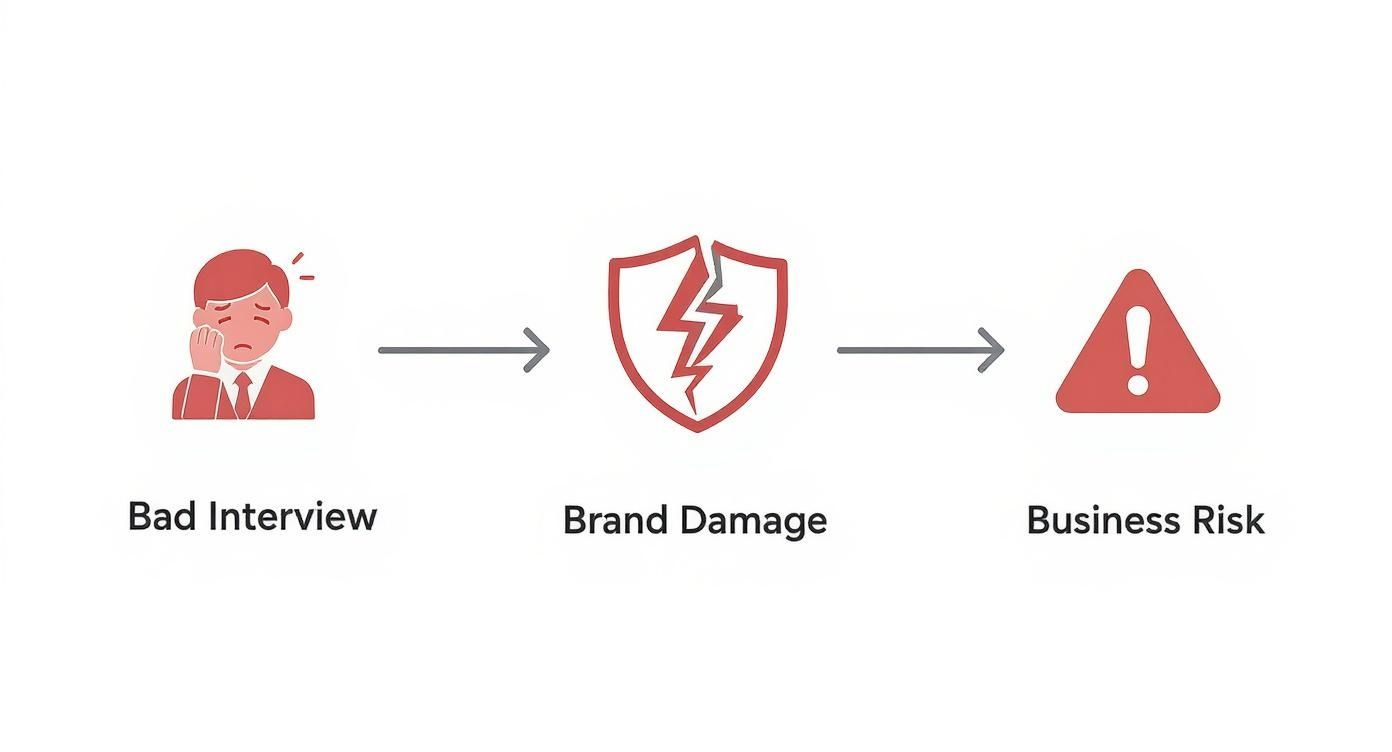
It’s a stark reminder that failing to train interviewers isn’t just an HR problem—it’s a direct threat to your company’s reputation and stability. For a deeper dive into tackling these issues, check out our guide on hiring manager interview training.
An interviewer's main job isn't to make friends; it's to be a detective. They need to gather clues (evidence of skills) and build a case for why a candidate is—or isn’t—the right fit for the role.
Ultimately, your curriculum should empower every interviewer with the confidence and tools to conduct interviews that are fair, consistent, and genuinely predictive of on-the-job success. This is how you transform hiring from a game of chance into a strategic business function.
Fostering an Inclusive Interview Experience
Creating an interview process that’s genuinely inclusive goes way beyond just ticking boxes and avoiding illegal questions. It’s about a conscious, active effort to dismantle the subtle biases that creep into conversations and build an environment where every single candidate feels seen, heard, and respected. This is precisely where most standard training for interviewers falls flat—it stays on the surface instead of digging into practical, in-the-moment guidance.
Think about this classic scenario: an interviewer and a candidate discover they went to the same university. The whole vibe of the conversation shifts, becoming warmer, more familiar. That’s affinity bias in action. We all have a natural tendency to gravitate towards people who are like us. It seems harmless, but it can easily lead the interviewer to lob softer questions or give the candidate the benefit of the doubt, creating a playing field that’s anything but level.
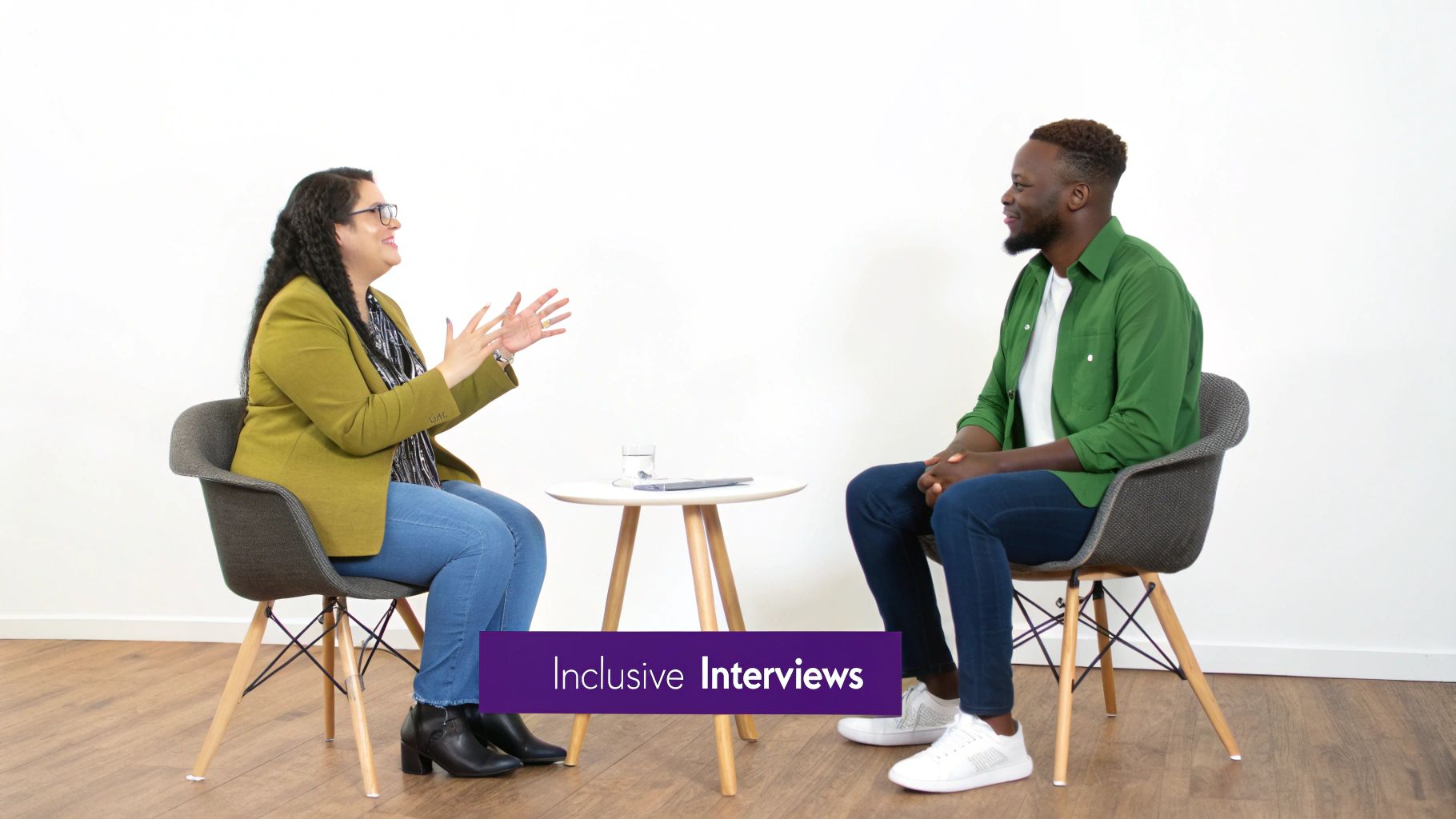
This is where great training makes a difference. It gives interviewers the tools to spot this happening and gently steer the conversation right back to the job's core competencies.
Moving from Awareness to Action
True inclusivity isn’t a passive state; it’s an active skill. It means training interviewers to adapt their approach on the fly to create a welcoming space for everyone. These are skills that need to be practised, not just talked about in a PowerPoint presentation.
Here are a few actionable areas to build into your training programme:
- Supporting Neurodiverse Candidates: Train interviewers to be crystal clear and direct with their questions, ditching vague or abstract language. Encourage them to offer simple accommodations, like providing questions in advance or being comfortable with pauses as a candidate processes their thoughts.
- Creating an LGBTQIA+ Affirming Space: This is about more than just a rainbow flag in your email signature. It involves practical training on using correct pronouns and gender-neutral language. The goal is to make the interview feel safe, respectful, and focused entirely on professional skills.
- Mitigating Cultural Misunderstandings: Teach your team to be aware of different communication styles. For instance, while direct eye contact is a sign of confidence in some cultures, it can be seen as disrespectful in others. An untrained interviewer might completely misread this cue.
Unfortunately, there's a huge skills gap here. Research in the UK has uncovered a stark disconnect: 92% of employers believe their diversity and inclusion policies are strong. But when you look closer, only about 32% mandate interview training on cultural competence, just 23% provide LGBTQIA+ awareness prep, and a mere 14% offer training on neurodiversity.
A truly inclusive interview isn't about treating everyone the same; it's about giving everyone the same opportunity to demonstrate their unique talents and abilities. This requires interviewers to be adaptable, empathetic, and highly self-aware.
Practical Scenario-Based Training
The absolute best way to build these skills is through realistic, scenario-based role-playing. Don’t just tell your team about bias; let them feel what it’s like to navigate it. Throw them a situation where a candidate gives a long, rambling answer and challenge them to redirect the conversation without making the person feel flustered or cut off.
For more guidance on building an equitable talent pipeline right from the start, our article on the best practices for diversity recruiting provides an excellent foundation.
By focusing on these hands-on, practical skills, your training can transform interviewers from gatekeepers into genuine ambassadors for your company's culture. It’s how you equip them to identify the very best talent, no matter a candidate’s background, identity, or communication style.
Choosing Training Methods That Stick
Let’s be honest: a one-off, lecture-style training session rarely changes anyone's deep-seated habits. For interviewer training to actually work, you need to think more like a campaign than a single event. It's about blending different learning styles to respect your team's busy schedules while building skills that genuinely get used.
The key is combining different methods to cover foundational knowledge and then build practical, real-world confidence. Some topics are perfect for a quick e-learning module, while others absolutely demand live, interactive practice. Marrying these formats creates a far more engaging and impactful experience.
Blending Self-Paced Learning with Live Practice
It's best to start with the fundamentals using self-paced methods. This is the most efficient way to get essential, non-negotiable information across without pulling everyone into a room for hours on end.
- Self-Paced E-Learning: This is your go-to for covering the legal guardrails, compliance topics, and the basic principles of structured interviewing. Modules can be completed whenever an interviewer has a spare 30 minutes, making it incredibly scalable.
- On-Demand Video Library: Think of this as your "just-in-time" resource. Create short, digestible videos on specific skills—a five-minute refresher on using the STAR method or quick tips for giving constructive feedback.
Once you've established that baseline knowledge, it's time for the hands-on practice. This is where live, interactive sessions become indispensable. These workshops aren't for lecturing; they're for doing.
The real muscle memory for interviewing is built through practice, not theory. An interviewer needs to feel the discomfort of a challenging conversation in a safe environment to learn how to handle it in a real one.
Live, facilitated sessions are non-negotiable for building the nuanced skills that separate good interviewers from great ones. For more ideas on what to practice, our guide outlines several techniques for effective interviewing that are perfect for workshop scenarios.
Deciding on the right mix of training formats can feel overwhelming. To help, here’s a breakdown of the most common delivery methods, their strengths, and where they might fall short.
Comparing Training Delivery Methods
| Method | Best For | Pros | Cons |
|---|---|---|---|
| E-Learning Modules | Foundational knowledge, legal compliance, company policies, basic structured interviewing principles. | Scalable, consistent, flexible for busy schedules, cost-effective for large groups. | Lacks interaction, can feel impersonal, not ideal for nuanced skill-building. |
| Live Workshops (In-Person or Virtual) | Role-playing, practising behavioural questions, feedback delivery, bias mitigation exercises. | Highly interactive, builds team cohesion, allows for real-time coaching and feedback. | More expensive, logistically complex, requires skilled facilitation. |
| On-Demand Video Library | Quick skill refreshers (e.g., STAR method), "just-in-time" learning, reinforcing key concepts. | Accessible 24/7, great for reinforcement, caters to different learning speeds. | Passive learning format, no opportunity for Q&A or practice. |
| Peer Coaching/Mentoring | Continuous improvement, sharing real-world challenges, building a culture of feedback. | Builds strong internal networks, highly relevant and practical, low cost. | Success depends on participant commitment, can be inconsistent without structure. |
Ultimately, the best strategy uses a combination of these methods. Start with e-learning to lay the groundwork, then use live workshops to turn that theory into practice.
Making the Skills Stick for the Long Haul
Training shouldn't be a "one and done" deal. If you want these new skills to become second nature, you have to build a system of continuous reinforcement that keeps best practices top of mind.
Here are a few ways to do that:
- Role-Playing Workshops: This is the heart and soul of effective interviewer training. Facilitate sessions where participants get to practise asking tough behavioural questions, navigating awkward silences, and delivering difficult feedback to each other.
- Peer Coaching Circles: Group small cohorts of interviewers together to debrief their recent interviews. This creates a safe space to share what worked, discuss challenges, and get advice from colleagues who are in the exact same boat.
- Quarterly Refresher Sessions: Don't try to boil the ocean. Hold brief, focused workshops each quarter on a single topic, like mitigating a specific type of bias or improving note-taking skills.
This blended approach ensures that training isn't just an event but an ongoing process of development. It respects your team’s time by delivering core knowledge efficiently, then uses those precious live sessions to build the practical skills and confidence they need to hire exceptional talent.
Measuring the Real Impact of Your Training
Once your training programme is live, the real work begins: proving its value. Simply tracking who completed the course tells you who showed up, but it reveals nothing about whether the training actually worked. To justify the investment, you have to connect your efforts to tangible business outcomes.
Effective training for interviewers isn't just a tick-box HR exercise; it's a strategic tool designed to improve the quality of your hires and, ultimately, strengthen the business. This means moving beyond vanity metrics and focusing on data that demonstrates a clear return on investment. The goal is to build a powerful business case that links your training directly to a stronger bottom line.
Key Metrics to Track Before and After Training
To really understand the impact, you need a baseline. Start gathering data on key hiring metrics before you launch the training, and then keep tracking these same data points in the months that follow. This pre-and-post comparison is the clearest way to show what’s changed.
You’ll want to focus your attention on these critical indicators:
- Quality of Hire: This is the ultimate measure of success. Look at the performance review scores of new hires after their first six to twelve months. A noticeable increase in the average score for employees hired by your newly trained interviewers is a powerful testament to your programme's effectiveness.
- Offer Acceptance Rate: A higher acceptance rate is often a great sign of an improved candidate experience. When trained interviewers act as strong brand ambassadors, top candidates are far more likely to say "yes."
- Candidate Satisfaction Scores: Use simple post-interview surveys to get a read on the candidate experience. A jump in positive feedback is a direct result of more professional, consistent, and respectful interviews.
- Time to Hire: While not always a direct correlation, well-trained interviewers can often make faster, more confident decisions, which can certainly help shorten the hiring cycle.
For a comprehensive overview of which numbers matter most, our guide can help you master recruitment metrics for hiring success.
Measuring Interviewer Confidence and Behaviour
Beyond the hard business metrics, it's also crucial to measure the direct effect on the interviewers themselves. Are they actually internalising the new skills? Do they feel more equipped to make fair and objective decisions?
The goal isn't just to teach new techniques, but to build lasting confidence. An interviewer who feels competent and prepared is far more likely to stick to the structured process, even under pressure.
To capture this, implement simple pre- and post-training surveys for your interviewers. Ask them to rate their confidence on a scale of 1-10 in specific areas, like identifying bias, using the STAR method, or running a debrief session. A significant jump in self-reported confidence is a strong leading indicator of behavioural change.
You can also conduct periodic audits of interview notes and scorecard feedback. Look for evidence that interviewers are providing specific, evidence-based justifications for their ratings rather than falling back on vague "gut feelings." This kind of qualitative data provides concrete proof that the training is being applied in the real world.
Common Questions About Interviewer Training
Even the best-laid plans can hit a snag. As you start rolling out or refining your interviewer training, you’re bound to have questions. Getting ahead of these common queries can smooth out the entire process and make sure everyone’s on the same page from the start.
Let’s tackle some of the questions we hear most often.
How Often Should Interviewers Receive Training?
The sweet spot seems to be a comprehensive initial training session for all new interviewers, followed up with an annual refresher. Think of the first session as the essential deep dive – it needs to cover all the fundamentals, from legal compliance and structured interviewing to tackling unconscious bias and nailing the candidate experience. This sets a solid, consistent baseline for anyone involved in hiring.
But it can't be a one-and-done deal. Annual refreshers are vital for keeping those best practices top of mind. They're the perfect time to introduce new techniques, share important updates on employment law, or address any recurring issues you've spotted in your hiring data over the past year.
If you really want to keep skills sharp, consider adding short, quarterly micro-learnings. A quick 20-minute session on interviewing for remote roles or a practical workshop on giving better candidate feedback can make a huge difference without being a massive time commitment.
What Is the Biggest Mistake to Avoid When Creating Training?
Without a doubt, the single biggest mistake is making the training purely theoretical. A programme that’s just a series of slides and lectures won’t change ingrained habits or build any real-world confidence. Interviewing is a practical skill, and you have to teach it that way.
Effective training has to be interactive and centred on practice. The goal isn't just to transfer information; it's to build muscle memory so interviewers can apply these skills correctly, especially when they’re under pressure.
Make sure your training dedicates a significant chunk of time to hands-on activities. This means role-playing tricky scenarios, breaking down real-world case studies of great (and not-so-great) interviews, and getting reps in on how to complete a scorecard with solid, evidence-based notes.
How Can We Get Experienced Managers to Buy Into Training?
Getting seasoned managers on board can be tough. Many of them believe they already know how to interview, which often makes them your most sceptical audience. The key is to frame the training around strategic impact, not just basic compliance. Ticking boxes isn't going to get them excited.
Start with data. Show them the numbers. How do structured interviews improve quality of hire? How are inconsistent interview experiences damaging your employer brand and hurting offer acceptance rates? You need to connect the training directly to solving the business problems they actually care about.
Also, try positioning the training as a masterclass—a chance for them to sharpen their skills and become better talent advisors, not a remedial course for beginners. Involving them in the programme's design or asking them to help mentor newer interviewers can also work wonders. It creates a powerful sense of ownership and can turn your biggest sceptics into your strongest champions.
Ready to build a hiring process that attracts and secures top talent every time? SeeMeHired is an all-in-one applicant tracking system that streamlines everything from job posting and candidate screening to interviews and onboarding. Discover how our smart, intuitive platform can help you hire better, faster at https://seemehired.com.