HR Processes
Craft the Perfect Job Posting Template

A killer job posting template is way more than a simple list of duties. Think of it as a strategic tool, one carefully designed to pull in the right people and, just as importantly, gently push away the wrong ones. It works by giving candidates a clear, concise, and compelling snapshot of the role, the team, and what it’s really like to work with you. A solid, structured format means you’re consistent every time, and honestly, it saves a huge amount of time in the long run.
Listen to the podcast HERE:
Why Your Business Needs a Solid Job Posting Template
Let's get straight to the point. Winging it with ad-hoc job adverts is just inefficient. It almost always leads to muddled, inconsistent messaging that can confuse or even put off the very people you want to attract. A well-thought-out job posting template is the backbone of any serious recruitment strategy, making sure every single vacancy you advertise is professional, comprehensive, and perfectly in sync with your employer brand.
For any business that’s growing, this kind of consistency is absolutely vital. It makes collaboration between HR and hiring managers a breeze, seriously speeds up your time-to-fill, and helps you build a recognisable, trustworthy voice in the job market. It's your recruitment north star. For instance, when you need to fill a role quickly, like the team over at Darwin Escapes, having a template ready to go means you can move fast without cutting corners on quality.
A standardised approach has another hidden benefit: it helps you gather much better data. When you use the same structure for every role, it becomes so much easier to see which parts of your advert or which turn of phrase brings in the best candidates. That’s how you get to continuously improve your process.
The real purpose of a job posting template isn’t just to fill a role; it’s to start a conversation with the exact type of professional you want on your team. It sets clear expectations right from that very first interaction.
Just take a look at this screenshot from Indeed UK. It shows how wildly different job postings can look, which really highlights why a strong, consistent template is so crucial if you want to stand out from the crowd.
You'll notice the most effective listings immediately grab your attention with sharp, clear titles and short, punchy summaries. The secret is giving candidates the essential information upfront, making it easy for them to decide if it's a good fit. Before we break down how to build each part of your template, remember that a great one achieves several key goals:
It attracts qualified applicants by being crystal clear about the role and what it takes to succeed.
It enhances your employer brand by consistently showing off your company's culture and values.
It massively improves efficiency by slashing the time it takes to write and post new job ads.
With those fundamentals in mind, let’s get into the nitty-gritty of building a template that actually works. We'll break down each section, explain its purpose, and share some expert tips to make it truly effective.
Key Sections of a High-Impact Job Posting
Here’s a quick overview of the essential components of a job posting template that gets results. This table breaks down what each section should do and how you can make it shine.
| Section | Purpose | Key Tips |
|---|---|---|
| Job Title | To grab attention and clearly define the role for search engines and candidates. | Be specific and use standard industry terms. Avoid internal jargon. Think "Senior Marketing Manager," not "Marketing Guru." |
| Location & Work Style | To set clear expectations about where and how the work is done. | State whether the role is remote, hybrid, or in-office. Specify the city or region. Be upfront to avoid wasting time. |
| Salary Range | To attract candidates who align with your compensation budget and promote transparency. | Always include a realistic range. Research market rates. This is one of the top factors for candidates. |
| Company Overview | To sell your company's mission, values, and culture. | Tell a story. What makes your company a great place to work? Focus on your "why," not just your "what." |
| Role Summary | To provide a concise, engaging overview of the position’s core purpose. | Write a 2-3 sentence "elevator pitch" for the role. Make it sound exciting and impactful. |
| Responsibilities | To detail the day-to-day duties and key tasks of the role. | Use bullet points. Focus on outcomes, not just tasks. Use action verbs like "manage," "develop," and "create." |
| Qualifications | To outline the essential skills, experience, and education needed. | Separate "must-haves" from "nice-to-haves." Be realistic to avoid scaring off great-but-not-perfect candidates. |
| Benefits & Perks | To showcase what you offer beyond the salary. | Go beyond the basics. Mention things like professional development, wellness programmes, or flexible hours. |
| Application Instructions | To provide clear, simple steps on how to apply. | Keep it simple. Explain the next steps and provide a clear call-to-action (CTA). |
Each of these sections plays a critical role in painting a complete picture for a potential candidate. Getting them right is the difference between a flood of irrelevant applications and a shortlist of high-quality professionals who are genuinely excited about the opportunity.
Breaking Down the Core Components
Every truly effective job post is built on the same essential foundations. I like to think of the job title, summary, and call to action as the hook, line, and sinker of any recruitment strategy. Each element has to work perfectly with the others to reel in the right talent. Nailing these core components isn't just about listing facts; it’s about creating an instant connection with what your ideal candidate wants from their next career move.

This is why your job posting template has to be flexible, not rigid. A generic, one-size-fits-all approach just doesn't work in today's market. Take a transport and logistics role, for example—the required skills can change dramatically depending on regional demand. When you tailor these core sections to reflect what’s happening locally, you ensure your post stays competitive and gets seen by the right people.
For a great real-world example, have a look at how companies like the HATS Group structure their transport roles. They do an excellent job of attracting top-tier candidates in what can be a very tough field.
Crafting a Magnetic Job Title
The job title is the first—and often the only—thing a candidate will see. It has to be specific, easily searchable, and compelling enough to earn a click. My biggest pet peeve is seeing internal jargon or overly creative titles like "Sales Ninja" or "Marketing Rockstar." While they might sound fun in a meeting, they perform terribly on job boards and can put off serious professionals.
Keep it simple and stick to clear, industry-standard language. A title like "Senior Digital Marketing Manager (SEO & PPC)" is infinitely more effective than "Digital Growth Guru." It immediately tells candidates the seniority level, the specialisation, and the key skills involved. This simple change optimises it for both search engines and human eyes scanning a long list of vacancies.
Writing a Summary That Hooks
Think of the summary as your elevator pitch. You have maybe two or three sentences to grab a candidate's attention and convince them this role is worth their time. This is your moment to move beyond a dry list of duties and actually sell the opportunity.
The key is to focus on the impact the person will have. Instead of saying, "The successful candidate will manage social media accounts," try something much more engaging: "You will lead our digital voice, shaping our brand's narrative and building an engaged community across all major platforms." See the difference? That small shift frames the role around purpose, not just a list of tasks.
Your job summary should answer one critical question for the candidate: "What's in it for me?" Focus on growth, impact, and what makes this role a compelling next step in their career.
The UK job market is always in flux, which just reinforces why compelling, adaptive job posts are so important. In June, UK job postings shot up by 6.2% from May, with over 1.48 million active positions open. That's some fierce competition for talent. With numbers like that, it's clear that a generic job posting template will just get lost in the noise. You can dig into more of these trends over at the REC's UK labour market tracker.
The Final Step: A Clear Call to Action
Finally, every single job posting needs a clear, concise, and encouraging call to action (CTA). Don't make candidates hunt for the "apply" button or leave them guessing what to do next. Tell them exactly what you want them to do.
Use direct and positive language. Something like:
"Ready to make an impact? Apply today with your CV and a brief cover letter."
"If you're excited by this opportunity, we encourage you to apply now."
"Take the next step in your career and submit your application here."
This final instruction should be simple and frictionless. You want to make it as easy as possible for a qualified, interested candidate to get into your hiring pipeline.
Defining Clear Roles and Realistic Requirements
This is where your job posting template starts pulling its weight, shifting from a simple advert to a powerful screening tool. Nailing the responsibilities and requirements is a real balancing act. If you're too vague, get ready for a flood of applications from people who aren't the right fit. But if you're too demanding, you’ll scare off perfectly capable candidates battling a bit of imposter syndrome.
The trick is to paint a crystal-clear picture of what the day-to-day actually looks like. Instead of just rattling off a list of tasks, think about framing responsibilities around outcomes. A bullet point like "Manage social media channels" is fine, but it’s a bit dry. "Develop and execute a content strategy to grow our Instagram following by 25% in six months" is far more compelling. It hands candidates a clear mission and shows them exactly how they'll make an impact.

This part of your template absolutely has to be scannable, so use short, sharp bullet points. Kick each one off with a strong action verb—words like create, analyse, lead, or implement carry so much more weight than wishy-washy phrases. If it's a complex role, don't be afraid to group related tasks under subheadings to keep things organised.
Distinguishing Must-Haves from Nice-to-Haves
One of the most common pitfalls is creating an endless "laundry list" of requirements. This is where you need to be ruthless. Sit down with the hiring manager and separate the absolute essentials from the skills that are merely desirable. A simple way to do this is with two distinct lists.
Essential Requirements: These are the non-negotiables. Think of specific qualifications, vital software skills, or the minimum years of experience in a particular area that someone needs to hit the ground running.
Desirable Skills: These are the "nice-to-haves" that will make a candidate shine. This could be anything from experience with secondary software, knowledge of a niche industry, or public speaking skills.
By clearly labelling these two sections, you instantly broaden your talent pool. It’s a green light for candidates who tick all the core boxes—but maybe not every single "desirable" one—to go ahead and apply.
It’s also worth remembering that the modern workforce is changing shape. The UK recently hit a record 37.1 million jobs, and a big part of that was a 1.6% jump in self-employment. This means your job posting template should use language that appeals to traditional full-time employees and skilled contractors alike. You can dig deeper into these UK employment trends and what they mean for hiring to stay ahead of the curve.
Being realistic in your requirements isn't about lowering your standards; it's about widening your net. An overly restrictive list of qualifications is often the biggest barrier between you and a pool of talented, diverse candidates who have the potential to grow into the role.
Showcasing Your Benefits and Company Culture
Let's be honest, salary is the first thing candidates look for, but it’s rarely the final word. The real magic happens in the benefits and company culture section of your job posting. This is your prime opportunity to turn a standard job advert into a genuinely compelling reason for someone to apply.
This section is where you show what makes your company a fantastic place to work. It’s about moving beyond generic lists of perks and really communicating your workplace's personality. Top talent today isn't just chasing a pay cheque; they want an environment where they can actually thrive, both personally and professionally. So, things like flexible working and real opportunities for development matter. A lot.
Bringing Your Company Culture to Life
Your culture isn’t just a mission statement gathering dust on a wall. It’s the vibe of your office, the way your teams collaborate, the values you live by every single day. The goal here is to paint such a vivid picture that candidates can already see themselves pulling up a chair and getting stuck in.
Saying you have a "collaborative environment" is meaningless fluff. Show it instead. Try something like, "We believe the best ideas can come from anywhere. That's why our teams have weekly brainstorms and genuine open-door policies to solve problems together, making sure every voice is heard." Now that’s tangible. It gives candidates real proof of your culture in action.
A great example of this is often seen in the hospitality sector, where the work environment is a massive draw. You can see how companies like LQ Resorts showcase their vibrant culture in their job ads.
Your benefits and culture section needs to answer one simple question for the candidate: "Why should I choose to work here over anywhere else?" It's all about showing the human side of your business—that's often the most powerful magnet for attracting and keeping the right people.
Detailing Benefits That Truly Matter
When you get to the benefits, think beyond the standard holiday allowance and pension contributions. What perks really add value to your employees' lives? A good trick is to organise them into clear categories so they're easy to scan and digest.
Try grouping them like this:
Health & Wellbeing: Think private medical insurance, gym memberships, proper mental health support, and wellness programmes.
Financial & Future: This is where performance bonuses, share options, enhanced pension schemes, and even financial advice services come in.
Flexibility & Lifestyle: Talk about your hybrid or remote work options, flexible hours, and generous parental leave policies.
Growth & Development: Mention the dedicated training budget, mentorship programmes, and clear pathways for career progression.
When you spell these benefits out clearly, you’re not just listing perks. You’re demonstrating a genuine investment in your team’s long-term success and wellbeing, which makes your company a far more attractive place to be.
Getting Your Template Seen: SEO and Accessibility
Crafting a compelling job post is a massive achievement, but it's only half the battle. If top candidates can't actually find your vacancy, even the most perfectly written job posting template is completely useless. This is where a little search engine optimisation (SEO) and a focus on accessibility can make a huge difference, pushing your role to the top of job boards and search engine results.
Think of job boards just like you think of Google. They run on algorithms designed to rank postings, and keywords are your secret weapon here. The job title is your prime real estate – it's the most critical spot for your main keyword. So, instead of a vague title like "Marketing Pro," get specific with something searchable like "Senior Digital Marketing Manager (SEO/PPC)." This one small change helps both the search algorithms and real-life candidates understand the role instantly. From there, you'll want to sprinkle relevant keywords naturally throughout the job description, especially in the summary and responsibilities sections.
Making Your Post Accessible to Everyone
Accessibility isn’t just a box-ticking exercise for compliance; it's about opening your doors to a much wider, more diverse talent pool. A significant number of job seekers use screen readers or other assistive technologies, and your post needs to work for them, too. The easiest way to do this is by using clear headings (H2s and H3s) to give your content a logical structure. This simple formatting allows screen readers to navigate the page efficiently.
Here are a few other quick wins for making your posts more accessible:
Use descriptive link text. Ditch the generic "click here" and opt for text that clearly describes the destination, like "view our full company benefits package."
Add alt text to all images. If you're including photos of your team or the office, make sure to add descriptive alternative text for any visually impaired candidates.
Keep sentences and paragraphs short and sweet. This isn't just good writing practice; it dramatically improves readability for everyone, including those with cognitive disabilities.
This graphic really drives home the difference between a bog-standard template and one that has been carefully customised and optimised for performance.
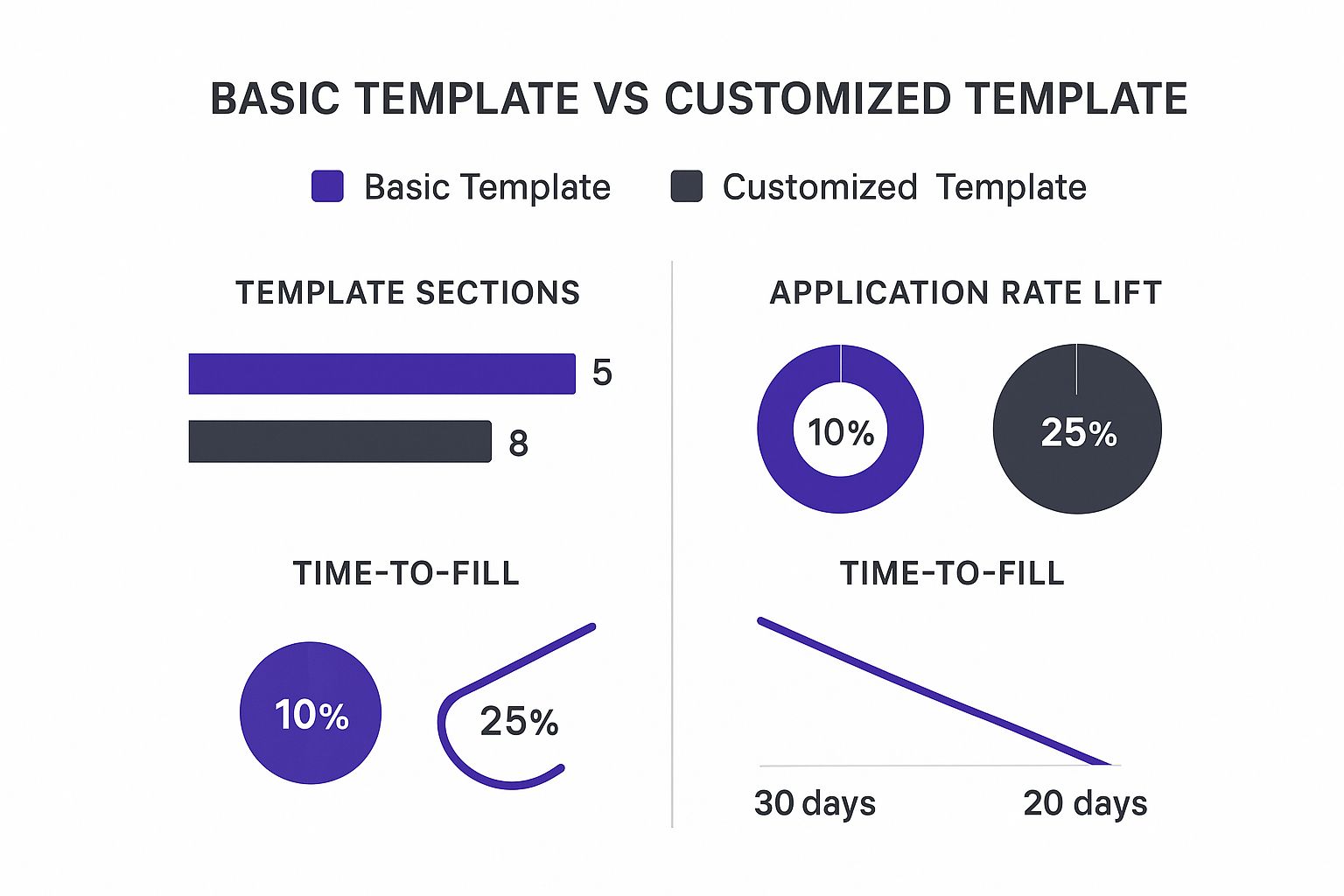
As the data shows, a well-structured, bespoke template doesn't just pull in more applicants; it can significantly speed up the entire hiring process from start to finish.
Choosing the Right Platforms for Maximum Reach
Where you post your job is just as important as what’s in it. Different job boards cater to different audiences and have their own unique strengths. For example, LinkedIn is a powerhouse for corporate and professional roles, whereas niche boards might be far more effective for highly specialised technical positions.
A solid strategy is to use an Applicant Tracking System (ATS) that can automatically distribute your post to multiple boards at once. This saves you a ton of time and maximises your visibility. You can see a great example of this in action with how the HATS Group advertises their driver roles across various platforms to reach a wide yet highly relevant audience.
Choosing the right mix of platforms is key to getting your job advert in front of the right people. Here's a quick look at how some of the top UK job boards stack up from an SEO perspective.
Comparing Job Board Platforms for SEO Impact
| Platform | Pros | Cons |
|---|---|---|
| Indeed | Huge search volume and strong domain authority. Jobs often rank well on Google. Simple, keyword-focused interface. | High competition can make it hard to stand out without paying for sponsorship. Less effective for very niche roles. |
| Excellent for professional roles and networking. Strong user profiles provide rich data. Good for organic reach within networks. | Can be more expensive than other platforms. The feed-based system means posts have a shorter lifespan. | |
| TotalJobs | Large UK-specific audience and strong brand recognition. Good integrations with ATS platforms. | Can feel quite generic. SEO benefits are primarily on-platform rather than on external search engines. |
| Reed.co.uk | Very well-known in the UK, attracting a broad range of candidates. Simple posting process. | The interface is a bit dated. Can attract a high volume of lower-quality applications if not targeted well. |
Ultimately, a multi-platform approach, driven by a central ATS, often yields the best results. It allows you to cast a wide net while still tailoring your approach to the specific platforms where your ideal candidates are most active.
An optimised and accessible job posting template isn't just about getting more views. It's about getting the right views from qualified, diverse candidates who feel respected and included from their very first interaction with your brand.
Avoiding Common Job Posting Mistakes
Even the most carefully crafted job posting template can fall flat if you stumble into a few common traps. I’ve seen it happen time and time again. These errors might seem small, but they can be the very things that deter brilliant candidates and leave you wading through a sea of mismatched applications.
The good news? A few small tweaks can make a world of difference to both the quality and quantity of applicants you attract.
One of the most frequent mistakes is using internal jargon. The acronyms and pet phrases that make perfect sense in your team meetings will almost certainly confuse anyone outside your company walls. Remember, you’re writing for an external audience, so keep your language clear, direct, and completely free from company-specific lingo.
Another major pitfall is creating a wish list of requirements that’s a mile long. It's tempting to throw in every possible skill you can think of, but this often discourages talented people from applying. This is especially true for women and candidates from underrepresented groups, who might not tick every single box but have all the potential to excel in the role.

Key Pitfalls to Sidestep
As you refine your template, keep these classic errors in mind and actively work to avoid them:
Vague Responsibilities: Don't just say "manage projects." That means nothing. Instead, describe the impact of that work. Something like, "Lead cross-functional teams to deliver software updates on schedule," gives a much clearer picture.
Forgetting a Diversity Statement: A clear commitment to diversity and inclusion isn't just a box-ticking exercise. It's a powerful signal that you foster a welcoming culture, which naturally attracts a much wider range of talent.
An Unclear Application Process: Don’t make people guess what to do next. Clearly state how to apply, what materials to include, and what the next steps in the process look like. Confusion is a major application killer.
The UK job market can be incredibly fierce, so a clear, targeted approach is non-negotiable. It’s been reported that during the pandemic, some low-skilled UK vacancies saw up to 506 applications each on average. That number alone shows just how critical a precise job posting is for standing out.
The goal isn't just to fill a position; it's to start a meaningful conversation with the right professionals. Every single element of your job posting, from the title to the final call to action, should be crafted to attract, not intimidate.
By sidestepping these common mistakes, your template becomes more than a simple form—it becomes a strategic recruitment tool. If you want to see how this looks in practice, check out some of the roles currently advertised by LQ Resorts for a bit of inspiration.
Got Questions? We’ve Got Answers
Even with a killer job posting template ready to go, questions always come up. The recruitment world doesn't stand still, and you have to adapt to stay ahead. Let's tackle some of the most common queries we hear from hiring managers day in and day out.
We'll cover how to tweak your template for the modern, flexible workforce and, crucially, how to make sure your language is both inclusive and fully compliant with UK employment law.
How Do I Adapt My Template for Remote or Hybrid Roles?
This is a big one. The key to adapting your template for remote or hybrid positions is clarity, right from the very start. Be explicit in the job title itself.
Using tags like (Remote), (Hybrid - London), or (Fully Remote - UK Only) does a lot of the heavy lifting for you. It immediately attracts the right people and filters out anyone whose expectations don't match the reality of the role.
Next, you'll want to give your "Benefits and Perks" section a remote-first makeover. Think about what truly makes your remote culture stand out.
Home Office Stipend: Do you offer an allowance to help new starters get their workspace set up? Mention it!
Flexible Working Hours: This is a massive draw for remote workers. Emphasise the trust and autonomy you give your team.
Virtual Socials: How do you build a sense of team when you're not all in the same room? Show candidates you've thought this through.
Little details like these prove you're not just offering remote work as an afterthought—it's a core part of how you operate.
How Can I Make Sure My Job Posting is Inclusive and Compliant?
Getting this right is non-negotiable. Creating an inclusive job post begins with a hard look at your language. It's so easy for unconscious bias to creep in.
Ditch gendered terms like "salesman" for neutral alternatives like "salesperson." Be wary of unnecessarily aggressive or masculine-coded words like "dominant" or "ninja." There are even tools out there that can scan your text for subtle biases you might have missed.
From a legal standpoint, UK employment law is crystal clear. Your job ads must not contain discriminatory language related to age, disability, gender reassignment, race, religion, sex, or sexual orientation.
A strong diversity and inclusion statement isn't just a box-ticking exercise. It's a powerful signal to every candidate that you're building a workplace where people from all backgrounds can belong and thrive. Make it authentic and give it pride of place in your template.
This means you can't specify an age range or imply a role needs certain physical abilities unless it's a genuine occupational requirement. The golden rule? Always focus on the skills and experience needed to do the job, not the characteristics of the person you think should be doing it. Keeping up with the latest Equality Act guidance is simply part of the job for any UK employer.
Ready to transform your hiring process? SeeMeHired is the all-in-one Applicant Tracking System designed to help you attract, manage, and hire top talent faster. Ditch the spreadsheets and streamline your recruitment from a single, intuitive platform. Discover how SeeMeHired can save you time and find your next great hire.