Candidate Experience
A Guide to Candidate Relationship Management

Let's be honest, traditional recruiting is a bit of a scramble. You post a job, cross your fingers, and hope the perfect person just happens to be looking at the exact right moment. It's reactive, it's stressful, and frankly, it’s not the smartest way to build a great team.
Listen to the podcast here:
This is where Candidate Relationship Management, or CRM for recruiting, flips the script. It’s a strategy focused on building and nurturing long-term connections with potential hires before you even have an open role. Think of it as moving from a frantic, last-minute sprint to a continuous, proactive process of building a community of talent who are already warmed up to your company.
What Is Candidate Relationship Management and Why It Matters Now

Imagine a farmer who only thinks about planting seeds after a famine has already started. The whole process would be rushed, chaotic, and the results would be a total gamble. That’s traditional recruiting in a nutshell.
In contrast, candidate relationship management is like a farmer who consistently tends their soil, plants seeds early, and nurtures their crops throughout the season. When the time comes to harvest, they have a healthy, thriving field ready to go.
This shift in mindset is about treating potential candidates like valued members of your professional community, not just names on an application list. It involves engaging with them over time, sharing useful content, and keeping them in the loop on your company's journey. By the time a suitable role opens up, you're not starting from scratch; you're reaching out to people who already know, like, and respect your brand.
The Modern Hiring Challenge
Today’s talent market is fiercer than ever. The best professionals are often passive candidates—they’re not actively scrolling through job boards, but they’re always open to the right opportunity. A "post and pray" approach is guaranteed to miss these people.
Recent shifts in the UK job market really drive this point home. Building stronger candidate relationships has become a top priority for 40% of talent acquisition leaders. Why? Because while the number of candidates has shot up by 39%, actual hiring rates have plummeted by 56%. This means recruiters are fighting tooth and nail over a smaller pool of open roles.
In this environment, just processing applications isn’t enough. You have to nurture prospects to stop top talent from slipping through your fingers. You can dig into more of these insights on the current recruitment market tensions on ukrecruiter.co.uk.
To put it simply, the old ways of recruiting are breaking down under modern market pressures. Here’s a quick look at why a CRM approach is no longer a "nice-to-have" but a must-have.
Why Candidate Relationship Management Is Critical in Today's Market
| Current Market Challenge | How CRM Provides a Solution |
|---|---|
| Increased Competition: More recruiters are competing for the same top-tier talent. | Builds Loyalty Early: By nurturing relationships, you become a preferred employer before candidates even start their job search. |
| Rise of Passive Candidates: The best people are often already employed and not actively looking. | Keeps You Top-of-Mind: Consistent, valuable engagement ensures your company is the first one they think of when they are ready for a move. |
| Poor Candidate Experience: Impersonal, transactional processes turn off top talent. | Creates a Positive Journey: A relationship-focused approach makes candidates feel valued, even if they aren't hired immediately. |
| High Time-to-Hire: Scrambling to find candidates from scratch for every role is slow and inefficient. | Creates a "Warm" Talent Pool: You have a pre-vetted, engaged pipeline of talent ready to go, dramatically speeding up hiring. |
This isn't just about being nicer to candidates; it's a strategic imperative for winning the war for talent in a saturated market.
From Transaction to Relationship
Ultimately, effective candidate relationship management changes the entire recruiting dynamic. It transforms the process from a one-off transaction (applying for a job) into an ongoing, mutually beneficial relationship. This strategy gives your organisation a serious advantage by:
- Building a Talent Pipeline: You cultivate a ready-to-go pool of pre-qualified talent, eliminating the mad dash when a critical role opens up.
- Enhancing Your Employer Brand: Consistent, positive interactions paint a picture of your company as an employer of choice, making you a magnet for top performers.
- Improving the Candidate Experience: Even candidates who aren't the right fit today can become powerful brand advocates if they’re treated with respect.
By focusing on relationships, you transform recruiting from a stressful, last-minute sprint into a continuous, strategic marathon. This long-term view not only helps you fill roles faster but also massively improves the quality of your hires and strengthens your company's reputation in the talent market.
The Strategic Benefits of Building a Talent Pipeline

Putting a candidate relationship management strategy in place isn't just about getting your contacts organised. It’s a complete shift in how you recruit, one that delivers powerful, tangible results for the business. By proactively building and nurturing a talent pipeline, you stop reacting to hiring emergencies and start taking strategic control.
This approach has a direct impact on your bottom line, bolsters your brand, and helps you secure better people, faster.
Think of it like this: would you rather have a bespoke suit made or grab one off the rack in a panic? The bespoke suit—your nurtured talent pipeline—is perfectly fitted to your needs, higher quality, and ready the moment you need it. The off-the-rack option—reactive hiring—is a rushed compromise that never quite fits and often ends up costing you more.
Your talent pipeline is your greatest weapon for cutting recruitment costs and timelines. Every single candidate you connect with is an investment, building a private pool of pre-qualified people who already know your company and what you stand for.
Slash Your Time to Hire
The most immediate win you'll see from a solid talent pipeline is a massive drop in your time-to-hire. When a job opens up, your first move isn’t posting an ad and hoping for the best; it’s searching your own warm talent pool. These are people you’ve already vetted and spoken with, meaning you can often jump straight past the initial sourcing and screening grind.
This proactive stance means filling crucial roles in days, not weeks or months. For industries like healthcare or hospitality, where a staff shortage can cripple service, that speed is a game-changer. You're not just filling roles faster; you’re protecting your business operations.
By cultivating relationships with past applicants and passive talent, you essentially create a bench of on-demand candidates. This transforms your recruitment function from a reactive cost centre into a strategic department that anticipates and fulfils talent needs before they become critical problems.
That kind of agility gives you a serious competitive edge. While your rivals are just starting their search, you could already be in the final interview with your perfect candidate.
Drive Down Recruitment Costs
It’s not just about speed. A talent pipeline built with smart candidate relationship management also brings down your cost-per-hire in a big way. Just think about the usual expenses you're trying to avoid:
- Advertising Fees: Paying for premium spots on multiple job boards really adds up.
- Agency Costs: Relying on external agencies often means paying out hefty commission fees.
- Screening Time: The hours your team sinks into sifting through hundreds of irrelevant applications is a huge hidden cost.
When you hire from your own pipeline, you shrink or even wipe out these expenses. Your main investment flips from paying for access to candidates to the far more affordable task of keeping relationships warm. This is a key part of any good talent management strategy, making sure you get the most out of your recruitment efforts. You can see how this all fits together in our guide to what is talent management.
Elevate Your Employer Brand and Candidate Experience
Every single message, email, and conversation a candidate has with your company shapes how they see your employer brand. A proper CRM strategy makes sure these touchpoints are always positive, professional, and personal. That incredible experience turns candidates into advocates—whether they get the job or not.
This is absolutely vital in a tough market. We know that 35% of recruiter time can be eaten up by scheduling, and candidates need more contact to stay engaged. CRM tools help you keep those connections strong. With 66% of applicants accepting offers because of a positive experience, and many rejecting them due to poor communication, it's clear what needs to be done.
Keeping your pipeline engaged with useful content and timely updates builds a reputation as an employer that people want to work for. As recent UK job market trends from KPMG show, the candidate experience is more important than ever. This positive branding leads directly to higher offer acceptance rates and attracts even more top-tier professionals into your talent community.
How to Measure Your CRM Success
Putting a new candidate relationship management strategy in place feels like a big step forward. But how do you actually prove it's working? To show its real value and fine-tune your approach, you need to look past gut feelings and focus on clear, measurable results. Tracking the right key performance indicators (KPIs) is the only way to see the true return on all that relationship-building effort.
This isn't about getting lost in complicated spreadsheets. It's about asking simple, powerful questions: Are we hiring better people, faster? Are our candidates happier with the experience? And are we saving money along the way? The answers are hiding in a few core metrics that will paint a very clear picture of your success.
Key Metrics for Your CRM Dashboard
To get started, just focus on a handful of high-impact KPIs. These are the numbers that directly connect your engagement activities to tangible business results, helping you show stakeholders exactly how a strong talent pipeline benefits the entire organisation.
Here are the essential metrics you should be tracking:
Talent Pool Growth Rate: This is a simple one – how quickly is your pipeline of potential candidates expanding? A healthy growth rate is a clear sign your sourcing and branding efforts are pulling new talent into your orbit.
Source of Hire: Where are your best hires really coming from? You’ll want to track the percentage of hires sourced directly from your talent pool versus those coming from job boards or agencies. When that percentage starts to climb, you’ve got a massive win on your hands. It proves your CRM is becoming your main hiring engine.
Offer Acceptance Rate (Nurtured vs. Cold): This is a fantastic comparison. Look at the acceptance rate of candidates you’ve nurtured in your talent pool and compare it to those who applied out of the blue. Nurtured candidates almost always have a higher acceptance rate because they’re already bought into your brand.
By keeping a close eye on these numbers, you can build a powerful business case for your entire candidate relationship management strategy.
Measuring Candidate Engagement and Experience
Beyond the hard hiring numbers, it's crucial to measure how candidates feel about your process. A positive experience is what keeps your talent pool warm and turns applicants into brand advocates, even if they don't get the job this time around.
A communicative, timely hiring experience is the single best way for a prospective employer to make a good impression. When candidates feel respected and informed, they are more likely to accept an offer and speak positively about your company.
To put a number on this, track these experience-focused KPIs:
Candidate Satisfaction Score (CSAT): After key moments in the process (like an interview or a final decision), send a quick survey asking candidates to rate their experience. A high score is a strong indicator that your communication and processes are hitting the mark.
Application Completion Rate: Are candidates dropping off halfway through your application? A low completion rate can signal a clunky, frustrating process. Fixing this is a quick win for enhancing the candidate journey right from the start.
Time-to-Respond: Measure how quickly your team gets back to initial applications and follows up on questions. Quick, consistent communication stops candidates from feeling like they’ve been left in the dark and dropping out of your pipeline.
Tracking these KPIs gives you the hard data you need to keep improving. For a deeper dive into the numbers that matter most, check out our complete guide to mastering recruitment metrics for hiring success. It will help you build a comprehensive framework for measuring every part of your talent acquisition function and proving its strategic value.
Best Practices for Engaging Your Talent Community
Knowing you need to engage your talent pool is one thing. Actually doing it effectively is a whole different ball game. Firing off a generic monthly newsletter just won’t cut it anymore.
A great candidate relationship strategy is all about turning that passive list of contacts into a vibrant, engaged community—one that sees your company as a top place to work. Every single interaction has to feel personal, relevant, and genuinely useful. The aim here is to build real connections at scale, keeping your brand front and centre so when the perfect role opens up, you’re the first employer they think of.
Let’s get into the practical steps you can take to make this a reality.
Personalise Communication at Scale
Let's be honest, nobody likes feeling like just another number on a mass mailing list. Generic, faceless emails are easy to ignore and can even chip away at your employer brand. The secret is to personalise your outreach without getting bogged down crafting hundreds of individual messages. This is where a good recruitment CRM really shines.
Start with the data you already have. Simple things like addressing candidates by their first name, referencing the kind of roles they’re interested in, or even mentioning a past conversation show you’re paying attention. For example, ditch the bland "We have new jobs" for something like, "Hi Sarah, we've just opened a new senior nursing role that looks like a great match for your A&E experience."
This targeted approach makes candidates feel seen and valued. It dramatically boosts the odds they’ll open, read, and act on what you send.
Effective personalisation is all about relevance. It’s sending the right message to the right person at the right time. This simple principle transforms your outreach from spam into a welcome update, building trust and keeping your best prospects warm.
Share High-Value Content
Your communication should offer more than just job alerts. Think of your talent pool not just as potential hires, but as professionals in your industry. When you share content that helps them grow their career, you position your company as a knowledgeable, supportive leader in your field.
So, what kind of content actually works? Here are a few ideas to get you started:
- Industry Insights: Share quick articles or short videos on emerging trends in your sector.
- Career Development Tips: Offer practical advice on interview skills, CV writing, or navigating a career path.
- Company Culture Sneak Peeks: Post behind-the-scenes photos, employee spotlights, or news about team achievements.
This kind of content keeps your brand visible in a positive, non-pushy way. It shows you care about professional growth, not just filling vacancies. This proactive engagement is a cornerstone of creating an outstanding candidate experience, turning every touchpoint into a positive one.
Segment Your Talent Pool for Targeted Outreach
One of the most common mistakes is treating your entire talent pool as one giant, uniform group. A software developer, a marketing manager, and a registered nurse all have very different interests and career goals. To be effective, you need to segment your audience into smaller, more specific groups.
This allows you to tailor your content and job alerts with laser-like precision. You can slice and dice your talent community based on several factors:
- Job Function: Grouping candidates by their role (e.g., IT, Finance, Clinical Staff).
- Skill Set: Tagging candidates with specific skills (e.g., Java, CQC compliance, digital marketing).
- Past Interactions: Separating "silver medallist" candidates from those who only applied once.
- Location: Targeting individuals based on their geographic area for specific site openings.
With proper segmentation, a hospital in Manchester can send targeted alerts for nursing roles directly to qualified nurses in the North West, instead of spamming their entire UK-wide database. This precision not only skyrockets engagement rates but also shows you respect your candidates' time.
Establish a Consistent Communication Cadence
Finally, consistency is absolutely crucial. If your communication is sporadic and unpredictable, it's impossible to build any real momentum. You need to find a predictable rhythm that keeps you on candidates' radar without overwhelming their inboxes.
There’s no magic number here; the "perfect" frequency depends on your industry and audience. A good starting point for most is a high-value monthly email, sprinkled with occasional targeted alerts for highly relevant roles. The key is to be consistent. This regularity builds anticipation and stops your talent community from going cold. Remember, candidate relationship management is all about playing the long game.
Choosing the Right Technology to Power Your Strategy
A brilliant candidate relationship management strategy is only as good as the tools you use to run it. While the principles of engagement are all about human connection, trying to manage a talent pool with spreadsheets and manual reminders is a recipe for disaster. This is where modern technology, specifically an Applicant Tracking System (ATS) with built-in CRM features, makes all the difference.
Think of these platforms as the central nervous system for your recruitment. They automate the repetitive tasks, organise huge amounts of candidate data, and give you the insights needed to make smarter decisions. Ultimately, this frees up your team to focus on what actually matters: building genuine connections with top talent.
The core idea is simple: let technology handle the logistics so you can handle the relationships.
Connecting Strategy to Essential Features
The right system should directly support your candidate engagement goals. It's not about having the most features; it's about having the right features that solve your biggest recruitment headaches. You need tools that help you personalise, segment, and communicate effectively.
A key challenge for UK employers is simply the volume of applications. With an average of 72 applications per role, manually managing every single interaction is impossible. Sophisticated CRM technology becomes essential to manage these touchpoints and stop great candidates from slipping through the cracks. While 81% of businesses plan to expand AI use, only 19% of UK recruiters feel confident with it, making a user-friendly CRM the perfect bridge to smarter automation. You can dig deeper into this trend in the latest UK CRM software market overview from Statista.
To help you connect the dots, we've mapped out the main goals of candidate relationship management and the corresponding ATS features that make them happen.
Mapping CRM Goals to Essential ATS Features
This table connects common recruitment challenges with the specific ATS features that solve them. It's a great way to identify the most critical technology requirements for your organisation.
| Your CRM Goal | Essential ATS Feature | How It Helps |
|---|---|---|
| Build a "Warm" Talent Pool | Talent Pooling & Tagging: Allows you to create searchable, segmented lists of past applicants and sourced candidates. | You can quickly find "silver medallists" or candidates with specific skills for new roles, bypassing the need for a new search. |
| Personalise Communication at Scale | Automated Email Workflows: Set up sequences that trigger based on candidate actions or statuses, with customisable templates. | Nurture hundreds of candidates with personalised, timely messages without manual effort, keeping your brand top-of-mind. |
| Measure and Improve Success | Analytics & Reporting Dashboards: Provide real-time data on KPIs like source-of-hire, time-to-fill, and offer acceptance rates. | You gain clear visibility into what's working, allowing you to prove ROI and make data-driven improvements to your strategy. |
As you can see, a powerful ATS turns abstract goals into concrete actions, making your entire recruitment process more efficient and effective.
The image below perfectly illustrates how the core pillars of talent engagement—personalisation, segmentation, and knowledge sharing—all stem from building a strong central community.
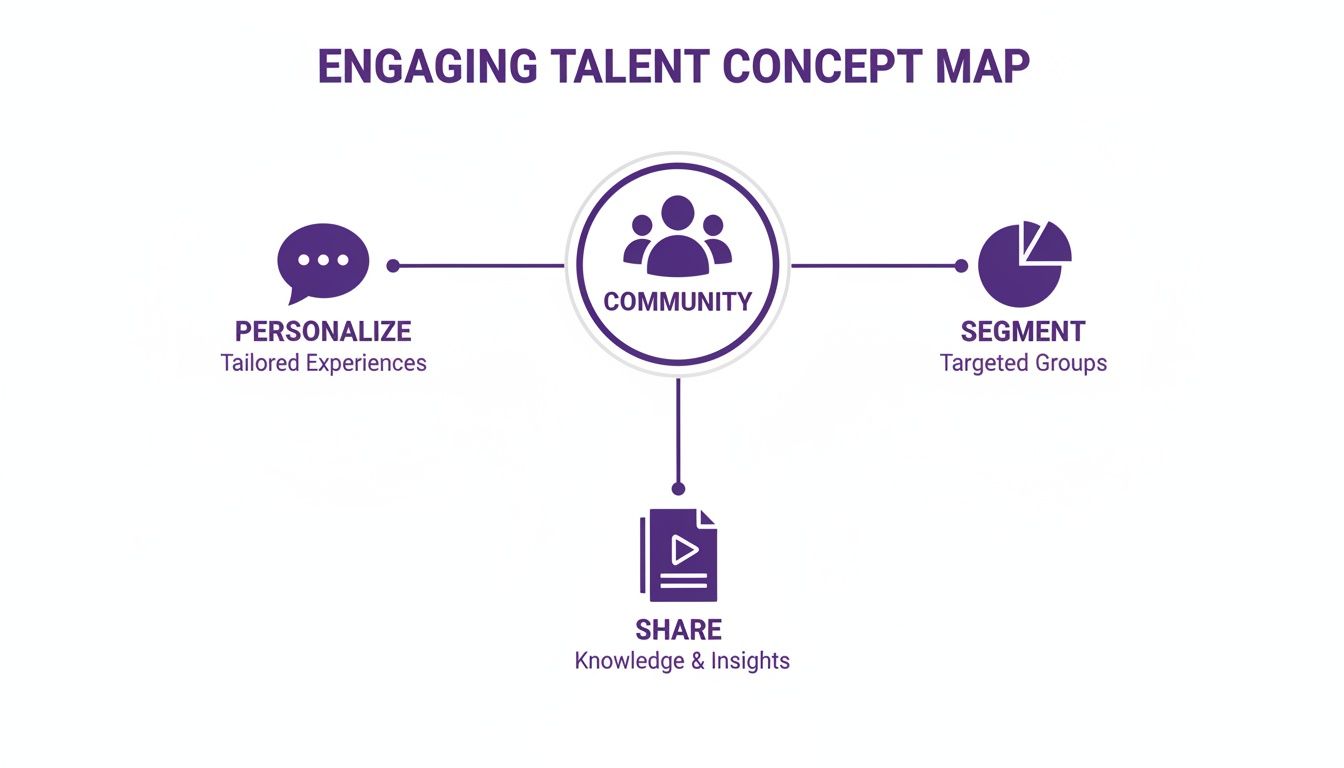
This shows that a successful strategy isn't about isolated actions but a unified approach to community building, all powered by the right technology.
When you're evaluating your options, focus on platforms designed to bring these elements together seamlessly. To help you navigate the market, we've put together a guide to the best applicant tracking systems in 2024, breaking down their strengths and ideal use cases. It's a great starting point for finding a tool that fits your unique needs.
Putting Candidate Relationship Management into Practice
Theory is all well and good, but the real magic happens when you see candidate relationship management in action. It’s where the true value really clicks. So, let's look at how different organisations are taking these principles and shaping them to solve their own unique hiring puzzles.
These aren't just hypotheticals. These are real-world examples of how a smart CRM strategy can turn a dusty, passive database into a dynamic, strategic asset. From the highly regulated world of healthcare to the breakneck pace of a startup, the core goal is always the same: build relationships today so you can hire better tomorrow.
Scenario One: A Busy NHS Trust
A large NHS trust is in a constant battle to fill specialised nursing roles, especially in critical care and theatre departments. Just posting job ads is a slow, expensive grind, and it rarely catches the eye of experienced nurses who aren't actively looking for a new job.
To get ahead, they decided to implement a proactive CRM strategy.
- Talent Pooling: First, they created a specific talent pool in their ATS for all their "silver medallist" nursing candidates. These were the brilliant, qualified applicants who were strong contenders for previous roles but just missed out.
- Targeted Engagement: Every quarter, this group gets a targeted email. It's not a generic job alert; it might link to a blog post about professional development at the trust or highlight a recent team achievement. It keeps them warm and engaged.
- Proactive Outreach: Now, when a new Senior Theatre Nurse role opens up, the recruitment team doesn’t start with a job ad. Their very first move is to search this talent pool. They quickly identify three highly qualified, pre-vetted nurses and reach out to them personally before the job ever goes public.
This simple shift has slashed their time-to-hire for critical positions. It's also done wonders for their employer brand within the local nursing community, painting them as an organisation that genuinely values talent for the long haul.
By nurturing a pipeline of qualified, passive candidates, the trust has transformed its recruitment from a reactive scramble into a predictable, strategic function. This ensures clinical wards stay safely staffed and cuts down their reliance on expensive agency nurses.
Scenario Two: A Fast-Growing Tech Startup
Picture a rapidly scaling software company in Manchester. They frequently need to hire developers with very specific coding skills. The problem? They were losing fantastic candidates in one hiring cycle who would have been a perfect fit for another role just a few months down the line. They needed a way to keep these high-potential people plugged in and ready for the next opportunity.
Now, they use their CRM to re-engage past applicants intelligently. When a new backend developer role opens, they filter their talent pool for candidates who previously applied for similar roles and have the right skills. An automated workflow then pings them a personalised email, inviting them to check out the new opening.
This simple act of re-engagement saves the startup a massive amount of time and sourcing costs. In fact, they now fill 40% of their technical roles by tapping into this warm talent pool. It’s a powerful testament to treating every single applicant as a potential future hire.
Both of these examples show how the right approach, often powered by modern recruitment technology tools, can give you a serious competitive advantage in the war for talent.
Frequently Asked Questions
Even with a solid plan, a few questions always pop up when you start putting a new strategy into practice. Let's tackle some of the most common ones we hear from recruiters.
Getting these details ironed out will help you sidestep any hurdles and move forward with confidence. Think of this as the final piece of the puzzle.
What’s the Difference Between an ATS and a Recruitment CRM?
It’s easy to get these two mixed up, but they have very different jobs. An Applicant Tracking System (ATS) is transactional; it’s all about managing active applicants for specific, open roles. It’s focused on the ‘right now’—filling today’s vacancies.
A recruitment CRM, on the other hand, is all about relationships. Its main purpose is to build and nurture long-term connections with a whole community of talent, including passive candidates who might be a perfect fit for a role that doesn't even exist yet. The best modern platforms blend both, giving you a powerful system to manage today’s hiring while building a pipeline for tomorrow.
An ATS manages the application; a CRM manages the relationship. When they work together seamlessly, you turn every past applicant into a valuable resource for future hiring.
How Can a Small Business Implement a CRM Strategy?
You don’t need a massive team or an eye-watering budget to start building a talent pipeline. For small businesses, the key is to start simple and stay consistent.
- Create a "Silver Medallist" Pool: Your first move? Tag all those brilliant candidates who just missed out on past roles. They already know you, you’ve already vetted them, and they represent a huge head start for your next search.
- Establish a Simple Cadence: Forget complex marketing campaigns. A simple, valuable quarterly email is all it takes to stay on their radar. Share a quick company update, a link to an interesting industry article, or a piece of career advice.
- Focus on Quality, Not Quantity: The aim is to maintain a connection, not to spam their inbox. This light-touch, consistent approach turns your past recruitment efforts into an asset you can draw on again and again.
This straightforward method allows even a one-person HR team to build a powerful talent community over time, without a huge investment of resources.
How Much Time Should Recruiters Dedicate to CRM?
Finding the right balance is crucial. As a starting point, we recommend recruiters dedicate around 15-20% of their time to proactive CRM activities. This includes sourcing new talent for your pipeline, segmenting your contacts, and planning those simple engagement campaigns.
While that might sound like a lot upfront, it pays for itself down the line. This initial effort massively cuts down the time you'll spend on cold sourcing and screening when a new position opens up. Using an ATS with built-in automation can also lighten the load, freeing up recruiters to focus on building genuine relationships instead of getting bogged down in admin.
Ready to shift your hiring from reactive to proactive? SeeMeHired is an all-in-one ATS with powerful candidate relationship management features built right in. Start building your talent pipeline today and hire better, faster. Learn more at https://seemehired.com.