Hiring Statistics
Diversity In Recruitment Practical Strategies For Inclusive Hiring

Diversity in recruitment is more than ticking boxes—it’s about inviting people from different walks of life into your team, ensuring a blend of experiences and viewpoints. A truly diverse hiring process balances fairness with opportunity, sparking creativity and driving stronger decision making.
Listen to the podcast here:
Understanding Diversity In Recruitment
Picture your team as a jigsaw puzzle: each person is a piece with its own shape and colour. Yet, unconscious bias can act like tinted glasses, hiding perfectly fitting candidates from view.
When those glasses stay on, talent slips through the cracks. Take a mid-size charity that shortlisted three candidates from diverse backgrounds but ended up considering only one—because of an old habit of relying on referrals.
They quickly realised pieces were missing from their bigger picture. Before the next hiring round, they committed to spotting bias and casting a wider net.
- Demographic Diversity covers age, gender, ethnicity and socio-economic background
- Cognitive Diversity brings together different problem-solving styles and life experiences
- Inclusive Outreach means sharing opportunities across multiple channels to reach every community
Defining Core Diversity Types
Understanding these categories helps highlight where your process might be excluding talent. Each definition guides you to a more inclusive approach.

Organisations that embrace demographic diversity tap into fresh perspectives and curb groupthink. Cognitive diversity equips teams to tackle challenges from multiple angles. Meanwhile, inclusive outreach is the bridge between untapped talent and your vacancies.
- Builds innovation through varied viewpoints
- Enhances employer brand by demonstrating commitment to fairness
- Improves decision making with a broader knowledge pool
Why Gaps In Hiring Persist
Even with the best intentions, bias and ingrained routines can steer decisions off course. Leaders often favour familiar profiles over equally qualified candidates without realising it.
Between July 2024 and June 2025, the UK Civil Service’s recruitment data reveal ethnic minority candidates were appointed at rates below their share of applications and the working-age workforce. These gaps show that, despite wider outreach, hiring funnels still skew outcomes.
Discover more insights in the UK Civil Service’s recruitment diversity statistics.
“Unchecked bias is like wearing tinted glasses that make only familiar faces clear.”
Roadmap For This Guide
Here’s what lies ahead:
- Define the business case and legal context
- Set measurable KPIs and baselines
- Implement evidence-based diversity strategies
- Leverage ATS tools for inclusive hiring
- Explore industry examples and next steps
You might be interested in our full research on tailoring inclusive hiring: Check out our guide on diversity in recruitment at SeeMeHired.
Armed with these core ideas, you’ll have a solid base for launching inclusive hiring campaigns. Next, we’ll dive into the business case and legal requirements that make diverse recruitment a must.
Bridging Theory And Practice
Throughout this guide, analogies will simplify complex concepts. Thinking of recruitment as a puzzle and bias as tinted lenses helps you spot and remove hidden barriers.
- Recruitment is a coordinated puzzle needing every piece
- Tinted glasses of bias distort your view of candidate quality
- Clear definitions point you toward targeted actions
Real World Reflection
A community clinic introduced outreach days to connect with under-represented local groups. In just two hiring cycles, applications from those towns jumped by 42%, greatly enriching their candidate pool.
This story shows demographic diversity and inclusive outreach working hand-in-hand. Later, we’ll explore how ATS features can automate these steps.
“A team’s strength lies in assembling the right mix of perspectives.”
With these foundational ideas in place, you’re ready to explore the strategic business case, set clear metrics and implement evidence-based tactics. Each upcoming section builds on this base, guiding you step by step.
Key Foundations Recap
This section lays down the groundwork with vivid metaphors and precise definitions, helping you see the full puzzle and remove the tinted lenses of bias.
- Puzzle Analogy clarifies diverse roles
- Bias Lens highlights areas to clear
- Guide Roadmap shows your journey ahead
Ready to transform your hiring approach? Let’s begin the journey now.
Business Case And Legal Requirements
Think of diversity in recruitment as the secret ingredient in your favourite recipe. It’s not just about fairness—it brings fresh ideas to the table, sharper customer insights and, yes, healthier profits.
A team with different backgrounds acts like a well-balanced diet, blending unique strengths and cutting out the monotony of groupthink.
- Enhanced innovation born from varied viewpoints
- Stronger financial performance: diverse companies are 36% more likely to outperform peers
- A compelling employer brand that draws top talent and new customer segments
Legal Frameworks And Standards
UK law demands fair play at every hiring stage. The Equality Act 2010 outlaws discrimination, while the UK Corporate Governance Code tasks boards with championing diversity and inclusion.
“Embedding equity in recruitment is both a legal duty and a strategic asset,” notes a leading HR compliance expert.
To stay on the right side of the law, organisations should:
- Remove biased language and barriers in job descriptions
- Conduct and publish equal pay and pay gap audits
- Document hiring decisions to remain audit-ready
Letting compliance slip can be costly—fines, legal fees and reputational damage can run as high as £10,000 per offence.
Financial Impact Of Bias
Bias in hiring doesn’t just hurt morale—it hits the bottom line.
- Recruitment delays can stretch time-to-hire by 20%, hiking agency fees
- Misaligned hires boost first-year attrition by 30%
- Public discrimination claims often rack up legal bills north of £100,000
| Scenario | Cost Type | Impact |
|---|---|---|
| Unfair dismissal claim | Legal fines | Up to £20,000 |
| Negative media coverage | Reputation loss | Trust falls by 15% |
| Extended vacancy | Productivity loss | £5,000 per month |
This financial snapshot makes it clear: robust diversity policies aren’t optional—they’re vital risk mitigators.
A recent UCL study highlights this further. The offer-rate gap between Black and White graduates narrowed from 38 percentage points in 2022 to 31 percentage points in 2024, even as overall disparities grew year-on-year. Learn more about these findings
Embedding solid diversity measures shields your brand and slashes legal exposure. Check out our guide on UK employment law compliance for essential strategies in our article UK Employment Law Compliance Essential Strategies
Embedding Policies In Practice
Policies live or die in execution. Start by crafting an inclusion charter that spells out goals, roles and accountability in plain English.
Next, arm every hiring manager with bias-busting training. When everyone speaks the same language, consistency follows.
- Draft an inclusive recruitment policy with clear targets
- Train hiring managers and interviewers on unconscious bias
- Run quarterly audits of recruitment metrics and share results
“Policies that live in practice are the measure of inclusive commitment.”
Securing Executive Buy-In
Securing the C-suite’s buy-in means speaking their language—growth, savings and risk avoidance.
Use case studies and hard numbers to show how diverse teams drive board performance and stakeholder trust.
- Present diversity ROI at executive and board meetings
- Assign clear accountability with measurable KPIs and deadlines
- Schedule regular policy reviews to stay ahead of legislative shifts
With a sharp business case and clear legal roadmap, HR leaders can weave inclusive hiring into the very fabric of their organisation.
Establishing Measurable KPIs And Baseline Metrics
If you wouldn’t track your workouts, you wouldn’t know if your fitness routine is working. The same goes for inclusive hiring. Without clear metrics and a starting point, you can’t see whether your efforts are moving the needle.
Selecting Baseline Metrics
Begin by choosing a handful of core measures that shine a light on every stage of your recruitment funnel:
- Applicant Diversity Ratio: The proportion of candidates from under-represented groups at the application phase.
- Interview Conversion Rate: The share of those diverse applicants who actually make it to the interview stage.
- Offer Acceptance Rate: How offer uptake varies by demographic.
- Onboarding Completion Rate: The percentage of new hires from these groups who finish their initial training.
These numbers act like your recruitment “before” photo. If you discover that just 15% of under-represented applicants proceed to interviews, you know where to focus your energy.
Setting Target Milestones
Think of your diversity goals as building strength: it’s better to lift an extra kilo each week than attempt a massive, unsustainable jump.
Set realistic, time-bound targets—for instance, grow your applicant diversity ratio by 10% over the next quarter. Small, consistent lifts add up to real progress.
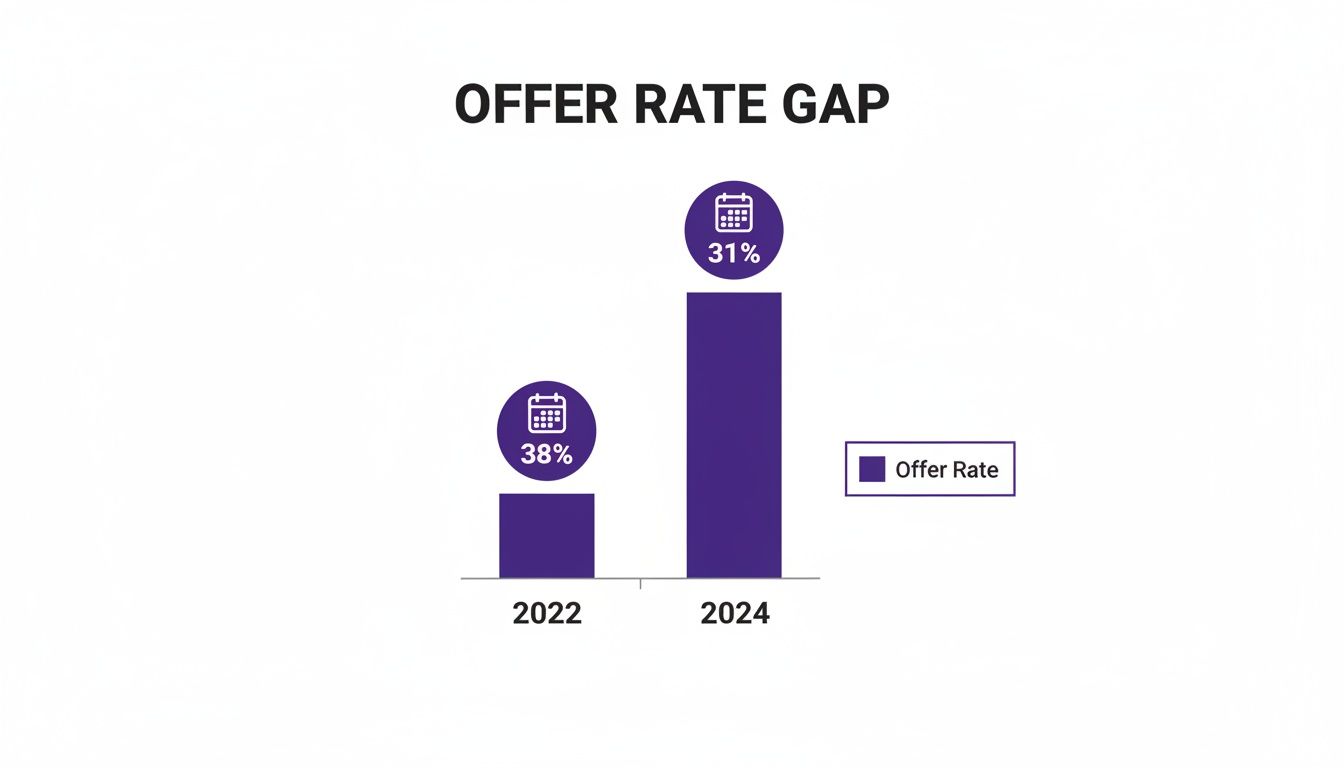
That drop in the offer rate gap—from 38% in 2022 to 31% in 2024—shows you’re on the right path, but still have room to tighten your approach.
Sample Diversity KPIs And Industry Benchmarks
Below is a quick comparison of common diversity KPIs against UK sector averages. Use these figures to calibrate your own targets:
Sample Diversity KPIs And Industry Benchmarks
| KPI | Definition | UK Public Sector Benchmark | UK Private Sector Benchmark |
|---|---|---|---|
| Applicant Diversity Ratio | Share of candidates from under-represented groups | 32% | 28% |
| Interview Conversion Rate | Percentage of diverse applicants proceeding to interview | 20% | 18% |
| Offer Acceptance Rate Gap | Difference in offer acceptance between demographic cohorts | ≤5% | ≤5% |
| Onboarding Completion Rate | Proportion of hires completing initial training cycle | 95% | 90% |
Comparing your performance to these benchmarks keeps your goals grounded in reality. If you’re below the 20% conversion rate, for example, dig into your interview process to see where candidates drop off.
Reporting Progress And Next Steps
Regular, transparent reporting keeps everyone on the same page. Share concise dashboards each quarter, highlighting:
- Key Wins: Celebrate where you’ve closed gaps.
- Areas For Improvement: Pinpoint stages where metrics slip.
- Action Plans: Tie next steps to specific KPIs.
“Tracking diversity metrics with transparency builds trust and accountability.”
For a deeper dive into best practices for recruitment reporting, check out our guide on Master Recruitment Metrics for Hiring Success.
Next Steps Checklist
- Agree on definitions and collect first-round baseline data.
- Assign owners to each KPI, set deadlines for quarterly targets.
- Embed your chosen metrics into monthly hiring reviews.
- Distribute progress summaries to executives and diversity champions.
- Schedule feedback loops with hiring managers to adapt as you learn.
By treating these measures as part of your everyday conversations—whether in stand-ups or strategy sessions—you’ll nurture accountability and drive genuine, lasting change.
Implementing Evidence-Based Strategies to Enhance Diversity

When you think about modern hiring, it’s clear that diversity in talent sources is vital. Picture your recruitment pipeline as a balanced menu: the more variety you add, the healthier your team grows.
Evidence-based diversity tactics work the same way—each technique brings fresh nutrients to your hiring mix. Next, we’ll walk through practical steps to broaden sourcing, curb bias, standardise assessments and onboard inclusive teams.
Expanding Your Sourcing Pipeline
Relying on a single channel shrinks your talent pool. By combining different pathways, you uncover hidden gems from a range of communities.
Use community partnerships, niche job boards and social groups—much like mixing grains, fruits and greens for a balanced meal.
- Partner with local charities to tap into under-represented talent pools
- Post on specialised platforms for diverse candidates, such as disability or ethnic-minority job sites
- Attend virtual and in-person networking events, from university fairs to diversity conferences
“Casting a wide net ensures no candidate group gets overlooked,” says a recruitment lead.
Review each channel’s performance quarterly. Track which sources deliver the most varied applicants, then fine-tune your mix—just like tweaking a recipe for better flavour.
Crafting Bias Free Job Descriptions
The words you choose shape perceptions. Job adverts laden with subtle bias can turn away excellent candidates before they even apply.
Aim for neutral language and crystal-clear criteria. Think of it as describing ingredients without favouring one spice over another.
- List only essential skills and experience to avoid deterring capable applicants
- Use tools that flag gendered or exclusionary terms automatically
- Invite inclusive phrasing, such as “we welcome applicants from all backgrounds”
Mini checklist:
- Remove jargon or acronyms
- Focus on role outcomes rather than personality traits
- Highlight flexible working and accommodation options
This simple process broadens appeal and boosts applications across diverse groups.
Standardising Interviews And Panels
Unstructured interviews can let unconscious bias run wild. A consistent question set and clear scoring guide level the playing field.
It’s like following a trusted recipe to achieve consistent results. Adding a diverse panel mixes in fresh perspectives.
- Design a core question bank aligned to key job competencies
- Rate each answer on a 1 to 5 scale for objective comparison
- Include at least two interviewers from different backgrounds
| Step | Action | Benefit |
|---|---|---|
| Create Question Bank | Link questions to critical job tasks | Consistent evaluation across candidates |
| Assign Scoring Criteria | Rate skills and behaviours objectively | Clear side-by-side comparisons |
| Diversify Interviewers | Involve varied panel members | Multiple viewpoints in scoring |
This structured approach trims bias and guarantees every candidate is judged by the same standards.
Strengthening Onboarding And Retention
Hiring diverse talent is just step one—they need to feel at home straightaway. Onboarding sets the tone, much like that first meal in a new setting.
Leverage tailored checklists and mentorship to support new starters from day one. This builds confidence and a sense of belonging.
- Provide buddy programmes pairing new hires with experienced colleagues
- Offer cultural awareness sessions to foster inclusive teamwork
- Monitor progress through 30-, 60- and 90-day check-ins
“A strong welcome plan cements early confidence and drives retention,” states an HR manager.
Embedding inclusive practices from the outset builds trust and sustains diversity gains.
For more detailed tips on these methods, check out our guide on 8 best practices for diversity recruiting.
Integrating ATS Features
SeeMeHired’s ATS can automate every one of these tactics, leaving you more time for strategic work.
With multi-channel posting, a single click pushes your role to leading job boards. Smart matching filters candidates against your criteria to curb bias.
- Multi-channel job posting broadens your pipeline
- Resume anonymisation hides identifiers to reduce unconscious bias
- Structured interview templates and scorecards enforce consistency
- Centralised communications ensure timely, transparent feedback
- Analytics dashboards track diversity KPIs in real time
- Compliance tools store audit-ready records of all decisions
These features slash admin tasks and elevate your hiring strategy. Armed with these evidence-based methods and an ATS tuned to support them, you’re ready to transform your recruitment approach.
Implement these strategies today, measure your progress and refine as you go. A richer, more diverse workforce drives fresh ideas, a stronger culture and long-term growth. Start enriching your recruitment diet with confidence now.
Leveraging ATS Features For Inclusive Hiring
Applicant tracking systems today do more than just collect resumes. They weave fairness into every step of recruitment, from how you post jobs to how you report on hires. By leaning on built-in tools, your team can reduce bias, reach a wider talent pool and keep everything audit-ready.
ATS Feature Mapping
In SeeMeHired ATS, you can tag each feature to a specific diversity tactic:
- Multi-Channel Job Posting pushes your roles to niche boards and community hubs. That widens the talent pool, especially among under-represented groups.
- Resume Anonymisation strips out names, graduation years and school details. Reviewers focus solely on skills and experience.
- Structured Interview Templates lock in the same question set and scoring scale for every candidate. It stops unconscious bias from creeping in.
- Compliance Reporting logs every decision and demographic snapshot in one place. You stay transparent and reduce legal risk.
You can see this alignment in action in the screenshot below.
That dashboard view highlights how posting performance and anonymisation rates update in real time—so you know exactly where to tweak your approach.
ATS Features Supporting Diversity Strategies
Below is a quick snapshot of how key ATS features align with your diversity goals and the benefits they bring.
| ATS Feature | Supported Strategy | Key Benefit |
|---|---|---|
| Multi-Channel Job Posting | Inclusive Outreach | Broadens talent pipeline |
| Resume Anonymisation | Bias Reduction | Focus on candidate qualifications |
| Structured Interview Templates | Standardised Assessments | Consistent candidate evaluation |
| Compliance and Audit Reporting | Transparent Decision-Making | Audit-ready diversity records |
By embedding these tools into everyday workflows, you remove manual guesswork and make best practices the default.
Setting Up Your ATS Dashboard
Follow these steps to get your dashboard aligned with diversity targets:
- Define diversity goals in settings—set target ratios by demographic group.
- Turn on blind review for resumes and test it with past applicant data.
- Pick a structured interview template and attach scoring metrics to each competency.
- Connect your account to all major job boards for multi-channel posting.
- Activate compliance reports and schedule monthly exports of diversity metrics.
“An ATS that enforces your policies prevents drift and builds accountability.”
Practical Tips
- Train your hiring teams on new dashboard features—and run a practice round.
- Share progress charts in weekly stand-ups to keep everyone on the same page.
- Set alerts if any demographic metric dips below your threshold.
Need more ideas? Check out our deep dive on 8 key benefits of an ATS for smarter hiring in 2025.
Real-World Applications
These features aren’t just theory—they deliver measurable results:
- In healthcare, compliance tools eased CQC checks and stored diversity data securely.
- A hospitality group used multi-channel posting to boost nurse applications by 30% in two months.
- SMEs deployed smart candidate matching and saw diverse hires rise by 18% in a quarter.
When you bake these functions into your routine, inclusion becomes part of your culture rather than an afterthought.
Next Steps
To keep momentum, build a monthly review cycle with diversity champions and hiring managers:
- Adjust your job board mix based on source performance.
- Tweak anonymisation settings to balance context and fairness.
- Refresh interview templates as competencies evolve.
By mapping each ATS feature to clear diversity tactics, you turn technology into your ally for fairer, more consistent hiring. Start your inclusive hiring journey today.
Industry Examples And Next Steps Checklist
Take the regional healthcare trust that struggled with low representation of nurses from minority backgrounds. They teamed up with local community centres and tapped into SeeMeHired’s multi-channel posting to cast a wider net. In just two recruitment cycles, minority nurse applications climbed by 38%, and interview-to-offer conversions jumped 22%.
Meanwhile, a hotel chain wrestled with a lack of diversity at the front desk. By rolling out structured interviews and blind resume screening in SeeMeHired, they sidestepped unconscious bias. Within one quarter, female hires went up by 30%, and ethnic minority hires rose 25%.
Similarly, an SME tech startup faced gaps in both skills and ways of thinking. They rewrote job adverts to be bias-free and reached out to niche coding communities via SeeMeHired’s smart matching. Six months on, diverse hires were up 18%, while first-year turnover dropped by 12%.
These cases prove that targeted strategies, backed by the right ATS tools, can shift the dial on diversity.
Implementation Checklist
Follow these steps to weave diversity into every stage of your hiring process:
- Expand sourcing channels by posting roles on both broad and specialist boards to reach under-represented groups.
- Use blind screening to anonymise resumes, keeping focus firmly on skills and experience.
- Standardise interviews with a shared question bank and diverse panels for fair, consistent assessments.
- Track diversity KPIs—applicant ratios, interview conversion rates and offer acceptance by demographic.
- Deliver inclusive onboarding with mentorship programmes, cultural-awareness training and regular check-ins.
Each action aligns with SeeMeHired’s ATS features for full transparency and consistency.
Recommended Next Steps
To keep momentum going, build regular reviews into your calendar:
- Schedule quarterly diversity audits to monitor KPIs and tweak your approach.
- Set up ongoing feedback loops with hiring managers and candidates to surface gaps and ideas.
- Hold executive reviews every six months to tie inclusion targets back to business goals.
- Refine your sourcing mix monthly, guided by ATS analytics dashboards.
- Update job descriptions and templates annually to match evolving inclusion standards.
“Consistent review cycles keep diversity goals on track and visible to leadership.”
Sustaining Momentum
True progress comes when inclusive hiring becomes second nature:
- Use SeeMeHired analytics to flag any dips in demographic metrics straight away.
- Rotate interview panel members regularly to bring fresh viewpoints to every hire.
- Host bias-awareness refreshers twice a year for all recruiters.
- Share success stories internally to celebrate wins and keep morale high.
- Review your progress via SeeMeHired dashboards and mark each milestone.
- Engage leadership with clear quarterly reports, then adjust tactics based on real-time feedback.
“A culture of continuous review turns hiring diversity from ambition into standard practice.”
Begin now to build a fairer, stronger workforce that truly mirrors the communities you serve.
FAQs on Diversity in Recruitment
What are the first steps to improve diversity in recruitment?
Take a good look at your current hiring pipeline and spot where it’s falling short. Then, bring key voices to the table—hiring managers, team leads, even employees—and agree on specific diversity targets. For example, aim for 30% candidates from under-represented backgrounds or set conversion-rate goals for interviews.
How can we measure KPIs without breaching data privacy?
Simple: anonymise demographic info and focus on the big picture. Store personal data in a separate, secure system that meets GDPR standards. By tracking trends rather than individual profiles, you stay compliant and still learn what matters.
Quick Sourcing Tips
- Tap into local community boards at little to no cost.
- Forge partnerships with professional bodies that support under-represented groups.
- Encourage employees to refer candidates and reward diversity-driven referrals.
What cost-effective sourcing channels suit small teams?
Small teams shine when they build direct partnerships. Community groups and niche job boards often offer free or discounted rates. Don’t forget social media hubs for specific demographics—they can deliver quality applicants. Keep an eye on each channel’s performance in your ATS.
“Consistent, cost-effective outreach fuels a richer candidate pool.”
Configuring Your ATS
How do we configure ATS tools to minimise unconscious bias?
Start by turning on resume anonymisation so names and alma maters stay hidden. Next, use structured interview templates and a standard scoring system right inside your ATS. Finally, schedule diverse panels through the platform to ensure every candidate meets a varied set of interviewers.
| Feature | Benefit |
|---|---|
| Resume Anonymisation | Cuts name-based bias |
| Structured Interview Guides | Ensures fair, repeatable reviews |
| Automated Analytics | Spots diversity gaps at a glance |
Can small organisations track diversity progress on a budget?
Absolutely. Most ATS dashboards come with built-in charts and alerts at no extra fee. Set up automated reports to flag any dip in your demographic targets. This way, you’ll catch issues early and keep your hiring on course.
These FAQs slot into the guide’s wider recommendations, giving you actionable steps and real-world examples. Combine them with your roadmap, and you’ll see immediate gains.
Ready to transform your recruitment process? Boost your inclusive hiring with SeeMeHired